Abakada Chart: Complete Guide to the Filipino Alphabet and Abakada.ph 2026
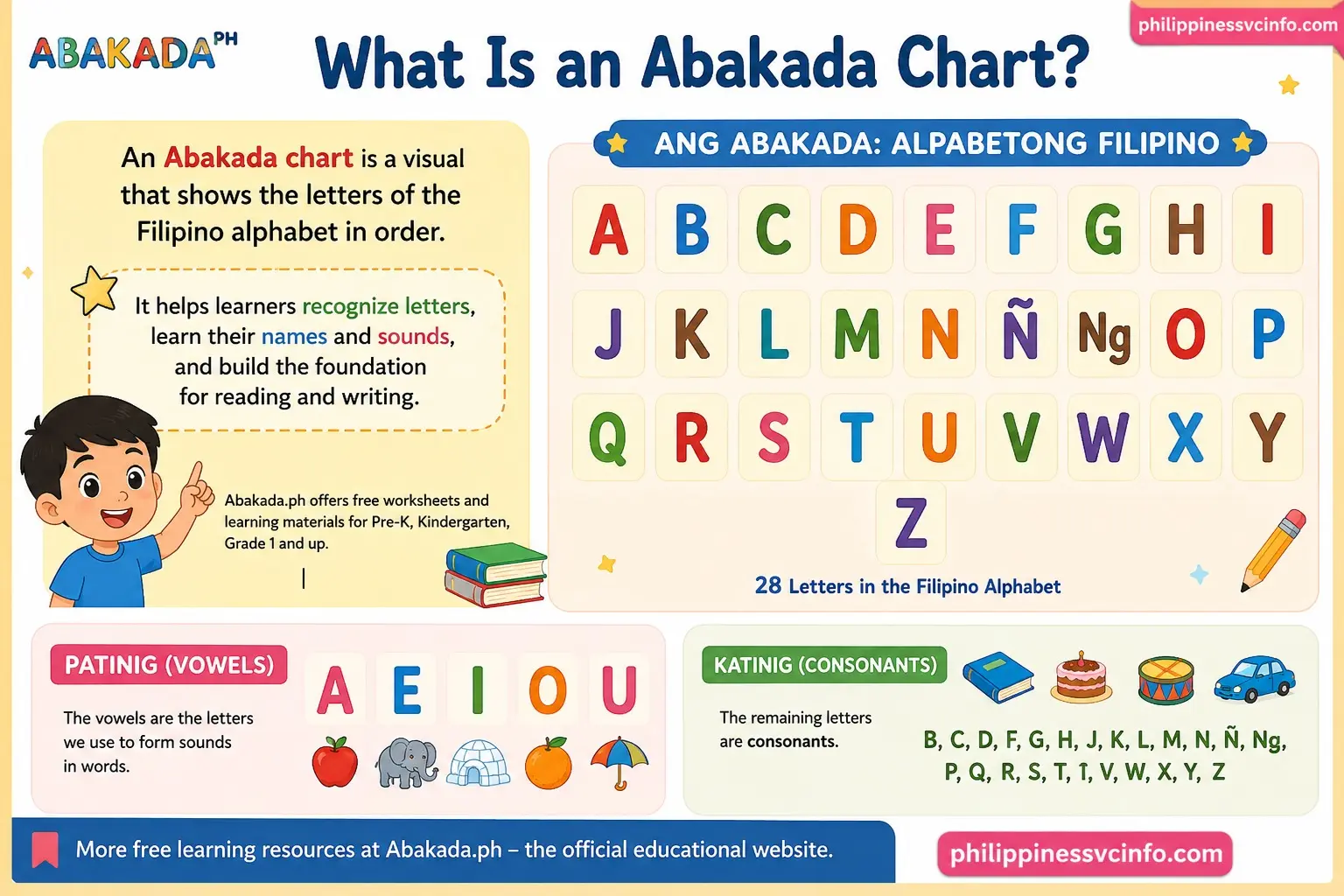
Learning the Filipino alphabet becomes easier with a clear and simple Abakada chart that helps students, parents, teachers, homeschoolers, and beginners recognise letters, practise writing, and develop early reading skills. One useful resource is Abakada.ph, an educational website offering free printable worksheets and digital learning materials for Filipino children from preschool through Grade 3, covering Filipino, English, reading, mathematics, science, and other early-learning subjects. The official website also features “Ang Abakada: Alpabetong Filipino,” a lesson for Pre-K, Kindergarten, and Grade 1 that introduces the Filipino alphabet along with patinig (vowels) and katinig (consonants).
What Is an Abakada Chart?
An Abakada chart is a visual learning resource that presents Filipino letters in an organised format. It can be used to help beginners identify letters, remember their order, practise handwriting, and gradually connect letters with sounds and words.
For young learners, a chart is particularly useful because it gives them something simple to look at while they practise. Instead of trying to memorise letters randomly, students can work through the alphabet from beginning to end and review the letters they find difficult.
The Abakada.ph alphabet lesson provides a direct online reference for this purpose. According to the official lesson, the Filipino alphabet presented there contains 28 letters.
The site also provides a worksheet that learners can use for writing practice after watching the lesson video.
Why Use an Abakada Chart?
An alphabet chart can help learners:
- Recognise Filipino letters
- Learn the order of the alphabet
- Practise uppercase and lowercase forms
- Improve early handwriting skills
- Review vowels and consonants
- Build a foundation for reading
- Practise Filipino vocabulary
- Study independently or with a parent or teacher
For teachers and parents, an Abakada chart can also serve as a quick classroom or home-learning reference.
What Is the Filipino Abakada?
The word Abakada is commonly associated with Filipino alphabet learning. When discussing the alphabet on Abakada.ph, however, it is important to use the site’s own current presentation.
The official Ang Abakada: Alpabetong Filipino lesson states that the Filipino alphabet has 28 letters and gives the following sequence:
A, B, C, D, E, F, G, H, I, J, K, L, M, N, Ñ, Ng, O, P, Q, R, S, T, U, V, W, X, Y, Z
This makes the Abakada chart on the website particularly useful for learners who want to see the complete sequence in one place.
It is also worth noting that the website includes Ñ and Ng in its 28-letter presentation.
Complete Abakada Alphabet Chart
For quick reference, here is the alphabet presented by the official Abakada.ph lesson:
|
No. |
Letter |
|---|---|
|
1 |
A |
|
2 |
B |
|
3 |
C |
|
4 |
D |
|
5 |
E |
|
6 |
F |
|
7 |
G |
|
8 |
H |
|
9 |
I |
|
10 |
J |
|
11 |
K |
|
12 |
L |
|
13 |
M |
|
14 |
N |
Full Abakada alphabet:
A B C D E F G H I J K L M N Ñ Ng O P Q R S T U V W X Y Z
This chart can be copied into study notes, printed as a classroom reference, or used as a starting point for alphabet practice.
Abakada Letters and Their Pronunciation
Learning an alphabet is not only about recognising its written form. Students also need opportunities to hear, repeat, and practise the letters.
The official Abakada.ph alphabet lesson introduces the Filipino alphabet and provides a short video lesson covering the alphabet, patinig, and katinig.
A practical way to study each letter is:
- Look at the letter.
- Say the letter aloud.
- Repeat it several times.
- Write the uppercase form.
- Write the lowercase form.
- Connect the letter with familiar Filipino vocabulary.
- Review it again later.
For example, a parent can point to each letter on an Abakada chart and ask the child to identify it. After several rounds, the child can try identifying letters without assistance.
Important Note About Pronunciation
The official Abakada.ph lesson confirms the alphabet and introduces patinig and katinig, but it should not be treated as a complete written pronunciation dictionary for every letter. For that reason, pronunciation information should be taught using the site’s lesson material rather than attributing unsupported pronunciation spellings to Abakada.ph.
Abakada Vowels: Patinig
Another important part of Filipino alphabet learning is understanding patinig, the Filipino term for vowels.
The five commonly recognised vowel letters are:
|
Vowel |
Letter |
|---|---|
|
1 |
A |
|
2 |
E |
|
3 |
I |
|
4 |
O |
|
5 |
U |
The official Abakada.ph lesson specifically introduces patinig together with the Filipino alphabet.
For beginners, practising these five vowels can be a useful first step before moving into consonants and syllables.
A simple exercise is to write:
A — E — I — O — U
Then have the learner:
- Read each vowel aloud.
- Trace each letter.
- Write each letter independently.
- Identify vowels inside simple words.
- Repeat the exercise until recognition becomes automatic.
This makes the Abakada chart more than a memorisation tool: it becomes the starting point for structured reading and writing practice.
Abakada Consonants: Katinig
In Filipino learning materials, katinig refers to consonants. Abakada.ph includes a Patinig at Katinig lesson among its Filipino learning resources.
Once a learner is comfortable with vowels, consonants can be introduced gradually.
A useful practice sequence is:
Consonant → vowel → syllable → word → sentence
For example, students can first identify individual letters and then practise combining consonants and vowels into simple syllable patterns.
This gradual method prevents beginners from feeling overwhelmed. Instead of asking a child to read complete sentences immediately, the learner develops skills in manageable stages.
Abakada Alphabet in Order
One of the easiest ways to use an Abakada chart is to practise the letters in sequence.
The alphabet shown on Abakada.ph is:
A → B → C → D → E → F → G → H → I → J → K → L → M → N → Ñ → Ng → O → P → Q → R → S → T → U → V → W → X → Y → Z
Quick Practice Method
Ask the learner to:
- Read the first five letters.
- Repeat them without looking.
- Add the next five.
- Continue until the entire sequence is familiar.
- Point to random letters and identify them.
- Practise difficult letters separately.
Random-letter practice is especially useful because memorising the alphabet only as a sequence does not always mean the learner can recognise individual letters quickly.
Abakada Chart for Kids
An Abakada chart can be especially useful for young learners because it gives children a simple visual reference while they develop early Filipino reading and writing skills. Abakada.ph provides Filipino learning resources for children at different stages, including Preschool, Kinder, Grade 1, Grade 2, and Grade 3.
The dedicated Ang Abakada: Alpabetong Filipino lesson is labelled for Pre-K, Kindergarten, and Grade 1 learners. It introduces the Filipino alphabet, patinig (vowels), and katinig (consonants).
For younger children, avoid trying to teach the entire Abakada chart in one sitting. Instead, divide the alphabet into smaller groups and allow the learner to practise repeatedly.
A Simple Learning Routine
|
Stage |
Activity |
|---|---|
|
1 |
Look at the letter |
|
2 |
Identify the letter |
|
3 |
Say the letter |
|
4 |
Trace the letter |
|
5 |
Write the letter |
|
6 |
Practise with words |
|
7 |
Review |
A short daily session can be more manageable than a long study session. The goal is to make alphabet practice familiar and enjoyable rather than stressful.
Abakada Chart With Pictures
Pictures can make an Abakada chart more engaging for children because visual associations can help connect written letters with familiar objects and vocabulary.
When using an alphabet worksheet with pictures, encourage the child to:
- Look at the letter.
- Identify the picture.
- Say the word aloud.
- Notice the beginning letter.
- Trace or write the letter.
- Repeat the activity with another word.
This type of practice can gradually move a learner from simply recognising letters to understanding how letters are used in Filipino words.
Abakada.ph’s recent Filipino worksheet material specifically describes activities involving letter tracing, patinig and katinig, matching letters to pictures, simple handwriting, and beginner vocabulary activities.
Abakada Worksheets for Practice
One of the main advantages of using Abakada.ph is that the website does not stop at an alphabet reference. It provides printable learning materials that can be used for continued practice.
The official website states that its worksheets are free to download and print and are designed for Filipino children from Preschool through Grade 3.
How to Access the Official Abakada Chart Online
If you want to use the official website rather than a third-party alphabet resource, follow these steps.
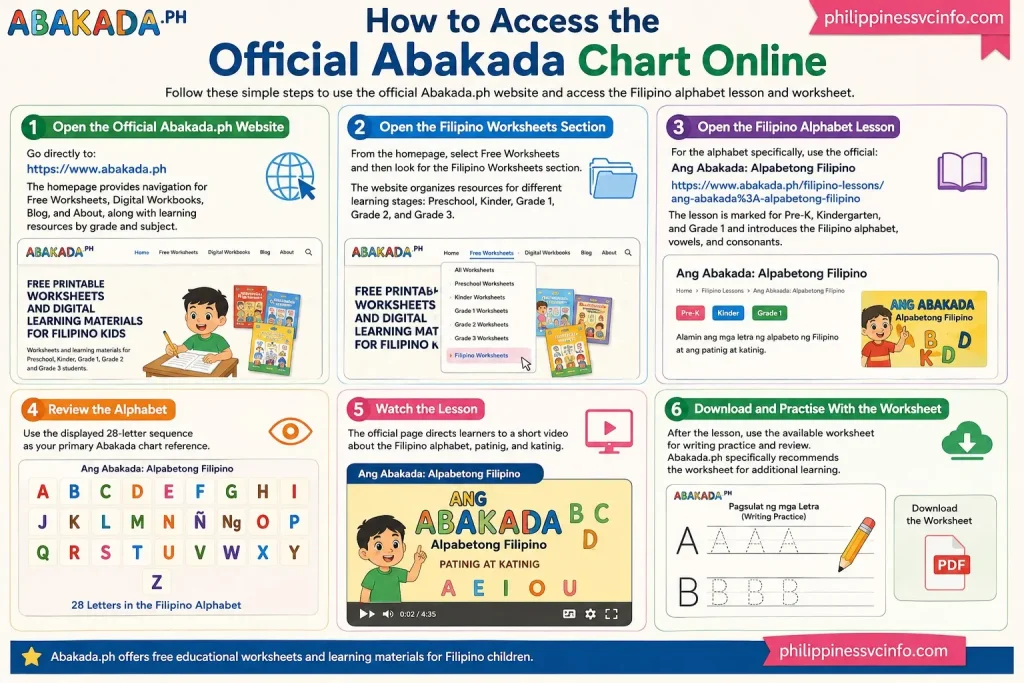
Step 1: Open the Official Abakada.ph Website
Go directly to:
The homepage currently provides navigation for Free Worksheets, Digital Workbooks, Blog, and About, along with learning resources organised by grade and subject.
Step 2: Open the Filipino Worksheets Section
From the homepage, select Free Worksheets and then look for the Filipino Worksheets section.
The website organises resources for different learning stages, including Preschool, Kinder, Grade 1, Grade 2, and Grade 3.
Step 3: Open the Filipino Alphabet Lesson
For the alphabet specifically, use the official:
The lesson is marked for Pre-K, Kindergarten, and Grade 1 and introduces the Filipino alphabet, vowels, and consonants.
Step 4: Review the Alphabet
Use the displayed 28-letter sequence as your primary Abakada chart reference.
Step 5: Watch the Lesson
The official page directs learners to a short video about the Filipino alphabet, patinig, and katinig.
Step 6: Download and Practise With the Worksheet
After the lesson, use the available worksheet for writing practice and review. Abakada.ph specifically recommends the worksheet for additional learning.
How to Use an Abakada Worksheet and Chart for Daily Practice
A parent or teacher can follow these simple steps to make Abakada chart and worksheet practice more effective:
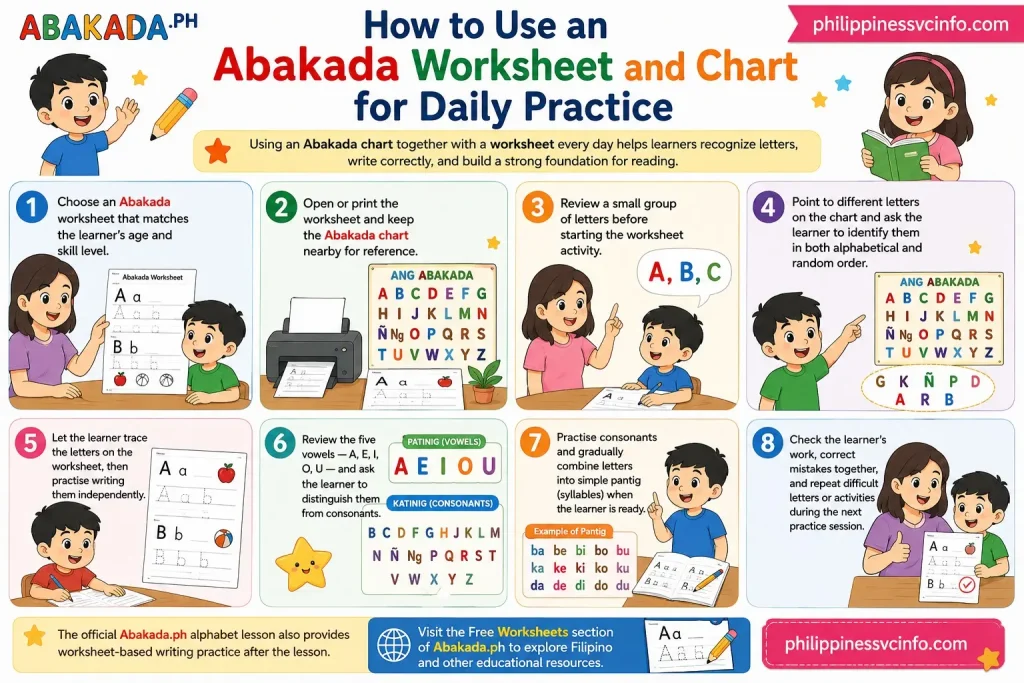
Step 1: Choose an Abakada worksheet that matches the learner’s age and skill level.
Step 2: Open or print the worksheet and keep the Abakada chart nearby for reference.
Step 3: Review a small group of letters before starting the worksheet activity.
Step 4: Point to different letters on the chart and ask the learner to identify them in both alphabetical and random order.
Step 5: Let the learner trace the letters on the worksheet, then practise writing them independently.
Step 6: Review the five vowels — A, E, I, O, U — and ask the learner to distinguish them from consonants.
Step 7: Practise consonants and gradually combine letters into simple pantig (syllables) when the learner is ready.
Step 8: Check the learner’s work, correct mistakes together, and repeat difficult letters or activities during the next practice session.
The official Abakada.ph alphabet lesson also provides worksheet-based writing practice after the lesson. You can visit the Free Worksheets section to explore Filipino and other educational resources.
How to Learn the Abakada Step by Step
If you are a parent, teacher, or beginner learner, the following routine provides a practical way to use Abakada.ph.
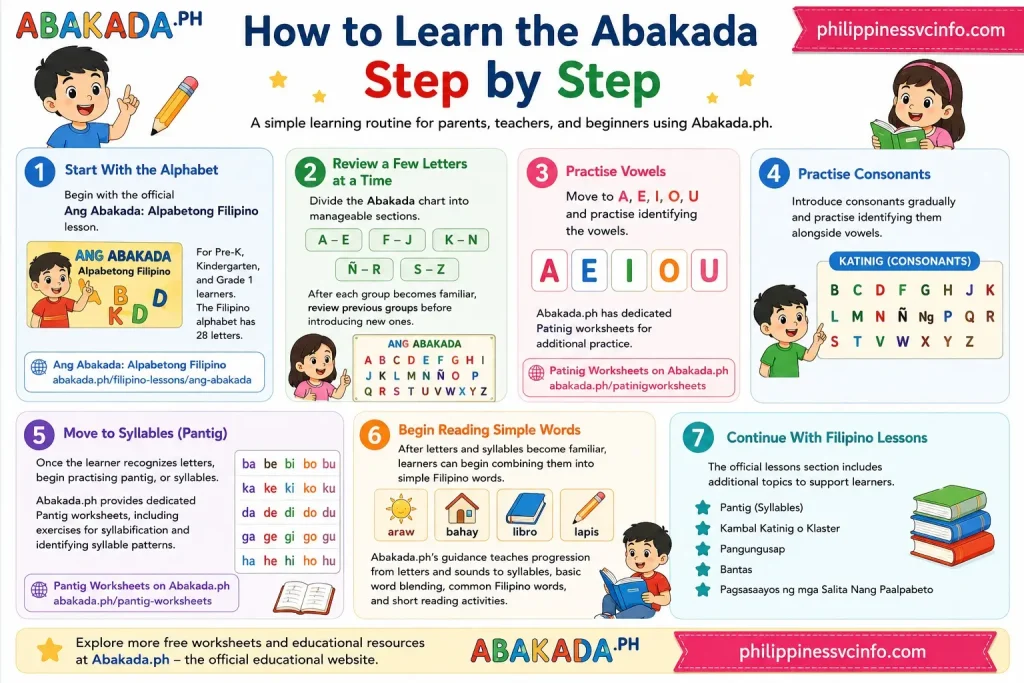
Step 1: Start With the Alphabet
Begin with the official Ang Abakada: Alpabetong Filipino lesson.
The page identifies the lesson for Pre-K, Kindergarten, and Grade 1 and presents the Filipino alphabet as 28 letters.
Step 2: Review a Few Letters at a Time
Instead of requiring a child to memorise all 28 letters immediately, divide the Abakada chart into manageable sections.
For example:
- A–E
- F–J
- K–N
- Ñ–R
- S–Z
After each group becomes familiar, review previous groups before introducing new ones.
Step 3: Practise Vowels
Move to A, E, I, O, U and practise identifying the vowels.
Abakada.ph has dedicated Patinig worksheets that can provide additional practice.
Step 4: Practise Consonants
Introduce consonants gradually and practise identifying them alongside vowels.
Step 5: Move to Syllables
Once the learner recognises letters, begin practising pantig, or syllables.
Abakada.ph provides dedicated Pantig worksheets, including exercises for practising syllabification and identifying syllable patterns.
Step 6: Begin Reading Simple Words
After letters and syllables become familiar, learners can begin combining them into simple Filipino words.
Abakada.ph’s own recent worksheet guidance describes a progression from letters and sounds to syllables, basic word blending, common Filipino words, and short reading activities.
Step 7: Continue With Filipino Lessons
The official lessons section includes additional topics such as Pantig, Kambal Katinig o Klaster, Pangungusap, Bantas, and Pagsasaayos ng mga Salita Nang Paalpabeto.
Patinig and Katinig Practice
After becoming familiar with the Abakada chart, learners can begin separating letters into vowels and consonants.
Patinig
Patinig means vowels. Abakada.ph provides dedicated vowel worksheets covering A, E, I, O, and U. Its activities include missing-vowel exercises, identifying words that begin with vowels, and other writing and recognition activities.
A basic practice sequence is:
A → E → I → O → U
Ask the learner to identify each vowel, write it, and then find vowels in simple Filipino words.
Katinig
Katinig refers to consonants. Abakada.ph includes Patinig at Katinig among its Filipino learning resources.
Once learners understand vowels and consonants separately, they can begin combining them to practise syllables.
This creates a natural progression:
Abakada chart → letters → vowels/consonants → syllables → words → reading
Abakada Chart and Handwriting Practice
Alphabet recognition and handwriting should work together. A learner may recognise a letter when looking at a chart but still need considerable practice writing it independently.
A good handwriting routine is:
See → Trace → Copy → Write → Review
See
Show the learner the letter on the Abakada chart.
Trace
Let the learner follow the provided lines or letter shapes.
Copy
Ask the learner to reproduce the letter while looking at the example.
Write
Remove the example and let the learner write independently.
Review
Compare the result with the model and practise again if necessary.
Abakada.ph also provides separate Practice Handwriting Sheets through its supplementary lessons.
Abakada Chart for Kindergarten and Grade 1
Different learners need different levels of practice.
Kindergarten
For Kindergarten learners, focus primarily on:
- Letter recognition
- Letter tracing
- Uppercase and lowercase forms
- Patinig
- Katinig
- Matching letters and pictures
- Simple Filipino vocabulary
- Basic handwriting
Abakada.ph’s recent Filipino worksheet guide describes its Kinder materials as focusing on recognition, tracing, simple vocabulary, vowels, consonants, and handwriting practice.
Grade 1
For Grade 1 learners who already recognise basic letters, the focus can gradually shift toward:
- Pantig
- Syllable reading
- Simple Filipino words
- Short sentences
- Reading practice
- Writing words and sentences
The same Abakada.ph resource describes Grade 1 materials as progressing into syllable practice, simple word reading, short sentences, and basic reading comprehension.
Abakada Chart vs. Modern Filipino Alphabet
The terms Abakada and modern Filipino alphabet should not automatically be treated as exactly the same thing.
For this article, the most useful distinction is between the historical Abakada system and the contemporary alphabet presentation used in modern Filipino education.
The current Abakada.ph alphabet lesson presents 28 letters:
A, B, C, D, E, F, G, H, I, J, K, L, M, N, Ñ, Ng, O, P, Q, R, S, T, U, V, W, X, Y, Z.
The website’s recent Filipino worksheet article also discusses the modern Filipino alphabet and identifies letters such as C, F, J, Ñ, Q, V, X, and Z as hiram na letra, or borrowed letters, in its learning materials.
For an SEO article about the Abakada chart, it is therefore better to explain the distinction clearly instead of presenting historical and modern alphabet systems as interchangeable.
Why Abakada Charts Are Useful for Filipino Learners
A good Abakada chart gives beginners a clear starting point. Rather than immediately asking children to read long words or sentences, it allows them to develop smaller skills first.
The learning process can be visualised as:
Alphabet recognition
↓
Letter writing
↓
Patinig and katinig
↓
Pantig
↓
Simple words
↓
Sentences and reading
This progression also matches the types of resources available through Abakada.ph. The website offers alphabet, vowel and consonant, syllable, handwriting, and broader Filipino lessons.
Tips for Parents and Teachers
1. Practise for Short Periods
When using an Abakada chart with young learners, keep the activities simple and consistent.
A short daily session can be easier for a young learner than a long lesson.
2. Read Aloud
Say letters, syllables, and words aloud and encourage the learner to repeat them.
3. Use Visual Materials
Keep the alphabet chart or worksheet where the child can easily see it.
4. Mix Activities
Do not rely only on memorisation. Combine:
- Reading
- Writing
- Tracing
- Matching
- Speaking
- Picture activities
- Syllable practice
5. Repeat Difficult Letters
If a learner struggles with particular letters, return to them regularly rather than rushing forward.
6. Move at the Child’s Pace
The goal is not simply to finish an Abakada chart. The goal is to help the learner recognise, understand, write, and eventually use the letters while reading Filipino.
Official Abakada.ph Resources
For readers who want to use the actual website, these are the most useful official pages:
- Abakada.ph Official Website — main website and learning-resource directory.
- Free Worksheets — free printable Filipino and other educational worksheets.
- Ang Abakada: Alpabetong Filipino — dedicated Filipino alphabet lesson.
- Patinig Worksheets — vowel practice and related Filipino worksheets.
- Pantig Worksheets — syllable practice resources.
- Official Lessons — additional Filipino lessons and learning topics.
From Abakada Chart to Reading
An Abakada chart is only the beginning of Filipino literacy practice. Once learners recognise letters, they can gradually move toward more complex reading skills.
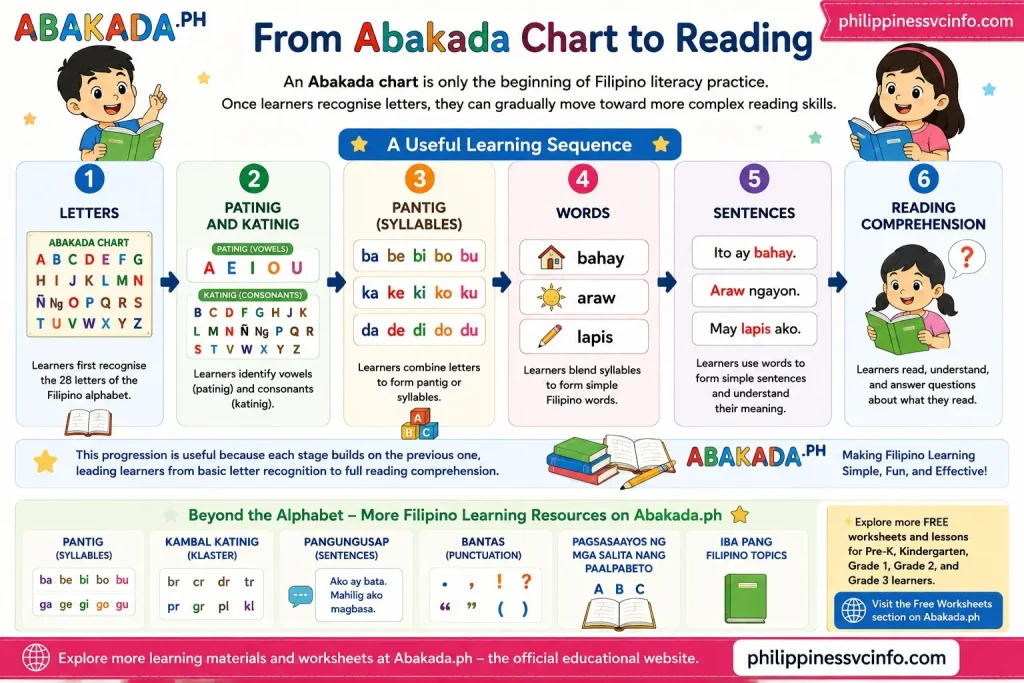
A useful learning sequence is:
Letters
↓
Patinig and Katinig
↓
Pantig
↓
Words
↓
Sentences
↓
Reading comprehension
This progression is useful because each stage builds on the previous one.
Abakada.ph provides resources beyond the alphabet, including pantig, kambal katinig, sentences, punctuation, and other Filipino topics.
Common Mistakes When Learning the Abakada
Learning the Filipino alphabet is straightforward, but beginners can still encounter a few common problems.
Trying to Memorise Everything at Once
One of the biggest mistakes is expecting a young learner to remember the entire Abakada chart immediately.
Instead, divide the letters into small groups.
Focusing Only on Alphabet Order
A learner may be able to recite:
A, B, C, D, E…
without being able to identify D or E when shown randomly.
To prevent this, include random-letter recognition in practice sessions.
Skipping Handwriting
Recognition and writing are different skills. A child should have opportunities to trace, copy, and independently write letters.
Moving to Words Too Quickly
If a learner is still struggling with individual letters, moving directly to long words can create unnecessary difficulty.
Build confidence with:
letters → vowels/consonants → syllables → words
Not Reviewing Previous Lessons
Regular review is important. Before introducing new letters, spend a few minutes revisiting letters already learned.
Abakada Chart for Parents
Parents can use an Abakada chart as a simple home-learning tool.
A parent does not need to be a Filipino-language teacher to support basic alphabet practice. The official website provides lessons and worksheets that can be used as supplementary learning materials. Abakada.ph describes its resources as suitable for learners from preschool through Grade 3.
A Simple Parent-Led Routine
Monday: Review five letters.
Tuesday: Practise the same letters through writing.
Wednesday: Review vowels and consonants.
Thursday: Introduce another small group of letters.
Friday: Review everything learned during the week.
The exact schedule can be adjusted according to the learner’s age and progress.
Abakada Chart for Teachers
Teachers can also use the alphabet chart as a classroom reference.
Possible classroom activities include:
- Alphabet recognition games
- Letter-matching exercises
- Letter tracing
- Board-writing activities
- Vowel and consonant sorting
- Picture-to-letter matching
- Syllable practice
- Alphabet-order exercises
- Short reading activities
For classroom use, the Abakada chart can be displayed on a wall or included in student worksheets.
Abakada.ph’s resources can supplement these activities with printable materials and Filipino lessons.
Abakada Chart for Foreign Filipino Learners
The Abakada chart can also be useful for adults and foreign residents who are beginning to study Filipino.
Although the Abakada.ph materials are largely designed for young learners, beginners of any age can use an alphabet chart as a foundation.
An adult learner can use the same progression:
Alphabet → pronunciation practice → vowels/consonants → syllables → vocabulary → sentences
The advantage of starting with the alphabet is that it gives learners a basic understanding of Filipino written forms before they begin studying longer phrases.
For adults, however, the children’s worksheets may be better treated as supplementary practice rather than a complete Filipino-language course.
Abakada Chart and Modern Filipino Alphabet
A frequently searched question is whether the Abakada and modern Filipino alphabet are identical.
They should not simply be treated as interchangeable historical terms.
For this guide, the relevant point is that Abakada.ph currently presents a 28-letter Filipino alphabet containing:
A, B, C, D, E, F, G, H, I, J, K, L, M, N, Ñ, Ng, O, P, Q, R, S, T, U, V, W, X, Y, Z.
The site’s other Filipino worksheet material discusses the modern Filipino alphabet and identifies several letters as hiram na letra, or borrowed letters.
Therefore, when writing an SEO guide, it is better to distinguish the historical concept of Abakada from the contemporary alphabet material presented on Abakada.ph.
Why Is the Abakada Chart Important?
Alphabet knowledge provides an important foundation for early literacy.
When a learner can recognise letters, the learner can begin making connections between:
Written symbols → sounds → syllables → words → sentences
The Abakada chart makes the first stage easier by providing a clear visual reference.
Abakada.ph positions its Filipino alphabet lesson as introductory learning material and combines it with worksheet-based writing practice.
The broader website then allows learners to move beyond alphabet practice into additional Filipino learning topics.
Where to Find More Filipino Learning Materials
Once you have finished practising the Abakada chart, you can continue using the official Abakada.ph resources.
Official Abakada.ph Website
Visit:
This is the main website and starting point for its educational resources.
Filipino Alphabet Lesson
For the dedicated alphabet lesson:
This page provides the alphabet lesson for Pre-K, Kindergarten, and Grade 1 learners.
Abakada.ph Lessons
For additional Filipino learning topics:
The site’s lesson resources include alphabet-related material, patinig at katinig, pantig, kambal katinig, sentences, punctuation, and other Filipino topics.
Frequently Asked Questions About the Abakada Chart
Final Thoughts
The Abakada chart is a simple and useful starting point for Filipino alphabet learning, helping beginners recognise letters, practise their order, learn vowels and consonants, and develop basic handwriting skills. For learners using the official website, Abakada.ph offers more than an alphabet reference, with Filipino worksheets, alphabet lessons, vowel and consonant activities, syllable practice, handwriting materials, and other learning resources. To get started, visit the official Abakada.ph website, open “Ang Abakada: Alpabetong Filipino,” review the 28-letter sequence, and practise with the available lessons and worksheets. Young learners can benefit from short, regular practice sessions that gradually progress from letters to syllables and words, while parents and teachers can continue using the Abakada chart as a helpful visual reference throughout early Filipino literacy practice.
Discover What You Need to Know:
- UM Portal Philippines 2026: Login, Registration, Grades, Fees & Student Services
- CHED Philippine (2026): Complete Guide to Scholarships, Requirements, Application Steps, and Official Resources
- PUP Portal Guide 2026: Login, Admission, Enrollment & Student Services
- NEO LMS Login & User Guide: Registration, Password Recovery, Profile Settings & Online Learning
- CodeChum Guide 2026: How to Register, Log In, Join Classes & Submit Programming Assignments