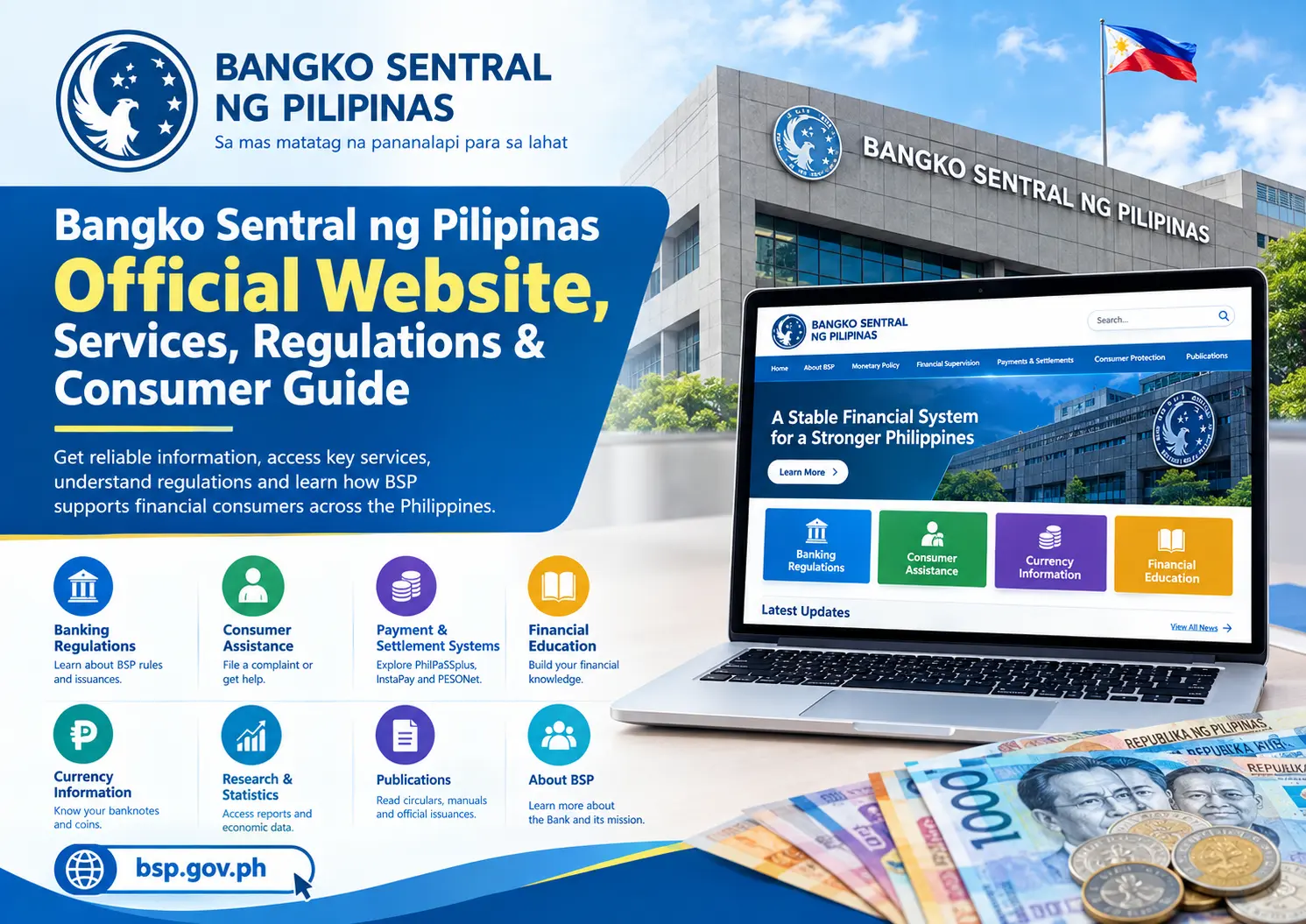
Bangko Sentral ng Pilipinas (BSP) is the central bank of the Philippines. It manages monetary policy, promotes price and financial stability, supervises banks and financial institutions, manages Philippine currency, oversees payment systems, and supports financial inclusion. BSP also provides consumer assistance, financial education, banking regulations, and official information through its website.
What Is Bangko Sentral ng Pilipinas?
The Bangko Sentral ng Pilipinas, commonly called BSP, is the central bank of the Republic of the Philippines. Its mandate covers several areas of the country’s financial and monetary system rather than ordinary retail banking services for the public.
According to the BSP, its responsibilities include monetary policy, monetary operations, systemic risk management, financial supervision, payment and settlement oversight, currency management, inclusive finance, lending and credit operations, international reserves management, and international operations.
In practical terms, this means the Bangko Sentral ng Pilipinas works behind much of the financial infrastructure that individuals, businesses and financial institutions use every day.
For example, BSP policies can affect how banks are regulated, how payment systems operate, how financial consumers raise complaints, and how the Philippine peso is managed.
Key BSP Responsibilities
| Area | What it involves |
|---|---|
| Monetary policy | Working towards price stability |
| Financial supervision | Supervising banks and covered financial institutions |
| Payment systems | Oversight and regulation of payment and settlement systems |
| Currency management | Issuing and managing Philippine currency |
| Financial stability | Addressing risks that could affect the financial system |
| Consumer protection | Supporting financial consumers dealing with BSP-supervised institutions |
| Inclusive finance | Promoting broader access to financial services |
| International reserves | Managing the country’s international reserves |
The BSP states that its mission is centred on price stability, a strong financial system, and a safe and efficient payments and settlements system that supports sustainable and inclusive economic growth.
How to Use the Official BSP Website
The official Bangko Sentral ng Pilipinas website brings together information for consumers, banks, businesses, researchers, financial institutions and other members of the public.
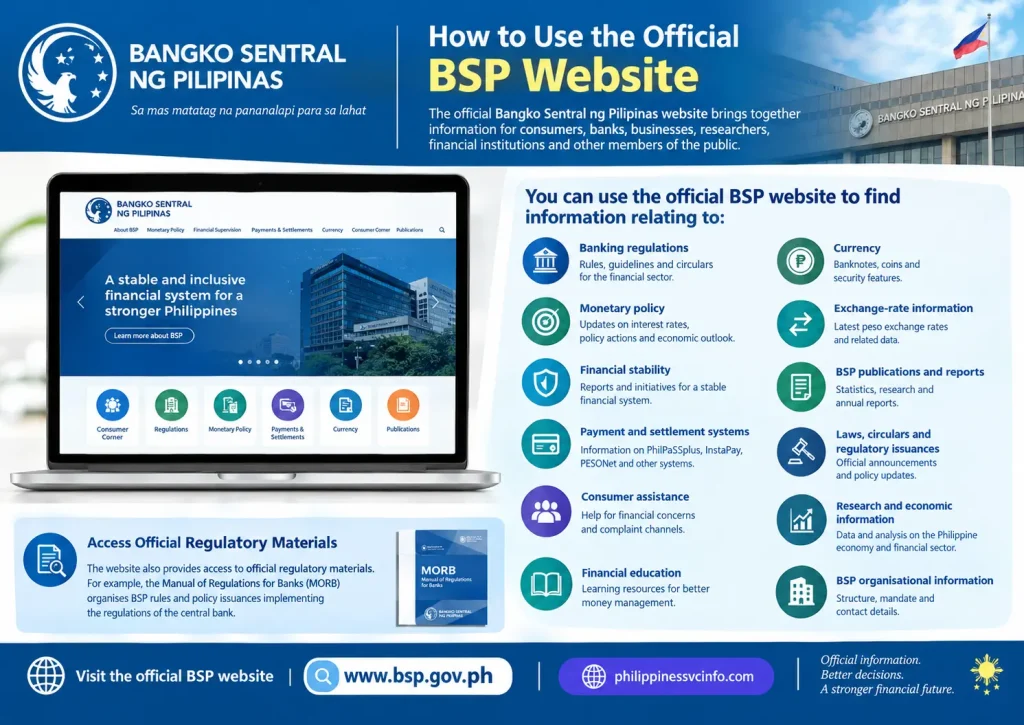
When visiting the website, look for the section that matches your purpose instead of relying on third-party websites for regulatory or financial information.
You can use the official BSP website to find information relating to:
- Banking regulations
- Monetary policy
- Financial stability
- Payment and settlement systems
- Consumer assistance
- Financial education
- Currency
- Exchange-rate information
- BSP publications and reports
- Laws, circulars and regulatory issuances
- Research and economic information
- BSP organisational information
The website also provides access to official regulatory materials. For example, the Manual of Regulations for Banks (MORB) organises BSP rules and policy issuances implementing the General Banking Law and other relevant banking legislation.
Understanding the Main Functions of BSP
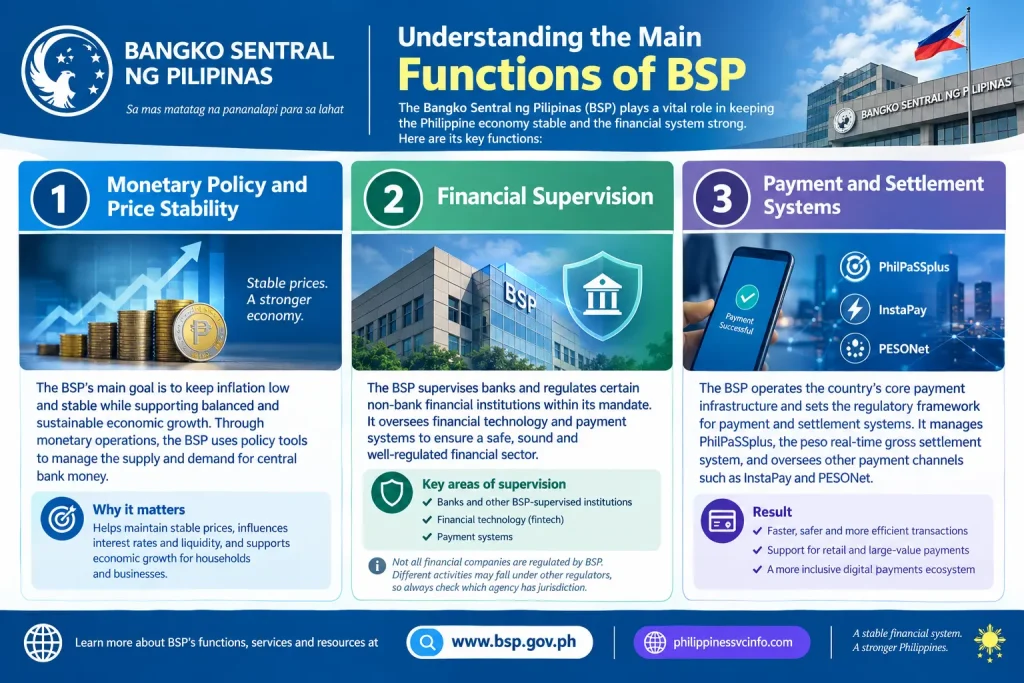
A common reason people search for the Bangko Sentral ng Pilipinas is to understand what the central bank actually does. Its work can be divided into several major functions.
1. Monetary Policy and Price Stability
One of the central responsibilities of the Bangko Sentral ng Pilipinas is maintaining price stability. The BSP explains that its main goal is to keep inflation low and stable while supporting balanced and sustainable economic growth.
Monetary operations involve using appropriate tools to influence the supply and demand for central bank money. These activities are part of the broader framework through which the BSP implements monetary policy.
This area is particularly relevant when consumers and businesses want to understand changes in inflation, interest rates, liquidity or broader monetary conditions.
2. Financial Supervision
The Bangko Sentral ng Pilipinas supervises banks and regulates certain non-bank financial institutions within its mandate.
The BSP’s Financial Supervision Sector is responsible for the regulation and supervision of banks and other BSP-supervised financial institutions, as well as oversight of financial technology and payment systems.
This does not mean every financial company in the Philippines is regulated by BSP. Different financial activities may fall under different regulators, so consumers should identify the institution and type of concern before submitting a complaint.
3. Payment and Settlement Systems
Modern banking depends heavily on reliable electronic and interbank payments. The Bangko Sentral ng Pilipinas operates the country’s core payment infrastructure and establishes regulatory frameworks for payment and settlement systems.
One important component is PhilPaSSplus, the peso real-time gross settlement system. BSP also oversees payment systems and works on reforms designed to improve the country’s payments infrastructure.
The National Retail Payment System (NRPS) provides a policy and regulatory framework for retail payment activities conducted through BSP-supervised financial institutions. Its framework focuses on principles including interoperability and inclusivity.
BSP Regulations and Banking Rules
For users researching Philippine banking regulations, the official BSP website is particularly useful because it provides access to laws, circulars, manuals and other regulatory materials.
The Manual of Regulations for Banks (MORB) consolidates BSP rules and policy issuances affecting banks. The BSP also publishes regulatory materials covering non-bank financial institutions and payment systems.
Where to Find BSP Regulations
You can access the official regulatory section here:
For banking rules specifically:
For payment-system rules, BSP publishes the Manual of Regulations for Payment Systems (MORPS), which includes regulatory provisions covering areas such as payment-system registration, retail payment systems, settlement and operational risk.
Important: Regulatory requirements can change through new circulars and issuances. When a financial or compliance decision depends on a specific rule, check the latest document on the official BSP website rather than relying on an older article.
Bangko Sentral ng Pilipinas Consumer Assistance
Another major reason people search for the Bangko Sentral ng Pilipinas is to complain about a financial product or service.
The BSP provides a Consumer Assistance Mechanism (CAM) for financial consumers who have concerns involving BSP-supervised financial institutions. The mechanism is intended to provide a way for consumers to escalate concerns when their issue remains unresolved after contacting the financial institution.
What Should You Do Before Contacting BSP?
The BSP advises consumers to first contact the financial institution involved and formally raise the concern through its appropriate customer assistance or complaint channel.
A practical sequence is:
Financial institution → Formal complaint → Allow the institution to address the issue → BSP Consumer Assistance Mechanism if unresolved
This is important because BSP’s consumer assistance process is not intended to replace the financial institution’s own first-level complaint process.
How to File a Complaint With BSP
If your complaint remains unresolved after raising it with the concerned BSP-supervised institution, you can use the available BSP consumer assistance channels.
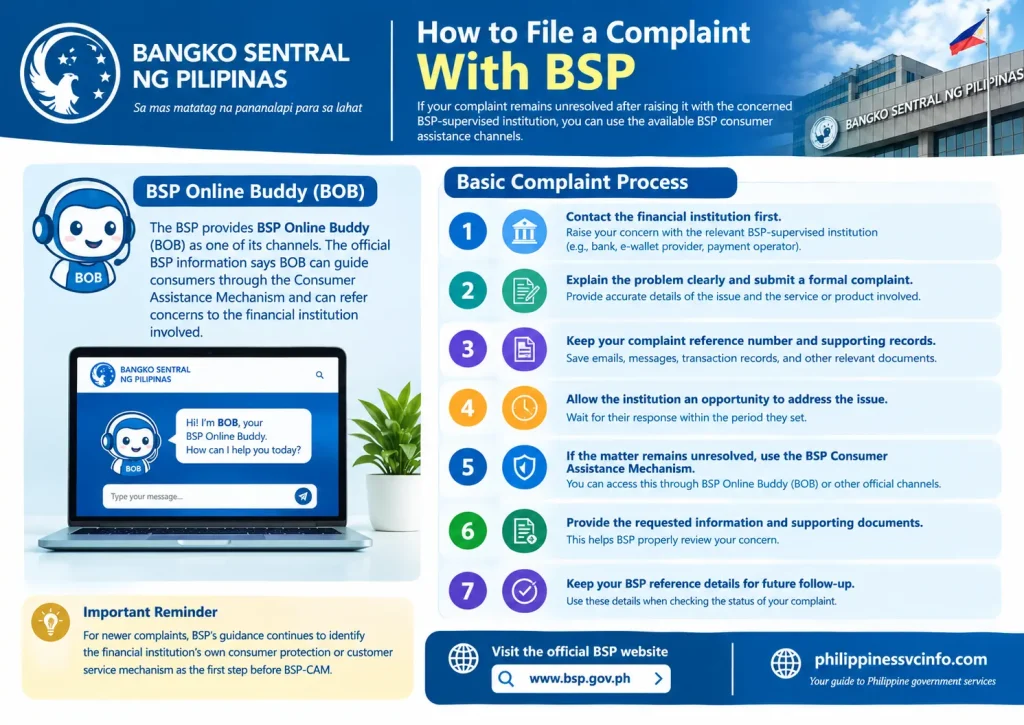
The BSP provides BSP Online Buddy (BOB) as one of its channels. The official BSP information says BOB can guide consumers through the Consumer Assistance Mechanism and can refer concerns to the financial institution involved.
Basic Complaint Process
- Contact the financial institution first.
- Explain the problem clearly and submit a formal complaint.
- Keep your complaint reference number and supporting records.
- Allow the institution an opportunity to address the issue.
- If the matter remains unresolved, use the BSP Consumer Assistance Mechanism.
- Provide the requested information and supporting documents.
- Keep your BSP reference details for future follow-up.
For newer complaints, BSP’s published guidance continues to identify the financial institution’s own consumer protection or customer service mechanism as the first step before BSP-CAM.
BSP Online Buddy (BOB)
BSP Online Buddy, commonly known as BOB, is the BSP’s online consumer-assistance chatbot/channel.
According to BSP, consumers can access BOB through the official BSP website. The BSP also provides other consumer assistance channels, including email, postal mail and walk-in assistance.
When submitting a complaint, keep relevant information available, such as your communication with the financial institution, complaint/reference number and documents that help explain the issue.
Never send passwords, PINs, one-time passwords or other security credentials simply because someone claims to represent BSP. Use contact information and complaint channels published through the official BSP website.
BSP Consumer Protection Resources
The BSP maintains a dedicated Consumer Corner for financial consumers. It includes resources such as consumer assistance channels, BSP Online Buddy, information on currency, credit-card interest rates and other consumer-protection materials.
The BSP also maintains a current directory of consumer assistance channels for BSP-Supervised Institutions (BSIs). The directory covers categories including digital banks, money service businesses, non-bank electronic money issuers, rural and cooperative banks, thrift banks, universal and commercial banks, payment-system operators and virtual-asset service providers.
This distinction matters. A financial complaint should first be matched to the institution and regulator involved rather than automatically being sent to the Bangko Sentral ng Pilipinas.
Explore BSP’s Financial Education Resources
The Bangko Sentral ng Pilipinas also provides educational material designed to help consumers understand everyday financial decisions.
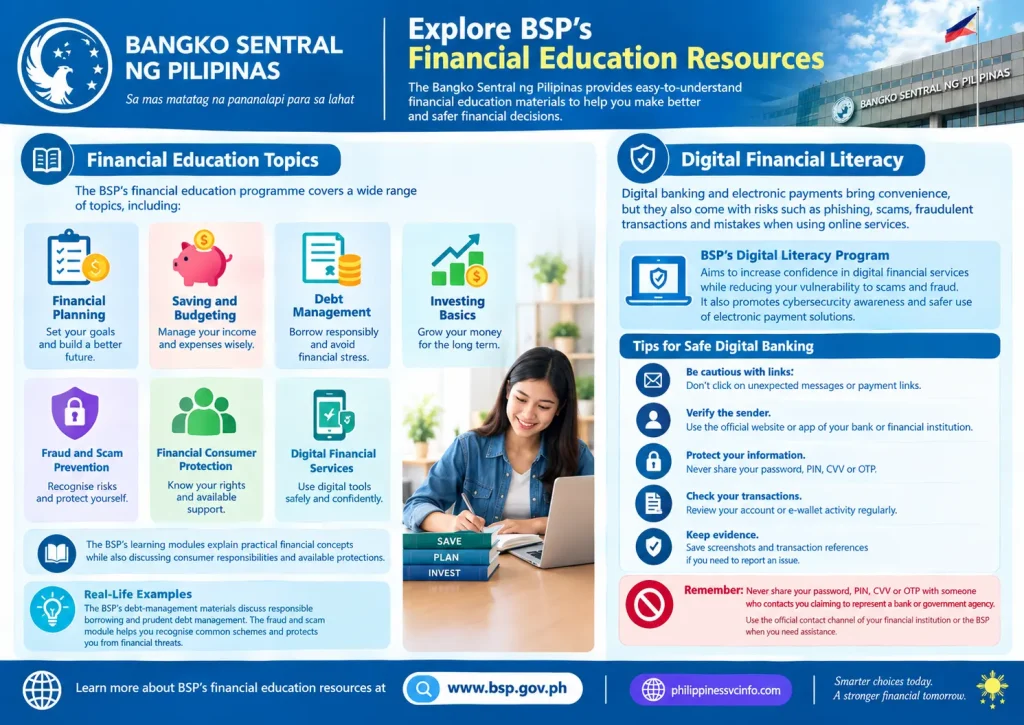
Its financial education programme covers topics such as:
- Financial planning
- Saving and budgeting
- Debt management
- Investing basics
- Fraud and scam prevention
- Financial consumer protection
- Digital financial services
The BSP’s learning modules explain practical financial concepts while also discussing consumer responsibilities and available protections.
For example, the BSP’s debt-management material discusses responsible borrowing and prudent debt management, while its fraud and scam module focuses on recognising common fraudulent schemes and protecting yourself against them.
Digital Financial Literacy
Digital banking and electronic payments create convenience, but they also introduce risks such as phishing, scams, fraudulent transactions and mistakes when using online services.
The BSP’s Digital Literacy Program aims to increase confidence in digital financial services while reducing consumers’ vulnerability to usage errors, scams and fraud. It also promotes cybersecurity awareness and safer use of electronic payment solutions.
A useful rule is simple: never share your password, PIN, CVV or OTP with someone who contacts you claiming to represent a bank or government agency. Use the official contact channel of your financial institution or the BSP when you need assistance.
Bangko Sentral ng Pilipinas & Philippine Currency
Currency is another major responsibility of the Bangko Sentral ng Pilipinas.
The BSP has official resources covering Philippine banknotes and coins, including information about currency series, designs and demonetised notes and coins. The BSP states that it has the authority to issue currency under the applicable central-bank law.
If you have an old Philippine banknote or coin, don’t automatically assume that it is still legal tender. BSP provides specific information about demonetised currencies and the applicable replacement or exchange arrangements.
What Does Demonetisation Mean?
Demonetisation means that a currency loses its monetary value as legal tender. The BSP explains that demonetised currency can no longer be used as payment for goods and services.
The BSP maintains historical information about older currency series, including the English Series and other previous designs.
For questions about whether a particular old Philippine note or coin remains valid, check the BSP’s current Coins and Notes resources rather than relying on social-media posts or unofficial lists.
BSP Payment Systems and Electronic Payments
The Bangko Sentral ng Pilipinas has an important role in the Philippine payments ecosystem.
One major system is PhilPaSSplus, the country’s peso real-time gross settlement system. It is owned and operated by BSP and is used for the settlement of large-value financial transactions between financial institutions. BSP explains that the system also supports settlement involving financial-market transactions and retail payment clearing results.
The Philippine payment environment also includes widely used channels such as InstaPay and PESONet.
PhilPaSSplus, InstaPay and PESONet
These names can be confusing because they serve different purposes.
| System | General role |
|---|---|
| PhilPaSSplus | BSP-operated real-time gross settlement infrastructure |
| InstaPay | Electronic payment channel for eligible retail transactions |
| PESONet | Electronic fund-transfer system for batch payments |
| Payment-system operators | Entities providing or operating payment-system services under the applicable framework |
PhilPaSSplus supports the settlement of payment clearing results, including transactions associated with channels such as checks, ATMs, InstaPay and PESONet.
Consumers normally interact with their bank or electronic-money provider rather than directly operating PhilPaSSplus.
How Find a BSP-Supervised Financial Institution
If you’re trying to determine whether a bank, e-money provider, payment operator or another financial institution falls under BSP supervision, use BSP’s official directories.
The BSP’s consumer-assistance directory categorises supervised institutions into groups such as digital banks, money service businesses, electronic money issuers, rural and cooperative banks, thrift banks, universal and commercial banks, pawnshops and operators of payment systems.
This is particularly useful before filing a complaint because the Bangko Sentral ng Pilipinas Consumer Assistance Mechanism is designed for concerns involving BSP-supervised financial institutions.
BSP Consumer Assistance Scope
The BSP Consumer Assistance Mechanism (CAM) provides an avenue for financial consumers to escalate concerns involving BSP-supervised financial institutions when they remain unresolved.
The process normally begins with the financial institution itself.
Recommended Complaint Sequence
1. Contact the financial institution
Raise your concern with the bank, e-wallet provider, payment operator or other relevant BSP-supervised institution.
2. Make a formal complaint
Clearly describe what happened and ask the institution to investigate.
3. Keep your records
Save emails, screenshots, transaction references, complaint numbers and relevant correspondence.
4. Wait for the institution’s response
Give the institution an opportunity to address the issue.
5. Escalate to BSP when appropriate
If the concern remains unresolved, use the BSP’s available Consumer Assistance Mechanism channels.
The BSP specifically instructs consumers to contact the concerned BSP-supervised financial institution first and lodge a formal complaint.
How to Contact BSP Through BOB
BSP Online Buddy (BOB) is the Bangko Sentral ng Pilipinas’ virtual assistant and an important channel for consumer assistance.
The official BSP page states that if a concern raised with a BSP-supervised financial institution remains unresolved, consumers can file a complaint through BOB. BOB guides the user through the Consumer Assistance Mechanism and can automatically refer the concern to the financial institution involved.
BSP also provides an alternative Complaints, Inquiries and Requests (CIR) Form route. According to the official BSP page, the completed form can be sent to [email protected].
What Information Should You Keep?
Before escalating a complaint, it is useful to have:
- Name of the financial institution
- Description of the issue
- Date of the transaction or incident
- Transaction or reference number
- Details of your previous complaint
- Response from the financial institution
- Relevant supporting documents
Avoid submitting unnecessary security credentials. A legitimate complaint process should not require you to disclose your banking password, PIN or OTP to an unknown person.
BSP Complaint Limits
One important point is that not every financial dispute falls under BSP’s consumer assistance mechanism.
BSP’s published consumer-assistance material explains that CAM does not cover certain matters, including disputes concerning policies or procedures that do not involve violations of banking laws or BSP regulations, cases already pending before a court or quasi-judicial body, and concerns involving institutions outside BSP’s supervisory authority.
For example, BSP identifies other regulators for certain categories of concerns. Its financial consumer resources direct consumers to the appropriate agency when the institution involved falls outside BSP supervision.
So before submitting a complaint, check who regulates the institution involved.
BSP Safety Tips for Financial Consumers
Using the official Bangko Sentral ng Pilipinas resources can help you avoid relying on outdated or misleading financial information.

Keep these practices in mind:
Use Official BSP Channels
For regulatory information, consumer assistance and official announcements, start with bsp.gov.ph.
Verify Financial Institutions
Check the relevant BSP directory when you need to determine whether an institution is supervised by BSP.
Protect Account Credentials
Do not disclose passwords, PINs, OTPs or other authentication credentials to people contacting you unexpectedly.
Be Careful With Links
If a message claims to come from BSP or a financial institution, don’t automatically click its link. Open the official website separately and use the published contact details.
Keep Complaint Evidence
When dealing with a disputed transaction, retain reference numbers, receipts, screenshots and communication records.
Check the Regulator
Not every financial company is regulated by BSP. If an institution is outside BSP’s supervisory scope, another government regulator may be responsible.
BSP Official Resources You Should Bookmark
For readers who frequently search for Bangko Sentral ng Pilipinas, these official resources are particularly useful:
| Resource | Purpose |
|---|---|
| BSP Official Website | Main source for BSP information and services |
| Consumer Corner | Consumer protection and financial resources |
| Consumer Assistance Channels | Contact information for supervised institutions |
| BSP Online Buddy | Consumer assistance and complaint support |
| Coins and Notes | Philippine currency information |
| Financial Education | Financial literacy resources |
| Payment Systems | Information about Philippine payment infrastructure |
| BSP Regulations | Regulatory rules and official issuances |
The BSP Consumer Corner brings several of these resources together in one official location.
How to Navigate the BSP Website
The official Bangko Sentral ng Pilipinas website can feel broad because it serves several audiences at once. Consumers, banks, researchers, businesses and other financial-sector users will see different sections covering regulation, payments, currency, monetary policy and financial education.
A useful way to navigate the site is to start with your specific purpose:
- Consumer concern: Go to the Consumer Corner and review the available assistance options.
- Banking regulation: Use the Regulations section for official rules, circulars and manuals.
- Currency information: Open the Coins and Notes section for Philippine banknotes and coins.
- Payment systems: Review the Payments and Settlements resources for official information about Philippine payment infrastructure.
- Financial education: Use BSP’s financial-literacy resources for consumer-focused learning materials.
- Economic information: Explore BSP publications, statistics and research when you need official economic data.
This approach is generally more efficient than searching the entire website randomly because BSP publishes information across different specialised sections.
BSP for Businesses & Financial Institutions
The Bangko Sentral ng Pilipinas is also an important source of information for banks, financial institutions and payment-system participants.
BSP publishes regulatory materials that explain applicable requirements, supervisory expectations and operating frameworks. Depending on the type of institution, relevant resources can include banking regulations, payment-system regulations and other official issuances.
Businesses operating in a regulated financial environment should check the applicable BSP rules directly rather than relying on summaries from blogs or social-media posts.
For banking rules, the Manual of Regulations for Banks (MORB) is an important official reference. BSP also provides other regulatory publications through its Regulations section.
Where to Check Philippine Currency Information
If your search relates to a Philippine banknote or coin, use BSP’s official currency resources rather than assuming that an image or list found online is current.
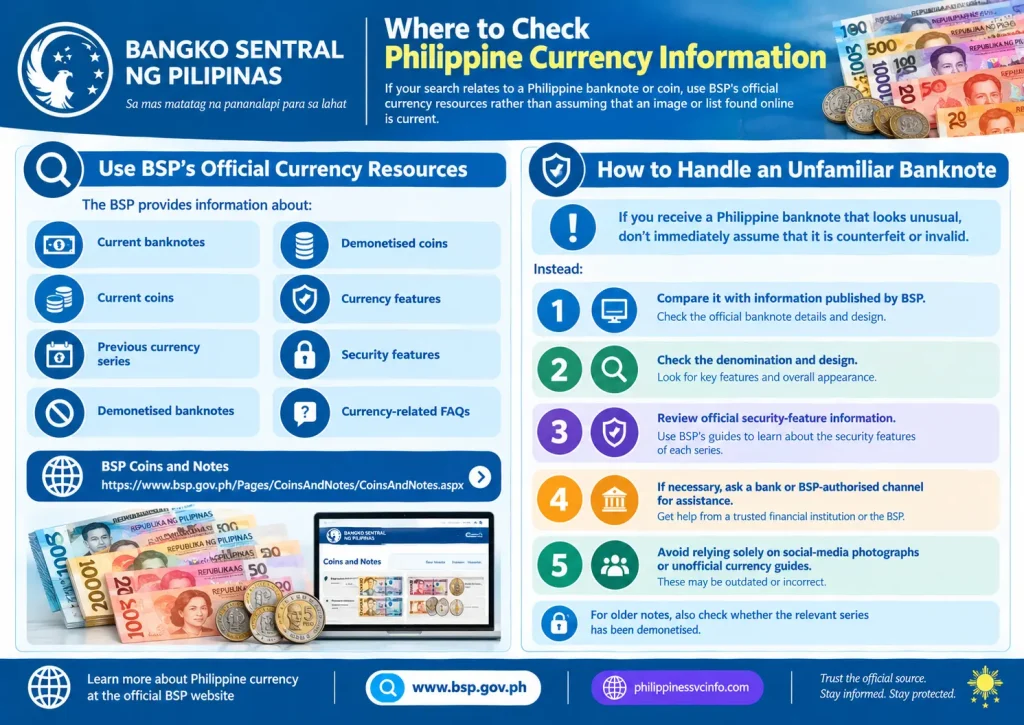
The BSP provides information about:
- Current banknotes
- Current coins
- Previous currency series
- Demonetised banknotes
- Demonetised coins
- Currency features
- Security features
- Currency-related FAQs
How to Handle an Unfamiliar Banknote
If you receive a Philippine banknote that looks unusual, don’t immediately assume that it is counterfeit or invalid.
Instead:
- Compare it with information published by BSP.
- Check the denomination and design.
- Review official security-feature information.
- If necessary, ask an appropriate bank or BSP-authorised channel for assistance.
- Avoid relying solely on social-media photographs or unofficial currency guides.
For older notes, also check whether the relevant series has been demonetised.
BSP & Digital Financial Safety
Digital payments have become an important part of everyday financial activity. The Bangko Sentral ng Pilipinas therefore places significant attention on digital financial literacy, consumer protection and the safe use of electronic financial services.
BSP’s Digital Literacy Program aims to help consumers use digital financial services more confidently and safely while increasing awareness of cybersecurity, fraud and common risks.
Consumers should develop a few basic habits:
Check before clicking.
Unexpected messages containing payment links should be treated cautiously.
Verify the sender.
Use an institution’s official website or application rather than a phone number or link supplied by an unknown message.
Protect authentication details.
Never disclose passwords, PINs or OTPs to another person.
Review transactions.
Regularly check your account or e-wallet activity and report suspicious transactions through the appropriate official channel.
Keep evidence.
Screenshots, transaction references and complaint numbers can become useful if you need to dispute a transaction.
Important Things to Remember About BSP
The Bangko Sentral ng Pilipinas is a central institution within the Philippine financial system, but its role is different from that of a commercial bank or an ordinary financial-service provider.
When using BSP information, keep these points in mind:
- Use bsp.gov.ph for official information.
- Identify whether your financial institution is supervised by BSP.
- Contact the financial institution first when raising a consumer complaint.
- Keep transaction and complaint records.
- Use official BSP consumer-assistance channels for eligible concerns.
- Check BSP’s currency resources before deciding that an old note or coin is invalid.
- Consult the latest regulatory issuance when dealing with compliance requirements.
- Be cautious about websites or messages pretending to represent BSP.
- Never share passwords, PINs or OTPs with unknown individuals.
- Check the appropriate regulator when an issue falls outside BSP’s authority.
Bangko Sentral ng Pilipinas FAQs
Final Takeaway
The Bangko Sentral ng Pilipinas serves a much broader purpose than simply managing Philippine currency. Its responsibilities extend across monetary policy, financial supervision, payment systems, financial stability, consumer protection and financial education.
For ordinary consumers, some of the most useful BSP resources are the Consumer Corner, Consumer Assistance Mechanism, BSP Online Buddy, Coins and Notes information, and financial-education materials. For banks and financial-sector organisations, the BSP Regulations section and applicable regulatory manuals provide important official references.
The best starting point is always the official BSP website. From there, select the section that matches your need—whether you’re checking a financial regulation, learning about a Philippine payment system, reviewing currency information or seeking help with a complaint.
This keeps your research tied to the organisation’s own published information rather than potentially outdated third-party summaries.
Discover What You Need to Know:
- LTFRB Philippines 2026 : Complete Guide Requirements, Registration, Franchise & Renewal
- PAIS Admin Philippine 2026: PNP Login, Registration, Website & Access Guide
- BFP Payslip Online 2026: Login, Download, Salary, Deductions & Payroll Guide
- DOH Philippines Guide 2026: Department of Health Services, Online Portal, Registration & Login