Department of Social Welfare and Development (DSWD) Philippines 2026: AICS Assistance, Programs, Requirements & How to Apply
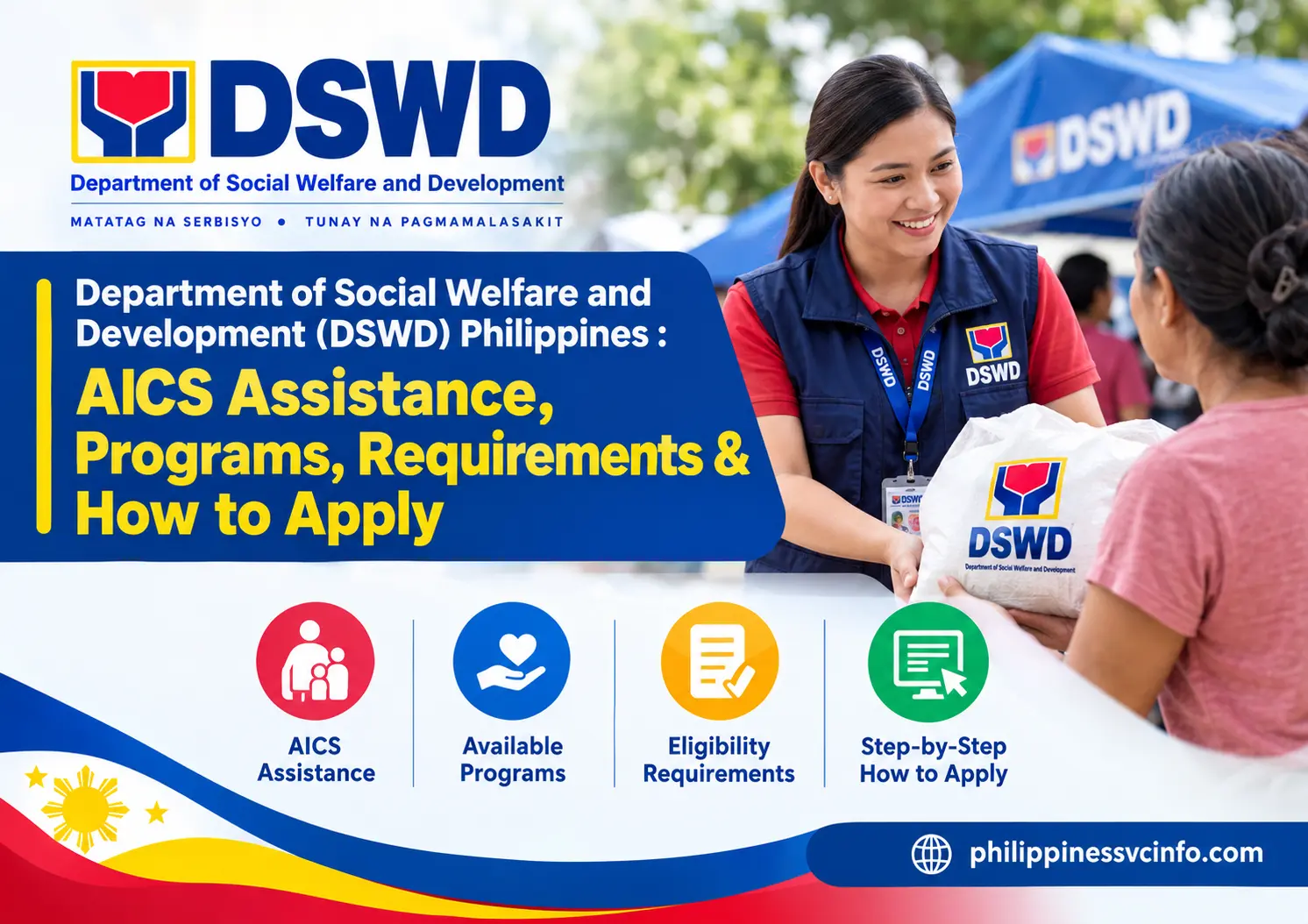
The Department of Social Welfare and Development (DSWD) is a Philippine government agency responsible for promoting social protection, welfare and community development. It provides assistance to individuals and families facing crises through programmes such as AICS, 4Ps, livelihood support, supplementary feeding, disaster response and social pension, helping eligible beneficiaries address immediate needs and improve well-being.
Department of Social Welfare and Development: What It Does
When a family faces a medical emergency, loss of income, educational expenses, burial costs or the effects of a disaster, knowing where to seek legitimate government assistance can make the process easier. In the Philippines, the Department of Social Welfare and Development (DSWD) provides social protection, assistance and development programmes for people and communities who need support.
The Department of Social Welfare and Development operates through national and regional structures, allowing its services to reach communities across the country. Its programmes cover several areas, including crisis assistance, conditional cash transfers, livelihood development, child nutrition, disaster response and support for indigent senior citizens.
For people looking specifically for immediate help during an unexpected crisis, one of the most relevant services is the Assistance to Individuals in Crisis Situations (AICS) programme. DSWD describes AICS as a social safety-net or stop-gap mechanism designed to support individuals and families experiencing unexpected crises. Assistance can include food, transportation, medical, educational and burial support, subject to assessment and applicable requirements.
Quick answer
The Department of Social Welfare and Development is the Philippine government department responsible for major social protection and social welfare development programmes. Depending on the applicant’s circumstances, services may include AICS assistance, 4Ps, supplementary feeding, sustainable livelihood support, disaster response and social pension assistance.
For an AICS request, applicants generally need to identify the type of assistance required, prepare the relevant supporting documents, approach the appropriate DSWD office or service channel, undergo an assessment and follow the instructions for release or referral.
What Services Does the Department of Social Welfare and Development Provide?
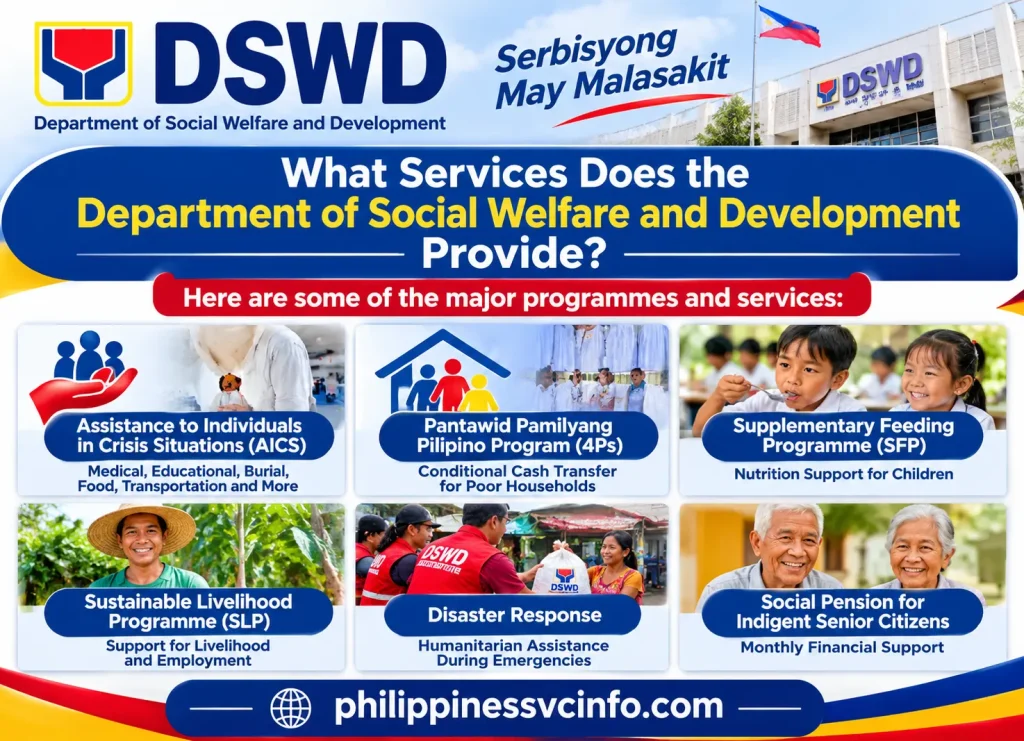
The Department of Social Welfare and Development does not operate as a single-purpose financial assistance office. Its programmes address different social and economic needs, and each programme has its own eligibility rules, procedures and supporting documents.
Here are several major areas covered by the department.
1. Assistance to Individuals in Crisis Situations
AICS is particularly relevant when an individual or family is dealing with an unexpected crisis.
The programme can provide assistance connected with:
- Medical needs
- Educational expenses
- Burial or funeral costs
- Food
- Transportation
- Other support needs assessed by DSWD
The department describes AICS as temporary assistance intended to help individuals and families cope with crisis situations rather than as a permanent income-support programme.
AICS may also involve referrals and other forms of support through the Crisis Intervention Unit. The official AICS service page identifies direct financial and material assistance as well as referrals for services such as medical and psychosocial support.
2. Pantawid Pamilyang Pilipino Program
The Pantawid Pamilyang Pilipino Program (4Ps) is a conditional cash transfer programme focused on poor households, with conditions and programme activities connected to areas such as health, nutrition and education.
4Ps should not be confused with AICS. AICS responds to individual or family crisis situations, whereas 4Ps is a structured social protection programme with its own beneficiary identification, compliance and programme rules.
The Department of Social Welfare and Development continues to issue and update guidelines relating to 4Ps. For example, DSWD’s current issuance listings include 2026 guidelines concerning programme exit protocols, Family Development Sessions and the maximum period for qualified beneficiaries.
3. Supplementary Feeding Programme
The Supplementary Feeding Programme (SFP) provides additional food to children enrolled in child development centres and supervised neighbourhood playgroups.
Its purpose is different from individual emergency assistance. Instead of responding primarily to a sudden crisis, supplementary feeding supports children’s nutritional needs through organised feeding activities.
4. Sustainable Livelihood Programme
The Sustainable Livelihood Program (SLP) is a community-based capacity-building programme. Its approach includes support related to micro-enterprise development and employment facilitation.
For families looking for longer-term livelihood opportunities, SLP is therefore different from emergency assistance under AICS.
5. Disaster Response
The Department of Social Welfare and Development also has a major role during disasters and other emergencies.
Its disaster response activities can include humanitarian assistance such as family food packs (FFPs) and non-food items for affected families. Depending on the emergency, assistance may also be coordinated through regional offices and local government structures.
This means that people affected by natural or human-induced disasters should pay attention to announcements from their relevant DSWD Field Office and local authorities rather than relying on unverified social-media posts.
6. Social Pension for Indigent Senior Citizens
Another important DSWD service is the Social Pension for Indigent Senior Citizens.
This programme provides monthly financial support to qualified indigent senior citizens to help with daily living and medical needs. Eligibility and implementation are governed by programme guidelines; applicants should therefore confirm current requirements through the appropriate DSWD office.
DSWD’s official issuance listings show that revised guidelines for the Social Pension for Indigent Senior Citizens were issued in September 2026, so applicants should rely on current official information rather than older articles or social-media posts.
AICS: The DSWD Assistance Many Applicants Search For
Among the services offered by the Department of Social Welfare and Development, AICS is one of the most commonly searched when someone needs help because of an immediate financial or personal crisis.
The official DSWD AICS information states that the programme provides immediate and temporary assistance to individuals and families affected by crises or unexpected life events. It can include financial, emotional and psychosocial support, along with assistance for basic needs such as food, transportation, medical, educational and burial expenses.
Who May Need AICS Assistance?
AICS is designed around the applicant’s current crisis and assessed needs. It is not simply a general cash-giving programme where everyone receives the same amount.
For example, a person may approach the programme because of:
- An urgent medical expense
- A need for educational support
- Funeral or burial expenses
- Transportation difficulties
- Food-related hardship
- Another crisis requiring appropriate social welfare intervention
The DSWD has also clarified in a 2026 statement that AICS assistance is based on the client’s circumstances and needs, with assessment playing an important role in determining the appropriate support.
That distinction matters. Applicants should not assume that submitting documents automatically guarantees a specific cash amount or approval.
How to Apply for DSWD Assistance
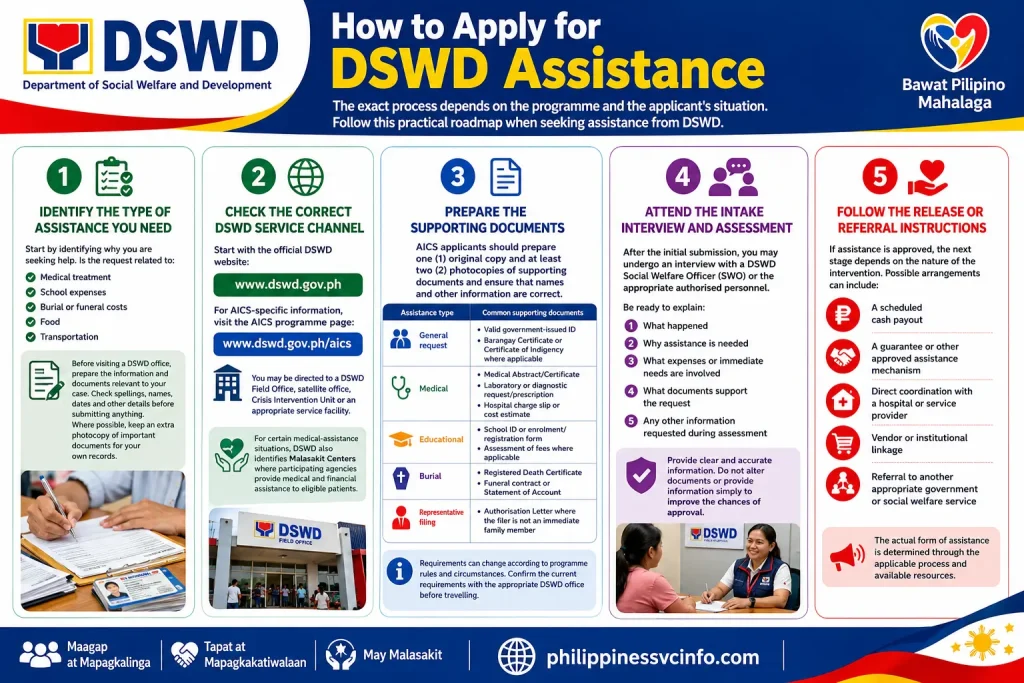
The exact process depends on the programme and the applicant’s situation. However, someone seeking direct intervention through AICS can use the following practical roadmap.
Step 1: Identify the Type of Assistance You Need
Start by identifying why you are seeking help.
For example, is the request related to:
- Medical treatment?
- School expenses?
- Burial or funeral costs?
- Food?
- Transportation?
Before visiting a DSWD office
Prepare the information and documents relevant to your case. Check spellings, names, dates and other details before submitting anything.
Where possible, keep an extra photocopy of important documents for your own records.
Step 2: Check the Correct DSWD Service Channel
The Department of Social Welfare and Development operates through central and regional offices.
You can start with the official DSWD website:
For AICS-specific information, the official AICS programme page is also available:
Depending on your location and case, you may be directed to a DSWD Field Office, satellite office, Crisis Intervention Unit or an appropriate service facility.
For certain medical-assistance situations, DSWD also identifies Malasakit Centers as a service setting where participating agencies provide medical and financial assistance to eligible patients.
Step 3: Prepare the Supporting Documents
The documents required depend on the assistance category.
Based on the information supplied for this guide, AICS applicants should prepare one original copy and at least two photocopies of supporting documents, while ensuring that names and other information are correct.
A practical document checklist includes the following:
| Assistance type | Common supporting documents |
|---|---|
| General request | Valid government-issued ID; Barangay Certificate or Certificate of Indigency where applicable |
| Medical | Medical Abstract/Certificate, laboratory or diagnostic request/prescription, hospital charge slip or cost estimate |
| Educational | School ID or enrolment/registration form; assessment of fees where applicable |
| Burial | Registered Death Certificate; funeral contract or Statement of Account |
| Representative filing | Authorisation Letter where the filer is not an immediate family member |
Requirements can change according to programme rules and individual circumstances. For that reason, treat this table as a preparation guide and confirm the current requirements with the appropriate DSWD office before travelling.
The official AICS site provides programme and service information, while regional offices may publish additional instructions for local processing.
Step 4: Attend the Intake Interview and Assessment
After the initial submission, an applicant may undergo an interview with a DSWD Social Welfare Officer (SWO) or the appropriate authorised personnel.
The purpose is to understand the applicant’s circumstances and determine what form of intervention may be appropriate.
Be ready to explain:
- What happened;
- Why assistance is needed;
- What expenses or immediate needs are involved;
- What documents support the request; and
- Any other information requested during assessment.
Providing clear and accurate information is important. Do not alter documents or provide information simply to improve the chances of approval.
Step 5: Follow the Release or Referral Instructions
If assistance is approved, the next stage depends on the nature of the intervention.
Possible arrangements can include:
- A scheduled cash payout;
- A guarantee or other approved assistance mechanism;
- Direct coordination with a hospital or service provider;
- Vendor or institutional linkage; or
- Referral to another appropriate government or social welfare service.
The actual form of assistance is determined through the applicable programme rules and assessment.
Important: AICS Is Not an Automatic Cash Grant
One common misunderstanding is that an AICS application guarantees a fixed amount of cash.
That is not how the programme should be understood. DSWD describes AICS as a stop-gap social safety-net mechanism, with assistance based on the circumstances and needs of the person or family seeking intervention.
So, submitting an application should be viewed as a request for assessment and assistance, not a promise of a particular payment.
Where to Find Your DSWD Field Office
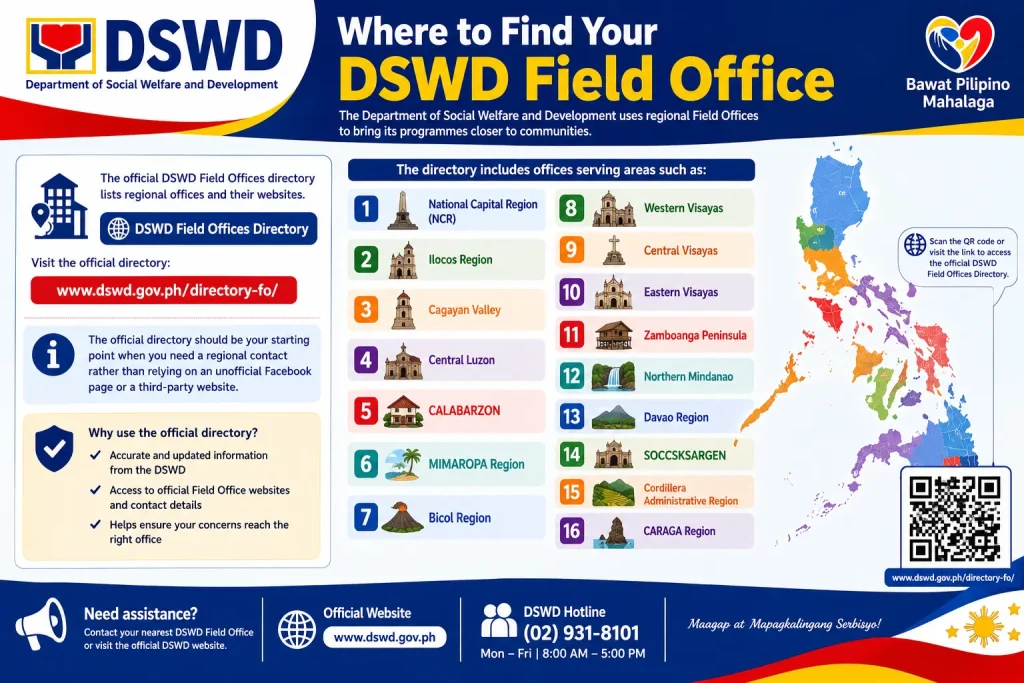
The Department of Social Welfare and Development uses regional Field Offices to bring its programmes closer to communities.
The official DSWD Field Offices directory lists regional offices and their websites.
The directory includes offices serving areas such as:
- National Capital Region
- Ilocos Region
- Cagayan Valley
- Central Luzon
- CALABARZON
- MIMAROPA
- Bicol Region
- Western Visayas
- Central Visayas
- Eastern Visayas
- Zamboanga Peninsula
- Northern Mindanao
- Davao Region
- SOCCSKSARGEN
- Cordillera Administrative Region
- CARAGA
The official directory should be your starting point when you need a regional contact rather than relying on an unofficial Facebook page or a third-party website.
Can You Access DSWD Services Online?
Yes, some Department of Social Welfare and Development services have online components. However, not every programme uses the same application process.
The official DSWD e-Services page is a useful starting point because it brings together available digital services and directs users to the relevant dedicated portals.
Before entering personal information, check that you are using an official DSWD domain. Avoid relying on links shared through random Facebook pages, private groups, messaging applications or unofficial websites.
A useful rule for online applications
If a website asks for sensitive personal information, pause before submitting anything and verify the domain.
For DSWD-related services, official domains may include:
dswd.gov.ph- Official DSWD regional Field Office domains
- Dedicated government service portals linked from the official DSWD website
This simple check can help reduce the risk of submitting personal information to an impersonation or fraudulent website.
Understanding DSWD 4Ps
The Pantawid Pamilyang Pilipino Program (4Ps) is one of the best-known programmes under the Department of Social Welfare and Development.
Unlike AICS, which responds to people experiencing a current crisis, 4Ps is a structured conditional cash transfer programme. It is institutionalised under Republic Act No. 11310, the 4Ps Act. The programme aims to support human-capital development through conditions connected with areas such as health, nutrition and education.
Who is 4Ps intended for?
The official 4Ps information explains that eligible households must meet programme criteria, including poverty or near-poverty targeting requirements and having members aged 0–18 or a pregnant member at the time of registration, together with willingness to comply with the programme’s conditions.
That means a person should not assume that simply being unemployed or having a low income automatically creates 4Ps eligibility.
Household selection and programme compliance are governed by the applicable 4Ps rules.
4Ps is different from AICS
The distinction is worth remembering:
| Programme | Main purpose |
|---|---|
| AICS | Assistance for people experiencing a crisis or emergency |
| 4Ps | Conditional cash transfer and human-capital investment for qualified households |
| Sustainable Livelihood Program | Livelihood and employment-related capacity building |
| Supplementary Feeding Program | Additional food support for eligible children in participating settings |
| Social Pension | Monthly assistance for qualified indigent senior citizens |
| Disaster Response | Humanitarian assistance to disaster-affected families |
If you need immediate help because of a medical, educational, burial, food or transportation crisis, AICS may be the more relevant programme to investigate.
If your concern is about long-term household social protection and 4Ps membership, use the official 4Ps information instead.
How DSWD AICS Assessment Works
One of the most important points for applicants is that AICS assistance is assessment-based.
The Department of Social Welfare and Development does not simply provide an identical amount to every applicant. A social worker considers the person’s circumstances, available resources, supporting documents and the nature of the crisis before making the appropriate recommendation.
A DSWD Field Office description of AICS explains that eligibility is determined through interview and scrutiny of supporting documents, with the social worker’s assessment forming the basis of the recommendation.
What should you explain during the interview?
Give a straightforward account of your situation.
You may be asked about:
- The reason for seeking assistance
- Your immediate financial or social difficulty
- The cost involved
- Available family or household resources
- Supporting documents
- Other assistance already received or available
- The specific intervention you are requesting
Do not exaggerate your circumstances.
Accurate information helps the social worker understand the case and identify the appropriate form of assistance or referral.
Medical Assistance Through DSWD
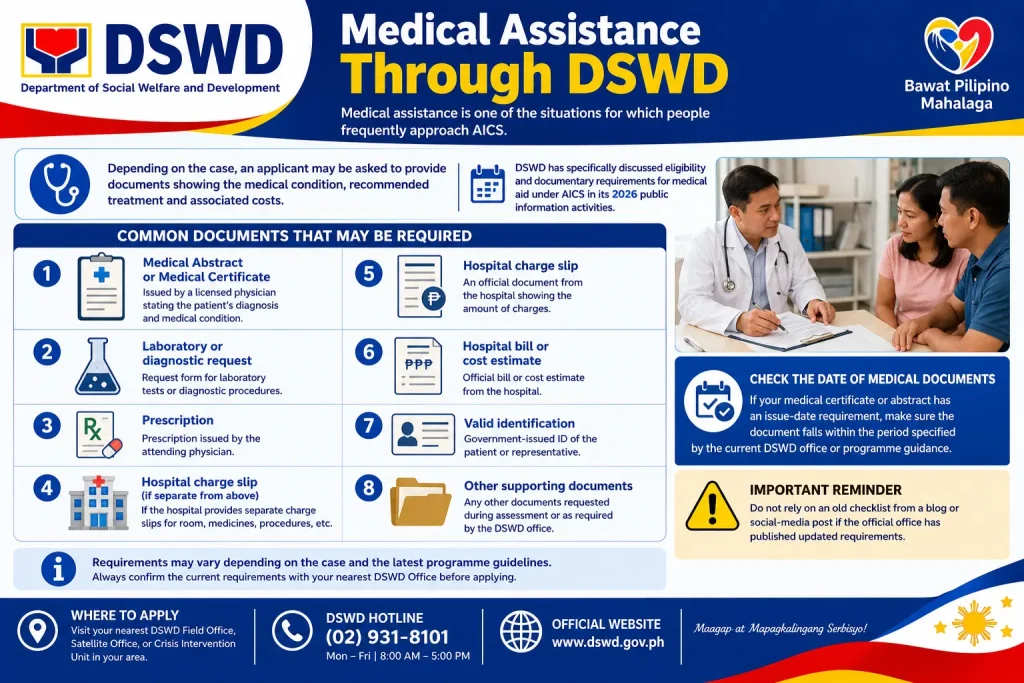
Medical assistance is one of the situations for which people frequently approach AICS.
Depending on the case, an applicant may be asked to provide documents showing the medical condition, recommended treatment and associated costs.
Common documents can include:
- Medical Abstract or Medical Certificate
- Laboratory or diagnostic request
- Prescription
- Hospital charge slip
- Hospital bill or cost estimate
- Valid identification
- Other supporting documents requested during assessment
DSWD has specifically discussed eligibility and documentary requirements for medical aid under AICS in its 2026 public information activities.
Check the date of medical documents
If your medical certificate or abstract has an issue-date requirement, make sure the document falls within the period specified by the current DSWD office or programme guidance.
Do not rely on an old checklist from a blog or social-media post if the official office has published updated requirements.
Educational Assistance: What Applicants Should Prepare
Families may also seek DSWD assistance when educational expenses become difficult to meet.
Depending on the applicable rules and assessment, supporting documents can include a student’s:
- School ID
- Enrolment or registration form
- Assessment of fees
- Other school-issued documents relevant to the request
Educational assistance should not be confused with a general scholarship.
The purpose and eligibility rules depend on the specific DSWD intervention being requested. If you are unsure whether your situation falls under AICS, ask the appropriate DSWD office for clarification before preparing a large number of documents.
Burial Assistance and Funeral Expenses
The death of a family member can create an immediate financial burden, particularly when funeral expenses must be paid while the household is already struggling financially.
For burial assistance, the documents supplied for this guide include:
- Registered Death Certificate
- Funeral Contract
- Statement of Account
- Valid identification and other applicable supporting documents
If someone other than an immediate family member is submitting the request, an Authorisation Letter may also be required depending on the circumstances.
The exact documentary requirements should always be confirmed with the relevant DSWD office before travelling.
What Happens If Someone Else Applies for You?
A representative may sometimes need to file or process a request on behalf of another person.
Where the person filing is not an immediate family member of the beneficiary, an Authorisation Letter may be required.
The representative should also be prepared to provide the documents requested by the DSWD office.
Do not assume that a friend, neighbour or unrelated person can automatically collect assistance on another person’s behalf. Ask the processing office what authorisation and identification are required for the particular case.
DSWD Grievance and Inquiry Tracking
If you have a complaint, inquiry, request for assistance or suggestion involving DSWD services, the department provides the Integrated Grievance Redress Management System (IGRMS).
The current DSWD IGRMS portal provides an online form for filing a grievance and includes options for classifying the concern. After the initial submission, the system instructs users to check their email for a One-Time PIN (OTP), enter the OTP and complete the submission. The portal also provides a facility for checking the status of a ticket using its ticket number.
How to Submit a DSWD IGRMS Concern
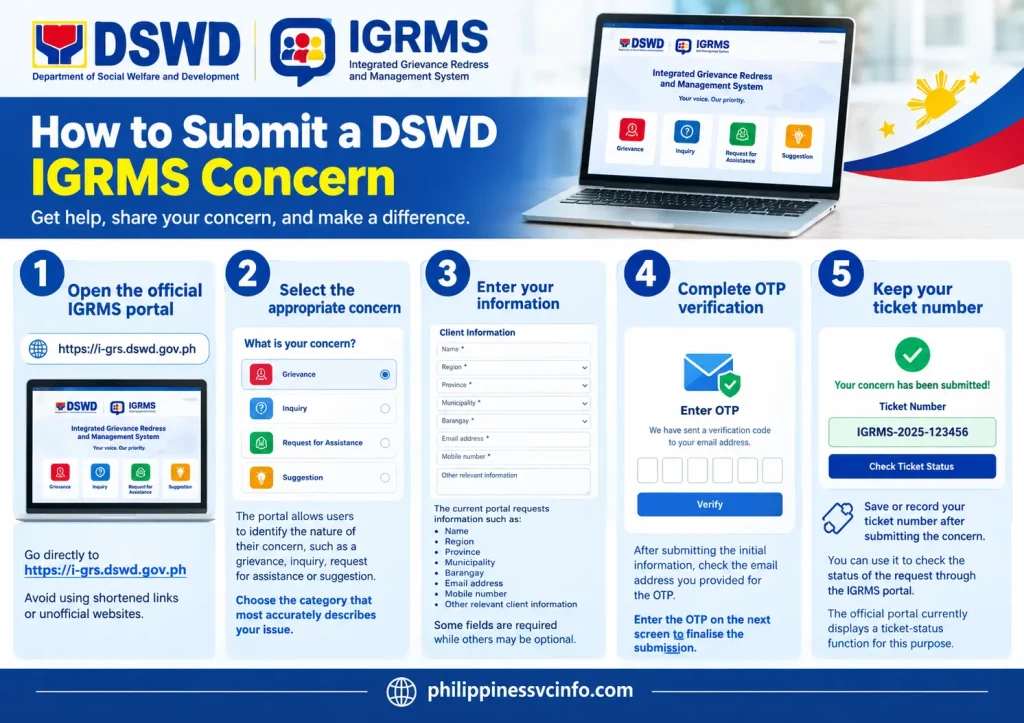
1. Open the official IGRMS portal
Go directly to:
Avoid using shortened links or unofficial websites.
2. Select the appropriate concern
The portal allows users to identify the nature of their concern, such as a grievance, inquiry, request for assistance or suggestion.
Choose the category that most accurately describes your issue.
3. Enter your information
The current portal requests information such as:
- Name
- Region
- Province
- Municipality
- Barangay
- Email address
- Mobile number
- Other relevant client information
Some fields are required while others may be optional.
4. Complete OTP verification
After submitting the initial information, check the email address you provided for the OTP.
Enter the OTP on the next screen to finalise the submission.
5. Keep your ticket number
This is one of the easiest steps to overlook.
Save or record your ticket number after submitting the concern. You can use it to check the status of the request through the IGRMS portal.
The official portal currently displays a ticket-status function for this purpose.
How to Avoid DSWD Application Problems
A large number of avoidable problems come from incomplete information rather than complicated procedures.
Before visiting a DSWD office or submitting an online request, use this preparation checklist.
Your DSWD preparation checklist
✓ Identify the programme
Determine whether your concern relates to AICS, 4Ps, livelihood assistance, disaster response, social pension or another DSWD service.
✓ Prepare the relevant documents
Do not bring unrelated paperwork instead of the documents supporting your actual request.
✓ Bring identification
Keep your valid government-issued ID available where required.
✓ Make copies
For document-heavy applications, prepare photocopies as instructed by the relevant office.
✓ Check names and dates
A spelling mismatch between identification, certificates and other documents can create additional verification work.
✓ Keep records
Take note of application, ticket, reference or appointment numbers when issued.
✓ Use official channels
Start from the DSWD website or an official regional Field Office rather than an unofficial intermediary.
DSWD Contact Information
For general enquiries, the official DSWD e-Services page currently lists the department’s main contact information as:
Landline: (632) 8-931-81-01 to 07
Globe: 0917-110-5686 / 0917-827-2543
Smart: 0919-911-6200
Email: [email protected]
Because government contact details can change, verify current information through the official DSWD website before relying on a number found in an older article.
Official website:
A Note About Changing DSWD Guidelines
Government assistance programmes can be updated through new memoranda, administrative orders and programme guidelines.
That is particularly important for AICS. DSWD’s 2026 issuance page includes new and amended guidelines affecting AICS-related implementation, including a pilot rice subsidy under AICS and guidelines for UPLIFT assistance.
For this reason, applicants should avoid treating a third-party checklist as permanently valid.
A better approach is:
Find the programme → check the current official requirements → prepare documents → contact the appropriate office → attend assessment → follow the release or referral instructions.
This approach is more reliable than relying on an old screenshot or social-media post.
Common DSWD Mistakes Applicants Should Avoid
Using an unofficial website
The Department of Social Welfare and Development has official websites and dedicated service portals. Always verify the domain before entering personal details.
Assuming every programme works the same way
AICS, 4Ps, SLP, Social Pension and disaster-response services have different purposes and rules.
Expecting automatic approval
Submitting documents does not automatically mean that assistance will be granted. Assessment remains an important part of AICS processing.
Bringing incomplete supporting documents
A missing medical document, school record, death certificate or financial document may require additional verification.
Losing your reference number
If you submit a concern through IGRMS, keep your ticket number. It is useful for checking the status of the submission.
Trusting promises of guaranteed DSWD cash
Be cautious of people claiming they can guarantee approval or asking for money to secure government assistance.
Use official DSWD channels and follow the established assessment process.
What to Do After Submitting a DSWD Request
After an application or inquiry has been submitted, keep your documents and reference information organised.
If DSWD asks for additional documentation, respond using the official channel provided to you. If your concern was filed through IGRMS, use the ticket number to monitor its status.
For an AICS application, remember that the next stage may involve assessment, approval, referral, a guarantee arrangement or another appropriate form of intervention depending on the case.
The Department of Social Welfare and Development’s role is not limited to handing out financial assistance. Its wider social protection system includes programmes intended to address immediate crises as well as longer-term household and community needs.
FAQs About the Department of Social Welfare and Development
Official DSWD Links You Should Bookmark
For readers who regularly need government social welfare information, keeping the main official resources available can save time.
| Purpose | Official resource |
|---|---|
| Main DSWD website | dswd.gov.ph |
| DSWD AICS information | AICS information |
| DSWD e-Services | DSWD e-Services |
| Field Office Directory | DSWD Field Offices |
| IGRMS complaints and inquiries | DSWD IGRMS |
| 4Ps official information | Pantawid Pamilyang Pilipino Program |
These links should be treated as starting points. A particular programme may direct applicants to a regional office, specialised portal or local government social welfare office.
DSWD Application Checklist
Before making a trip to a DSWD office, run through this checklist.
Personal preparation
- Identify the exact type of assistance needed.
- Check the current official requirements.
- Prepare a valid government-issued ID.
- Collect programme-specific documents.
- Check names, dates and spellings.
- Prepare photocopies when required.
- Keep your original documents safe.
- Record appointment, application or ticket numbers.
- Use only official websites and verified government channels.
For medical requests
Where applicable, prepare documents such as:
- Medical Abstract or Certificate
- Prescription
- Laboratory or diagnostic request
- Hospital charge slip
- Cost estimate or related billing document
For educational requests
Where applicable, prepare:
- School ID
- Enrolment or registration document
- Assessment of fees
- Other school-issued supporting documents requested by DSWD
For burial requests
Where applicable, prepare:
- Registered Death Certificate
- Funeral Contract
- Statement of Account
- Identification and other required supporting documents
Remember that the checklist is not a substitute for confirmation from DSWD. Requirements can depend on the assistance category, circumstances and current programme guidelines.
How to Choose the Right DSWD Programme
A simple way to understand the different services is to begin with the problem rather than the programme name.
Facing an unexpected personal or family crisis?
→ Investigate AICS.
Part of a qualified household receiving conditional cash transfer support?
→ Check 4Ps requirements and programme information.
Looking for livelihood development or employment facilitation?
→ Explore the Sustainable Livelihood Program.
Concerned about supplementary food for eligible children?
→ Check the Supplementary Feeding Program.
A qualified indigent senior citizen needs monthly support?
→ Check the Social Pension programme.
Family affected by a disaster?
→ Follow official DSWD disaster-response announcements and local coordination.
This approach helps prevent one of the most common mistakes: assuming that every DSWD service is an application for the same type of financial assistance.
DSWD and Local Social Welfare Offices
The Department of Social Welfare and Development works within a wider social protection system that also involves local government units and their social welfare offices.
For some concerns, an applicant may therefore be directed to a Local Social Welfare and Development Office (LSWDO) or another appropriate government service.
That does not necessarily mean the DSWD request has been rejected. A referral can simply indicate that another government office is better positioned to provide the required service.
If you are unsure where your case belongs, explain your situation to the relevant DSWD office and ask which agency or programme should handle it.
What to Do If Your Situation Changes
Circumstances can change while an application is being processed.
For example, a medical bill may increase, a hospital may issue a new statement, a school may update an assessment, or a family may experience another emergency.
Keep new documents and inform the appropriate processing office when necessary.
Do not submit conflicting information across different applications. If something in your circumstances has changed, explain the change clearly and provide supporting documentation when requested.
Stay Alert for DSWD Scams
Government assistance programmes can attract fraudulent offers, especially when people are urgently looking for financial help.
Be cautious if someone:
- Promises guaranteed DSWD approval;
- Asks for a payment to “release” assistance;
- Requests your password or OTP;
- Claims to be a DSWD employee without proper verification;
- Sends an unfamiliar application link;
- Requests sensitive information through an unofficial account; or
- Says you must pay an intermediary to access a government programme.
The safest approach is to verify information through the official DSWD website, Field Office or authorised government service channel.
Never share an OTP simply because someone claims it is needed to process your assistance.
Final Takeaway: Using DSWD Services the Right Way
The Department of Social Welfare and Development provides a broad social protection network covering immediate crisis assistance, household support, livelihood development, child nutrition, disaster response and assistance for qualified senior citizens.
For people facing an unexpected crisis, AICS can be an important avenue for assistance with needs such as medical expenses, education, burial costs, food and transportation. However, applicants should understand that assistance is subject to assessment and applicable programme requirements.
The best starting point is the official DSWD website and the relevant regional Field Office. Prepare accurate documents, keep copies of important records and follow the instructions given by authorised personnel.
For complaints, inquiries and requests submitted through the Integrated Grievance Redress Management System, retain the ticket number so that you can monitor the submission.
Most importantly, avoid unofficial websites and people promising guaranteed assistance. Government programme rules can change, so checking the latest official information before applying is one of the simplest ways to avoid unnecessary delays.
Discover What You Need to Know:
- POEA e-Registration Philippines 2026: DMW Login, Registration, Requirements & OFW Guide
- PNPA Admission Philippines 2026: Requirements, Application & PNPACAT Guide
- CIRAS Philippines 2026 : Login, Registration, Official Website & User Guide
- SALN 2026 Form Philippines: Download, Requirements & Filing Guide