PNPA Admission Philippines 2026: Requirements, Application & PNPACAT Guide
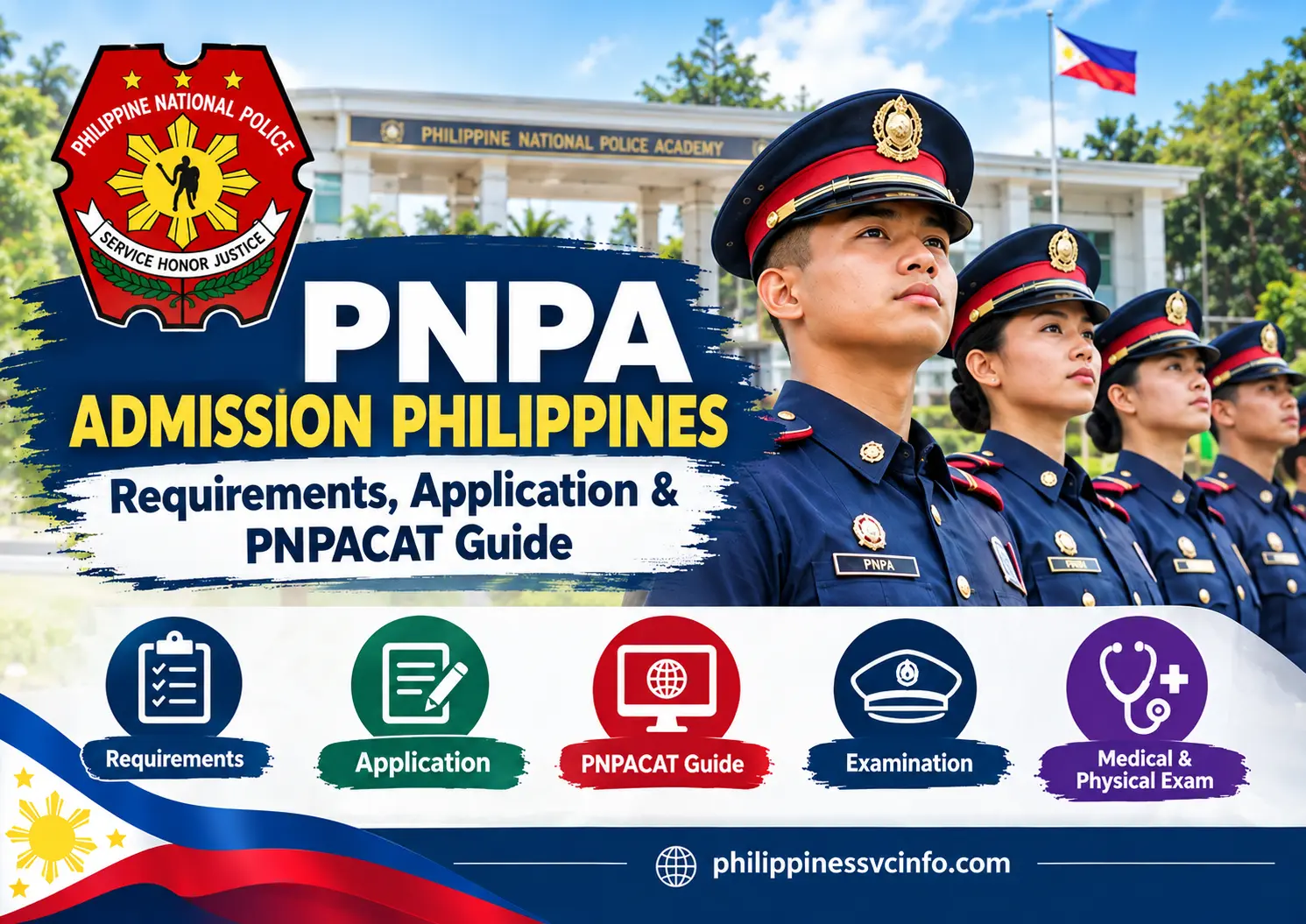
PNPA (Philippine National Police Academy) is a government service academy offering a four-year residential Cadetship Programme. It provides academic education, leadership training, physical development and public-safety preparation, leading to a Bachelor of Science in Public Safety degree and a career pathway within the PNP, BFP or BJMP after graduation.
What Is the PNPA Cadetship Programme?
The PNPA Cadetship Programme is a government-supported officer-development programme based at Camp General Mariano N. Castañeda in Silang, Cavite. Cadets follow a structured residential training environment while completing their academic and professional preparation.
The programme is intended to develop future public-safety officers through a combination of:
- Academic studies
- Physical conditioning
- Leadership training
- Public-safety education
- Law and ethics
- Tactical and operational instruction
- Character development
- Command and management training
The residential nature of the programme is an important consideration. Applicants should understand that PNPA cadetship involves much more than classroom study; it requires adapting to a disciplined training environment and meeting the Academy’s physical, academic and character standards.
What happens after PNPA graduation?
The PNPA pathway is connected with the country’s tri-bureau public-safety services. Depending on the applicable appointment and service requirements, graduates may enter the Philippine National Police (PNP), Bureau of Fire Protection (BFP) or Bureau of Jail Management and Penology (BJMP).
That makes the programme particularly relevant to students who are interested in becoming public-safety officers rather than pursuing an ordinary university degree.
PNPA Requirements You Should Check First
Before creating an application, candidates should compare their personal circumstances with the published qualification standards. For the 2026 admission cycle, the official PNPA announcement listed several core requirements, including citizenship, age, education, civil status, height, physical and mental fitness, moral character and previous service-academy history.
| Requirement | Published PNPA standard for the 2026 cycle |
|---|---|
| Citizenship | Natural-born Filipino citizen |
| Age | 18 to 22 years old before May 1, 2027 |
| Education | At least Senior High School graduate with GWA of 85% or higher |
| Civil status | Single and with no parental obligation |
| Height | At least 5’2″ male and 5’0″ female |
| Physical condition | Must have normal BMI corresponding to age, height, weight and gender |
| Fitness | Physically and mentally fit for rigorous training |
| Character | Good moral character and no disqualifying record |
| Previous academy | Must not be a former cadet of PNPA or another similar service academy |
| Employment history | Must not have been dismissed from government or private employment for cause |
1. Filipino citizenship
Applicants must be natural-born Filipino citizens. This is one of the basic eligibility conditions and should be confirmed before spending time preparing the rest of the application.
2. Age requirement
For the 2026 cycle, PNPA stated that applicants must be 18 to 22 years old before May 1, 2027. This date-specific requirement matters because applicants should not rely on a general statement such as “18 to 22” without checking the admission year and official announcement.
Age rules can change between admission cycles, so future applicants should always check the current PNPA announcement before applying.
3. Educational qualification
The published 2026 requirements specify at least Senior High School graduation and a General Weighted Average (GWA) of 85% or higher. Applicants should therefore make sure their academic record clearly supports the required grade.
If your grades are close to the minimum, don’t assume that an unofficial calculation will be accepted. Use the academic record requested by the Academy and make sure the uploaded copy is clear and readable.
4. Civil-status requirement
The published requirements state that applicants must be single, with no parental obligation. The official 2026 announcement also includes a specific condition concerning pregnancy for female applicants.
Because civil-status and personal eligibility conditions can be sensitive and highly specific, applicants should read the current official notice rather than relying on old social-media posts.
5. Height and BMI
The published minimum barefoot height for the 2026 application cycle was:
- Male: 5 feet 2 inches or 157.48 cm
- Female: 5 feet or 152.40 cm
The Academy also requires a body measurement appropriate to the applicant’s age, height, weight and gender. Its published BMI form is used to record the applicant’s physical measurements.
The BMI requirement deserves early attention. If you are planning to apply, have your height and weight checked properly instead of estimating them at home. The official PNPA BMI form indicates that the measurement is to be completed by an authorised medical professional.
6. Physical, mental and character standards
Being academically qualified does not automatically mean an applicant will pass the entire PNPA selection process.
Candidates must be physically and mentally capable of undertaking rigorous cadet training. The published requirements also include good moral character and restrictions concerning criminal, administrative or civil cases, pending complaints involving the specified grounds, previous service-academy cadetship and dismissal from employment for cause.
This is why applicants should treat the PNPA process as a complete suitability assessment rather than simply an entrance examination.
Documents Needed for a PNPA Application

Preparing documents early can prevent avoidable problems when the online application becomes busy.
For the 2026 cycle, the official PNPA announcement listed these scanned requirements:
- PSA Birth Certificate
- Passport-sized or 2×2 photograph with name tag
- Latest Form 137 or Form 138 showing a GWA of at least 85%
- Active and verified PNPACATOAS account
The Academy specifically instructed applicants to prepare clear scanned copies in JPG, JPEG or PNG format.
How to prepare your files
Before uploading anything, check each document on a computer or large screen.
Your scan should be:
- Clear enough to read every important detail
- Properly oriented
- Free from unnecessary shadows or glare
- Complete rather than cropped
- Saved in the format accepted by the application system
- Matched to the correct applicant
A blurry birth certificate or unreadable school record can create unnecessary delays. It is better to scan the original document carefully before beginning the application than to rush through the upload stage.
Where to Apply for PNPA
The online application is handled through the PNPA Cadet Admission Test Online Application System, commonly referred to as PNPACATOAS/CATOAS.
The official PNPA website directed applicants to pnpacatoas for the 2026 application. It also recommended using a computer where possible and advised mobile users to open the system in an external browser because of heavy traffic.
A safer way to start your application
Don’t begin by clicking a random social-media advertisement or an unofficial “PNPA registration” page.
Use this route instead:
PNPA official website → current admission announcement → PNPACATOAS application system
This gives you a better chance of working from the current admission rules instead of an outdated guide.
How the PNPA Online Application Works

The exact screens and prompts can change between admission cycles, so applicants should follow the instructions displayed in the current portal. The general process, however, starts with creating or accessing the required account and providing the information requested by the Academy.
Step 1: Open the official application portal
Visit the PNPACATOAS website and look for the current registration or application option.
Before entering personal information, confirm that you are on the correct application system. The Academy has repeatedly warned applicants to depend on official PNPA channels for accurate admission information.
Step 2: Prepare your personal information
Have your basic information ready before starting the form. Depending on the portal’s current requirements, this can include identifying information, contact details, educational background and physical measurements.
Enter information exactly as it appears on your official documents.
This small detail matters. A spelling difference between your application and your birth certificate or academic record can create questions later, even when the error was accidental.
Step 3: Add your educational details
Enter your Senior High School information and the academic details requested by the system.
Your academic record should support the minimum 85% GWA requirement stated for the 2026 cycle.
Before moving forward, compare the information you typed against your Form 137, Form 138 or latest accepted academic record.
Step 4: Upload the required files
Upload the requested documents in the correct format.
Take a moment after each upload to check whether the file actually appears correctly in the portal. Don’t assume that selecting a file automatically means the submission has been completed successfully.
Step 5: Review everything before submission
This is the stage where patience pays off.
Check your:
- Full name
- Date of birth
- Gender
- Contact details
- School information
- GWA
- Height and weight
- Uploaded documents
- Selected examination information
The PNPA’s 2026 qualified-examinee notices state that incomplete applications are not processed, while certain minor personal-information errors may be corrected on examination day after proper verification.
That should not be treated as permission to submit careless information. Correct the details before submission whenever the system allows it.
A Practical PNPA Preparation Checklist
Before submitting your application, make sure you can answer “yes” to these questions:
- Do I meet the current age requirement?
- Am I a natural-born Filipino citizen?
- Do I meet the required educational standard?
- Is my GWA at least 85%?
- Do I meet the current minimum height?
- Have I checked my BMI properly?
- Is my PSA Birth Certificate ready?
- Is my ID photograph prepared according to the instructions?
- Is my academic record clear and readable?
- Have I checked every personal detail before submitting?
- Am I using the current official PNPA and PNPACATOAS information?
What Happens After the PNPA Application?
Submitting the PNPA application is only the beginning. Eligible applicants must still go through the Philippine National Police Academy Cadet Admission Test (PNPACAT) and, if they qualify, continue through the succeeding stages of the selection process.
The important point to remember is that meeting the basic PNPA requirements does not guarantee admission. Candidates must successfully progress through the stages set by the Academy.
For the 2026 cycle, PNPA announced that the PNPACAT would be conducted nationwide, with examination centres covering different areas of the country. Applicants were required to indicate their preferred testing location during the application process.
Understanding the PNPACAT
The PNPACAT is the entrance examination used to assess candidates seeking admission to the PNPA Cadetship Programme.
It is designed to test abilities that are relevant to academic study and future public-safety training. Candidates should therefore prepare for more than memorising facts.
Areas commonly associated with the examination include:
- Communication and language skills
- Reading comprehension
- Mathematics
- Logical reasoning
- Abstract reasoning
- General information
- Basic science
- Philippine government and constitutional knowledge
- Current events
The exact examination coverage, instructions and testing arrangements should always be checked against the official admission announcement for the relevant batch.
How should you prepare for the PNPACAT?
A strong preparation plan starts several weeks before examination day.
Rather than studying everything randomly, divide your preparation into subject areas. Spend extra time on topics where your performance is weakest.
For example, an applicant who is comfortable with English but struggles with mathematics should not spend every study session reviewing vocabulary. A balanced routine with additional mathematics practice is more useful.
Build your preparation around four areas
Communication: Practise grammar, vocabulary and reading comprehension.
Mathematics: Review fundamental mathematical concepts, including algebra and geometry.
Reasoning: Work through logical and abstract reasoning questions under time limits.
General knowledge: Review Philippine government, the Constitution, science and relevant current affairs.
Timed practice is particularly useful. Knowing an answer is not enough if you cannot reach it within the examination time.
What Happens If You Pass the PNPACAT?
Passing the written examination does not mean the applicant has already become a PNPA cadet.
Qualified candidates continue to the Academy’s subsequent evaluation and processing stages. These stages are intended to determine whether an applicant is suitable for the demanding residential cadetship environment.
The process can involve physical fitness assessment, medical and dental evaluation, neuro-psychiatric assessment, interview and character investigation.
This is where preparation becomes broader than academic revision.
Physical Fitness Test
Physical fitness is a major part of the PNPA selection process because cadets are expected to cope with demanding training.
Applicants should expect physical activities that assess areas such as:
- Cardiovascular endurance
- Muscular strength
- Agility
- Speed
- General physical conditioning
The supplied admission roadmap identifies exercises such as push-ups, sit-ups, a 100-metre dash and a 3.2-kilometre run as standard events associated with the physical fitness assessment.
A sensible approach is to begin training well before the testing stage.
Don’t wait until you receive a processing notice to start exercising. Gradually improve your running endurance, core strength and upper-body strength while allowing adequate recovery.
A practical fitness approach
If you are currently inactive, begin gradually rather than immediately attempting maximum repetitions.
A basic preparation routine can include:
- Regular walking or jogging.
- Gradual increases in running distance.
- Push-up practice with correct form.
- Sit-up or core-strength exercises.
- Short running intervals for speed.
- Rest and recovery days.
Applicants should also consider obtaining appropriate professional fitness or medical advice before starting an intensive exercise programme.
Physical, Medical and Dental Examination

Applicants who progress beyond the examination and physical stages may undergo a detailed medical and dental assessment.
The supplied PNPA roadmap identifies several areas that may be examined, including:
- Blood tests
- Urinalysis
- Chest X-ray
- ECG
- Dental examination
- Vision assessment
- Colour-perception testing
- General physical examination
The Academy’s medical standards are not something applicants should try to interpret from unofficial social-media posts. If you reach this stage, follow the current PNPA instructions and the forms provided by the Academy.
Vision and colour perception
Vision is another area applicants should take seriously.
The supplied information identifies visual-acuity checking and the Isihara colour-perception test among the assessment areas. Applicants should not assume that passing the written examination means every medical requirement will automatically be satisfied.
If you have concerns about your eyesight or colour perception, an eye examination before the processing stage can help you understand your current condition.
Neuro-Psychiatric Examination
The selection process also considers psychological and behavioural suitability for the responsibilities associated with cadetship.
The supplied roadmap describes the neuro-psychiatric stage as an assessment of areas such as emotional stability, personality and mental capability in demanding situations.
Applicants should approach this stage honestly.
Trying to guess what an examiner “wants to hear” can create inconsistencies. Answer questions truthfully and follow the instructions given by the authorised assessment team.
Panel Interview and Character Investigation
Another important stage is the interview and character assessment.
The purpose is not simply to test how confidently an applicant speaks. Candidates may be assessed on their background, motivation, judgement, communication, character and suitability for a career in public safety.
Questions can naturally vary, so memorising a script is not the best preparation.
Instead, be ready to explain:
- Why you want to join PNPA
- Why public service interests you
- What leadership means to you
- How you handle pressure
- How you respond to mistakes
- What responsibilities you have taken at school or in your community
- Why you believe you are suited to disciplined service
A calm and truthful answer is usually more useful than an impressive answer that doesn’t reflect your actual experience.
How to Check PNPA Exam Results
Once examination and processing stages are completed, applicants need to monitor official channels for updates.
There are three useful places to check:
1. PNPACATOAS account
Log in to the official application system using the credentials associated with your application.
Your dashboard may contain status information or instructions relevant to your application.
2. PNPA official website
The Academy publishes admission announcements and applicant-related information through its official website.
Don’t rely solely on screenshots or forwarded messages. If someone sends you a result through Facebook Messenger or a group chat, verify it against an official PNPA announcement.
3. Official PNPA social channels
PNPA also uses its official social-media channels to communicate admission-related announcements. The Academy has specifically advised applicants to follow its official information channels and avoid relying on unofficial sources.
What Does PNPA Cadet Life Look Like?
The PNPA Cadetship Programme is a four-year residential programme, so successful applicants should understand the lifestyle before accepting a place.
Cadets don’t simply attend lectures during the day and return home afterwards. They live within the Academy environment and follow a structured routine involving academics, physical development, discipline and leadership training.
The four cadet classes generally progress through increasing levels of responsibility.
| Year | Cadet Class | General Development |
|---|---|---|
| Year 1 | Fourth Class | Foundation, discipline and basic training |
| Year 2 | Third Class | Leadership development and technical learning |
| Year 3 | Second Class | Greater responsibility and specialised studies |
| Year 4 | First Class | Leadership, command preparation and Academy responsibilities |
The actual curriculum and training activities are governed by the Academy’s current programme and policies.
Academic and Leadership Development
A PNPA cadet is both a student and a trainee.
The academic side leads towards the Bachelor of Science in Public Safety (BSPS) degree, while the training environment develops practical qualities needed for public-safety service.
Studies and training may cover areas connected with:
- Public safety administration
- Law
- Leadership
- Ethics
- Police and security concepts
- Emergency and public-safety operations
- Physical conditioning
- Character development
The combination is deliberate. A future officer needs academic knowledge, but also judgement, discipline and the ability to work with other people under pressure.
How the Four Years Progress

Fourth Class: Building the foundation
The first year is an adjustment period.
New cadets learn the Academy’s standards, routines and expectations while developing the academic and physical foundations required for later training.
For many students, this is likely to be the biggest lifestyle change they have experienced.
Third Class: Developing leadership
During the second year, cadets move beyond the initial adjustment phase.
Training increasingly involves responsibility, teamwork and leadership development. Cadets continue their academic studies while gaining experience in structured group environments.
Second Class: Greater responsibility
Third-year cadets have more experience with Academy routines and are expected to demonstrate stronger judgement and leadership.
Their education and training can become increasingly focused on the practical responsibilities associated with public safety.
First Class: Senior-cadet leadership
The final year is the stage in which cadets prepare for graduation and transition into professional public-safety service.
Senior cadets may have greater leadership responsibilities within the Academy while completing their academic and professional preparation.
Is PNPA Really Free?
One of the major attractions of PNPA is the government support provided to cadets.
The supplied programme information describes government support covering areas such as:
- Tuition
- Accommodation
- Meals
- Uniforms
- Books
- Medical care
- Training requirements
Cadets also receive government-provided pay or allowances under the applicable budget and government rules.
However, applicants should avoid treating old online posts about exact allowance amounts as permanent figures. Compensation and benefits can depend on current laws, appropriations and government policies.
For the most accurate information, use current PNPA announcements and official government sources.
Why the Financial Support Matters
For many students, the financial structure makes PNPA different from a conventional university programme.
Instead of paying ordinary university tuition and living costs for four years, qualified cadets receive government support while completing their education and training.
That benefit comes with a serious commitment.
PNPA should not be viewed simply as a way to obtain a funded college degree. Cadets are preparing for careers in disciplined public service, where professional responsibilities continue well beyond graduation.
Things Applicants Often Underestimate
The physical requirement
Passing the entrance examination does not mean physical preparation can be ignored.
The residential lifestyle
Living at the Academy means adapting to a structured environment rather than maintaining an ordinary university routine.
The academic workload
Physical training does not replace academic expectations. Cadets must continue performing as students.
The character requirement
Applicants are assessed as future public-safety officers, so integrity and personal conduct matter throughout the process.
The competition
Meeting the minimum requirements makes you eligible to compete; it does not guarantee selection.
A Better Way to Prepare Before Applying
If PNPA is your goal, don’t wait for the application portal to open before preparing.
A practical preparation timeline can look like this:
Several months before application:
Check age, education, height and other eligibility conditions.
Before registration:
Obtain your PSA birth certificate and academic documents.
Before uploading:
Prepare clear digital copies and check the required file formats.
Before the written examination:
Build a regular study routine covering communication, mathematics, reasoning and general knowledge.
Before physical processing:
Improve running endurance, strength and general fitness.
Throughout the process:
Monitor only official PNPA announcements for changes, schedules and instructions.
Key Takeaway for PNPA Applicants
The strongest PNPA applicant is not simply someone who can pass a written test. The selection pathway considers academic ability, physical readiness, medical suitability, psychological fitness, character and leadership potential.
That is why preparation should begin long before the application deadline.
Check the current requirements first. Prepare authentic documents. Train consistently. Keep your information accurate, and monitor the official PNPA channels instead of relying on outdated posts.
What Career Can You Pursue After PNPA?
Graduating from PNPA is intended to lead into a professional career in public safety. Cadets complete the four-year residential programme and work towards the Bachelor of Science in Public Safety (BSPS) degree.
The career pathway is associated with the country’s three uniformed public-safety bureaus:
- Philippine National Police (PNP)
- Bureau of Fire Protection (BFP)
- Bureau of Jail Management and Penology (BJMP)
The applicable appointment, rank and assignment are governed by the current laws, regulations and government policies in force at the time of graduation.
PNPA to PNP, BFP or BJMP
The traditional career pathway can be understood as follows:
| Service | Career pathway described in the supplied information |
|---|---|
| PNP | Police Lieutenant |
| BFP | Fire Inspector |
| BJMP | Jail Inspector |
This is one of the reasons PNPA attracts applicants who already know that they want a career in uniformed public service.
Rather than completing a conventional degree and then separately searching for a government appointment, PNPA combines academic education, professional preparation and cadet training within one structured programme.
What Makes the PNPA Path Different?
There are several significant differences between PNPA and an ordinary university experience.
A funded education
Government support can cover major costs associated with cadetship, including education, accommodation, meals, uniforms and other authorised requirements.
A residential environment
Cadets live and train within the Academy instead of following a normal commuter-student lifestyle.
Professional preparation
The programme is designed around public-safety service, leadership, discipline and command responsibilities.
A structured career pathway
Graduation is connected with entry into one of the tri-bureau public-safety services, subject to applicable appointment rules and requirements.
Long-Term Opportunities
The PNPA pathway is not limited to an entry-level position.
A graduate can build a long-term career within the relevant uniformed service and potentially progress into supervisory, management and executive responsibilities.
The supplied programme information also identifies opportunities for further professional development, including postgraduate education and specialised training.
Career progression, however, should not be understood as automatic. Advancement depends on the applicable service rules, performance, qualifications, vacancies and other government requirements.
Common PNPA Application Mistakes to Avoid
A large part of successful application preparation is avoiding preventable errors.
Mistake 1: Using outdated requirements
PNPA admission requirements can be tied to a particular admission cycle.
An applicant who relies on an old Facebook post may prepare the wrong documents or misunderstand the current age calculation.
Better approach: Check the latest announcement on the official PNPA website before submitting an application.
Mistake 2: Waiting until the deadline
Leaving document preparation until the final days can create unnecessary problems.
PSA documents, school records, photographs and medical forms may take time to prepare.
Better approach: Gather the documents well before the application deadline.
Mistake 3: Uploading poor-quality scans
A document may technically upload while still being difficult to read.
Better approach: Open every scanned file before submitting it. Check names, dates, grades and other important details.
Mistake 4: Guessing physical measurements
Applicants should not estimate their height, weight or BMI simply to complete a form.
Better approach: Have measurements taken properly and use the required PNPA documentation.
Mistake 5: Focusing only on the written examination
Passing PNPACAT is only one part of the wider selection pathway.
Better approach: Prepare academically, physically and mentally from the beginning.
Mistake 6: Trusting unofficial announcements
Social-media groups can be useful for discussion, but they should not be treated as the final authority for admission rules.
Better approach: Verify important information through the official PNPA website and official application portal.
Mistake 7: Giving inconsistent information
Differences between the application form and supporting documents can cause problems during verification.
Better approach: Enter your details exactly as they appear on your official records.
What Should You Do If the PNPA Portal Is Not Working?
Online application systems can experience heavy traffic, particularly close to deadlines.
If the portal is slow or temporarily unavailable, don’t immediately assume your account has been rejected.
Try these practical checks:
- Refresh the page and try again later.
- Use a reliable internet connection.
- Try a modern browser.
- Avoid repeatedly submitting the same form.
- Check whether PNPA has posted a system or deadline announcement.
- Save screenshots of relevant error messages when appropriate.
- Use official PNPA contact or support channels if the problem continues.
Most importantly, don’t create multiple accounts simply because a page fails to load unless the Academy specifically instructs applicants to do so.
What If You Entered Incorrect Information?
The correct response depends on the type of mistake and the stage of the application.
Some information may be editable through the application system, while other details may require verification or correction through PNPA procedures.
The 2026 qualified-examinee information indicates that certain minor personal-information errors could be corrected during examination-day verification, subject to the Academy’s procedures.
Don’t deliberately leave an error because you expect it can be fixed later. Correct information before submission is always the safer approach.
PNPA Frequently Asked Questions
Official PNPA Websites and Resources
For applicants, these are the most important official resources to bookmark:
Use the Academy website for admission announcements, notices, official information and institutional updates.
Use the application system for the online admission process and applicant-related activities.
PNPA admission announcements:
Check the Admissions section and current announcements on the official PNPA website before relying on any dates, qualifications or document instructions.
A useful rule is simple: if an admission detail affects your eligibility, application, examination or processing, verify it through an official PNPA source.
PNPA Application: Final Checklist
Before considering your application preparation complete, review the following checklist.
Eligibility
- Natural-born Filipino citizen
- Within the current age range
- Meets the educational requirement
- Meets the required GWA
- Meets the minimum height
- Meets the applicable BMI and physical standards
- Meets the civil-status conditions
- Meets the character and legal requirements
- Has no disqualifying previous service-academy history
Documents
- PSA Birth Certificate
- Correct ID photograph
- Name tag prepared according to instructions
- Latest acceptable academic record
- Required GWA clearly shown
- Required BMI documentation where applicable
- Digital files are clear and readable
- Files are saved in the accepted format
Online application
- Official PNPACATOAS portal used
- Personal details checked
- Educational information checked
- Physical information checked
- Documents uploaded correctly
- Application reviewed before submission
- Reference or control information safely retained
Examination preparation
- Communication skills revised
- Mathematics reviewed
- Logical and abstract reasoning practised
- General information reviewed
- Current affairs followed
- Physical conditioning started early
After the examination
- PNPACATOAS account monitored
- Official PNPA website checked
- Official announcements verified
- Processing instructions followed
- Physical, medical and other assessments prepared for
A Smart Way to Approach PNPA
The best approach is to treat PNPA as a long-term preparation project rather than a single entrance test.
Start with eligibility. Then organise your documents. After that, prepare academically while building physical fitness. Once the application is submitted, monitor official announcements and be ready for each stage of the selection process.
There is also no advantage in rushing simply because other applicants are discussing the process online. The information that matters is the information published by PNPA and the authorised application system.
Final Thoughts
For a student who wants a career in public safety, the PNPA Cadetship Programme offers a distinctive route combining university education, residential training and professional development.The opportunity is substantial, but so is the commitment. Applicants need to meet the published standards, perform well in the PNPACAT, pass the succeeding assessments and adapt to the discipline of Academy life.If PNPA is your goal, begin with the basics: check the current eligibility rules, prepare genuine and readable documents, build your academic foundation, improve your physical fitness and keep checking the official PNPA channels.Most importantly, don’t rely on an old admission post simply because it appears in a search result. PNPA requirements and schedules are tied to specific admission cycles, so the current official announcement should always be your final reference before you apply.
Discover What You Need to Know:
- CIRAS Philippines 2026 : Login, Registration, Official Website & User Guide
- mBlock 5 Tutorial Philippines 2026: Download, Setup, Coding & Robotics Guide
- LTO CDE Online Validation Exam Philippines 2026: Complete Guide
- FEO System Philippines 2026 : Login, LTOPF Registration, Requirements & Online Services
- SLU Student Portal Philippines 2026 : Login, Enrollment, Grades & Password Reset Guide
- SALN 2026 Form Philippines: Download, Requirements & Filing Guide