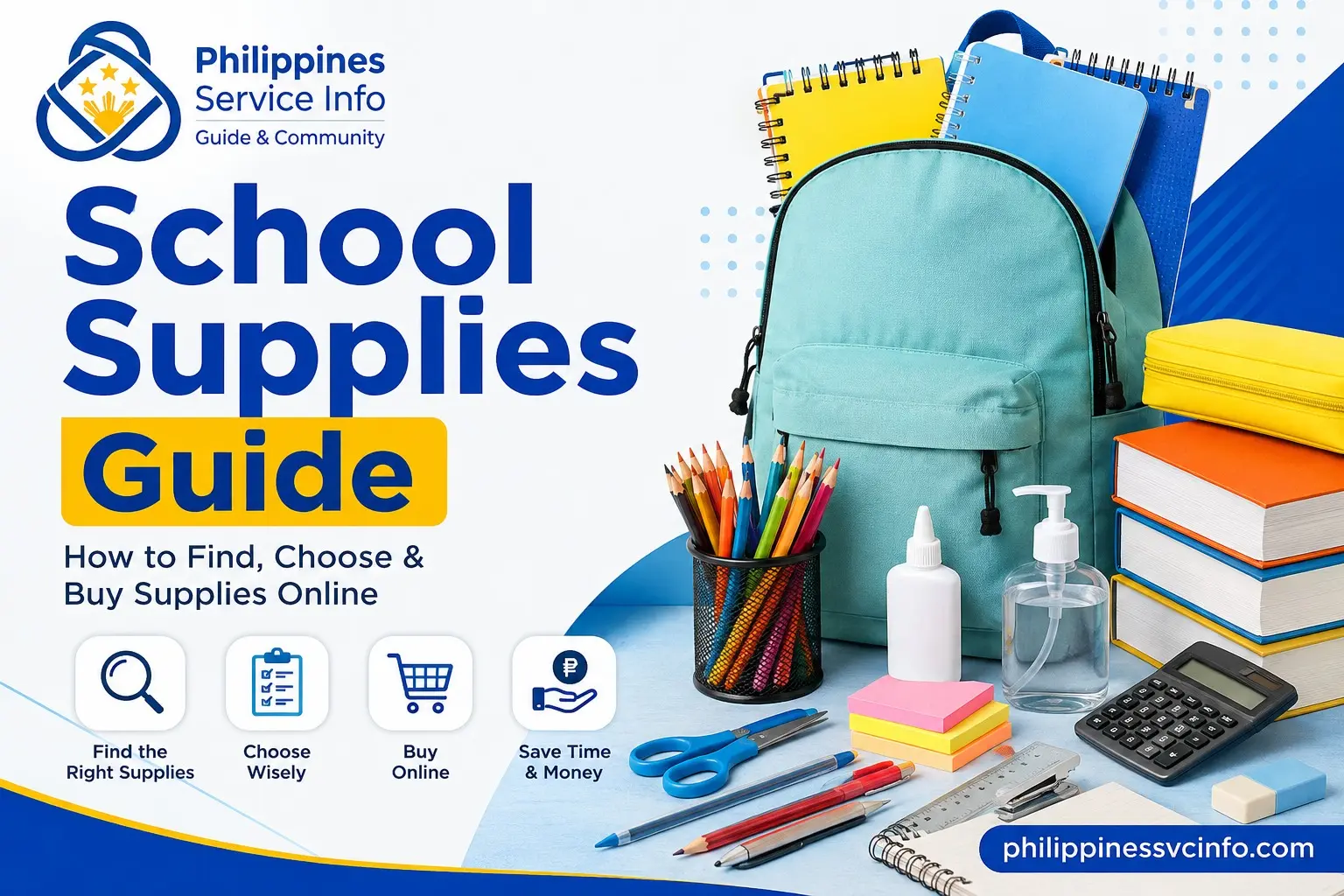
School Supplies: A Practical Guide for Students, Parents and Teachers
Buying school supplies becomes much easier when you know what you actually need before adding products to your basket. A student may only need notebooks, writing tools and a backpack, while a teacher may need classroom materials, storage products, presentation tools and bulk stationery.
The official School Supplies website provides a broad online catalogue organised around different educational needs. You can browse supplies by grade, including K–5, 6–8, 9–12, preschool and teachers, or explore individual categories such as backpacks, binders, calculators, notebooks, pencils, pens, scissors, technology and classroom products.
The smartest approach is not simply to buy more. Start with the requirements for your grade or classroom, check what you already have, then choose durable items that match the way you study or teach.
How to Navigate the School Supplies Website
If you are visiting the site for the first time, the large number of categories can seem overwhelming. A simple browsing process can help you reach the right products without repeatedly searching.
Start With Your Main Need
First decide what type of school supplies you are looking for.
For example:
- Student supplies: notebooks, pencils, pens, folders and backpacks
- Art supplies: crayons, coloured pencils, construction paper and markers
- Classroom supplies: whiteboards, dry-erase markers, organisers and teaching materials
- Math supplies: calculators, rulers and geometry-related tools
- Technology: laptops, tablets, headphones and computer accessories
- Organisation: binders, dividers, folders, storage and planners
The website separates many of these products into dedicated categories, making it possible to shop according to the task rather than scrolling through one enormous list.
Shop by Grade
One of the most useful navigation options is the Supplies by Grade section.
The current website provides shopping routes for:
| Grade/Group | Typical Focus |
|---|---|
| Preschool | Early-learning and activity materials |
| K–5 | Foundational writing, art and classroom supplies |
| Grades 6–8 | Organisation, writing and subject-specific tools |
| Grades 9–12 | Advanced study, mathematics and organisation |
| Teachers | Classroom, teaching and presentation essentials |
This approach can reduce unnecessary purchases because the required school supplies often change as students progress through different educational stages.
What School Supplies Do You Need?
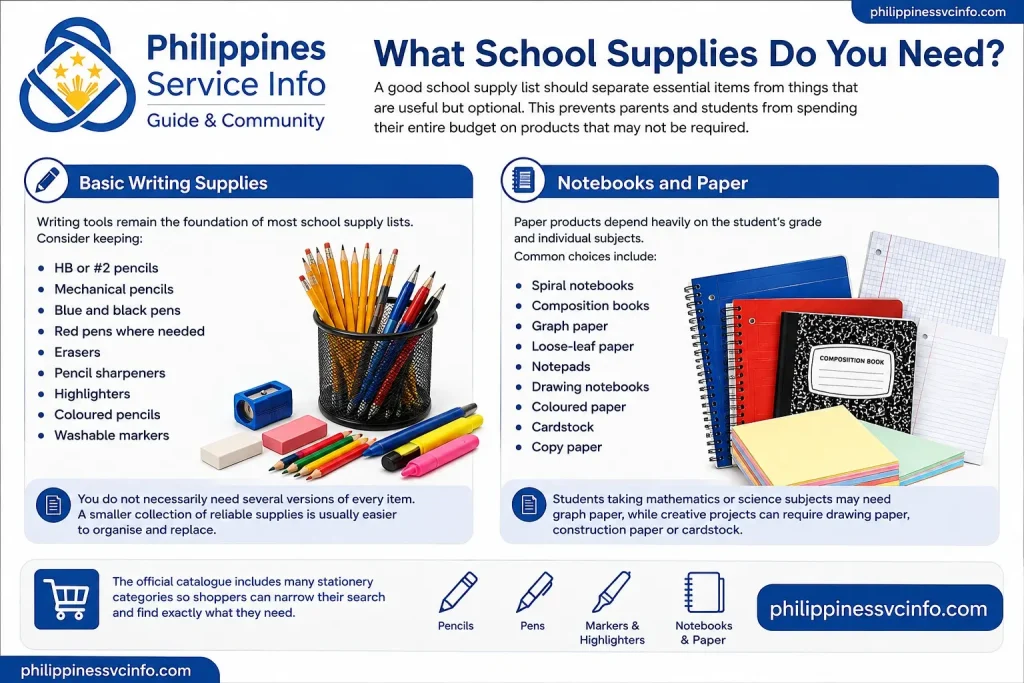
A good school supply list should separate essential items from things that are useful but optional. This prevents parents and students from spending their entire budget on products that may not be required.
Basic Writing Supplies
Writing tools remain the foundation of most school supply lists.
Consider keeping:
- HB or #2 pencils
- Mechanical pencils
- Blue and black pens
- Red pens where needed
- Erasers
- Pencil sharpeners
- Highlighters
- Coloured pencils
- Washable markers
You do not necessarily need several versions of every item. A smaller collection of reliable supplies is usually easier to organise and replace.
The official catalogue includes pencils, pens, markers, highlighters and related stationery categories, so shoppers can narrow their search rather than browsing unrelated products.
Notebooks and Paper
Paper products depend heavily on the student’s grade and individual subjects.
Common choices include:
- Spiral notebooks
- Composition books
- Graph paper
- Loose-leaf paper
- Notepads
- Drawing notebooks
- Coloured paper
- Cardstock
- Copy paper
Students taking mathematics or science subjects may need graph paper, while creative projects can require drawing paper, construction paper or cardstock.
The School Supplies catalogue currently lists several notebook and paper formats, including composition books, graph paper, A4 paper, copy paper, drawing notebooks and other paper products.
Choosing Supplies by School Level
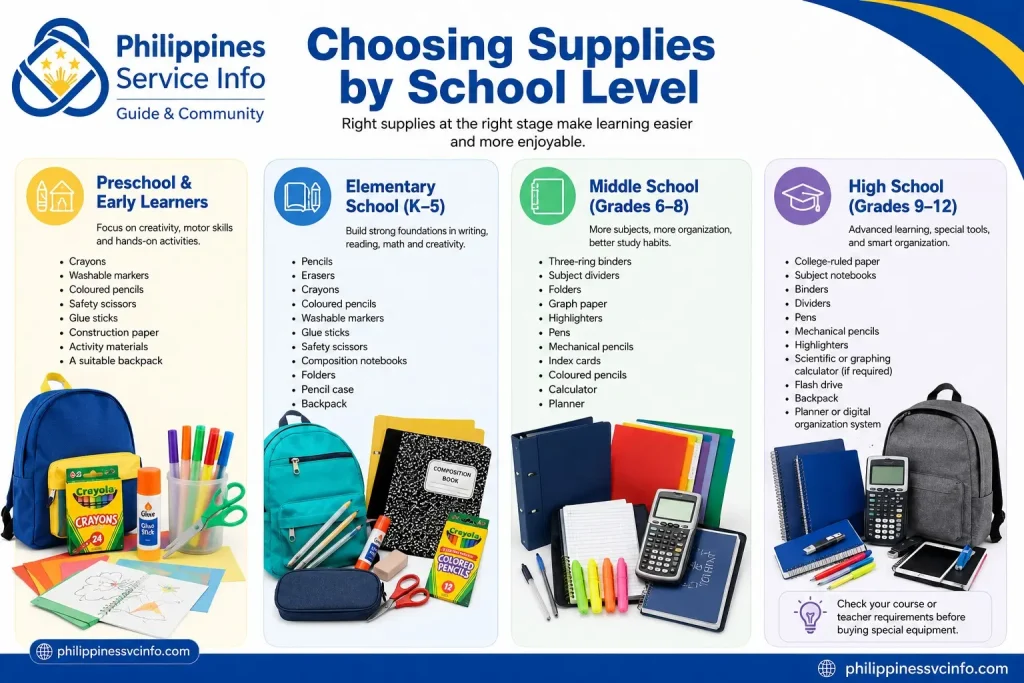
There is no single school supply list that works perfectly for every student. Age, curriculum, teacher instructions and extracurricular activities can all affect what belongs in the shopping basket.
Preschool and Early Learners
Younger children generally benefit from supplies designed around drawing, colouring, cutting and hands-on activities.
A basic collection can include:
- Crayons
- Washable markers
- Coloured pencils
- Safety scissors
- Glue sticks
- Construction paper
- Activity materials
- A suitable backpack
Safety and ease of use matter more at this stage than buying advanced stationery.
Elementary School
For K–5 students, school supplies typically centre on foundational writing, reading, mathematics and creative work.
A practical starting list might include:
- Pencils
- Erasers
- Crayons
- Coloured pencils
- Washable markers
- Glue sticks
- Safety scissors
- Composition notebooks
- Folders
- Pencil case
- Backpack
Rather than purchasing everything in large quantities, check the school’s or teacher’s specific list first.
Middle School
Grades 6–8 often require more organisation because students begin managing several subjects and teachers.
Useful school supplies may include:
- Three-ring binders
- Subject dividers
- Folders
- Graph paper
- Highlighters
- Pens
- Mechanical pencils
- Index cards
- Coloured pencils
- Calculator
- Planner
At this level, organisation becomes nearly as important as the individual stationery items. A good binder system can keep assignments and notes separated by subject.
High School
Students in grades 9–12 may need more specialised equipment depending on their classes.
Possible essentials include:
- College-ruled paper
- Subject notebooks
- Binders
- Dividers
- Pens
- Mechanical pencils
- Highlighters
- Scientific or graphing calculator when required
- Flash drive
- Backpack
- Planner or digital organisation system
Don’t automatically purchase an expensive calculator or electronic device. Check the requirements for the specific course first.
The Core School Supply Checklist
Before checkout, run through a simple checklist.
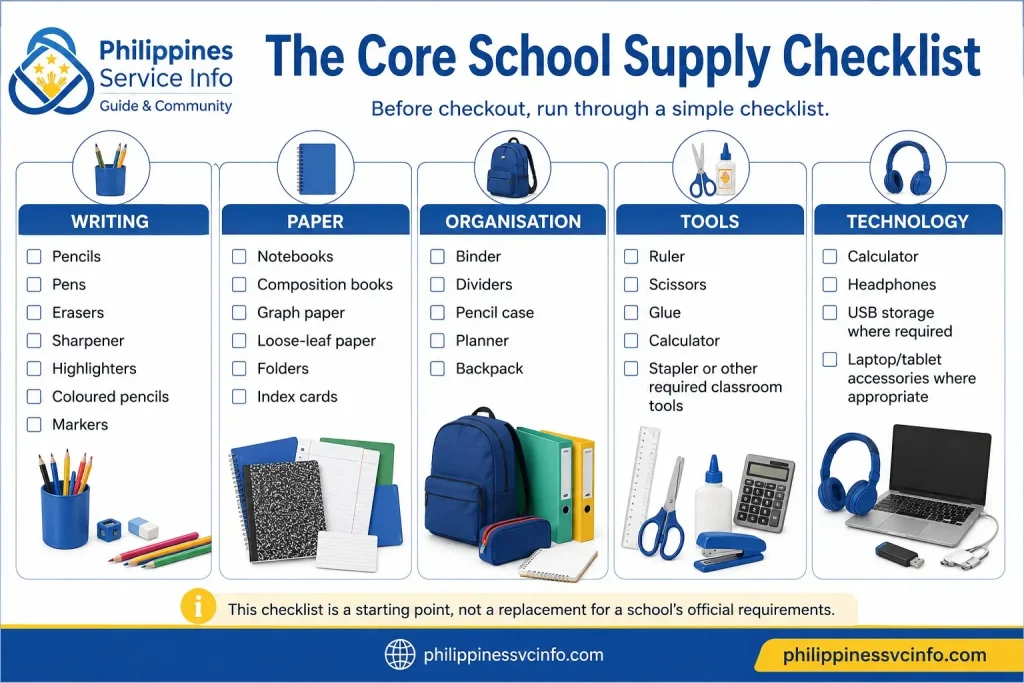
Writing
☐ Pencils
☐ Pens
☐ Erasers
☐ Sharpener
☐ Highlighters
☐ Coloured pencils
☐ Markers
Paper
☐ Notebooks
☐ Composition books
☐ Graph paper
☐ Loose-leaf paper
☐ Folders
☐ Index cards
Organisation
☐ Binder
☐ Dividers
☐ Pencil case
☐ Planner
☐ Backpack
Tools
☐ Ruler
☐ Scissors
☐ Glue
☐ Calculator
☐ Stapler or other required classroom tools
Technology
☐ Calculator
☐ Headphones
☐ USB storage where required
☐ Laptop/tablet accessories where appropriate
This checklist is a starting point, not a replacement for a school’s official requirements.
Where to Find Stationery on School Supplies
If stationery is your main priority, you can narrow your shopping journey to writing and paper-related categories instead of looking through every product.
The website currently includes dedicated sections for Pens, Pencils, Markers & Highlighters, Notebooks & Pads, Binders & Accessories, Glues & Glue Removers, and related school essentials.
For example, the pen category includes ballpoint pens, black pens, colour gel pens and felt-tip pens, while the pencil section includes coloured pencils, art pencils and pencil cases.
This category-based approach is particularly useful when replacing a few missing items rather than rebuilding an entire school supply collection.
How to Build a School Supply Basket Without Overspending
A common mistake is starting with attractive or specialised products before checking the essentials. Instead, use a three-stage approach.
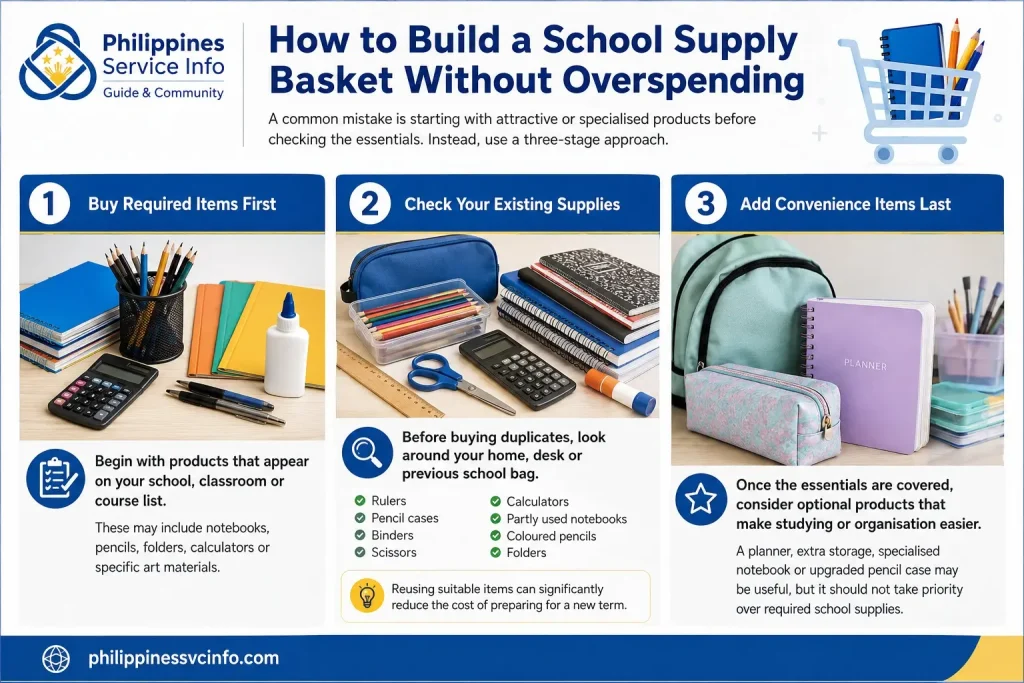
1. Buy Required Items First
Begin with products that appear on your school, classroom or course list.
These may include notebooks, pencils, folders, calculators or specific art materials.
2. Check Your Existing Supplies
Before buying duplicates, look around your home, desk or previous school bag.
You may already have:
- Rulers
- Pencil cases
- Binders
- Scissors
- Calculators
- Partly used notebooks
- Coloured pencils
- Folders
Reusing suitable items can significantly reduce the cost of preparing for a new term.
3. Add Convenience Items Last
Once the essentials are covered, consider optional products that make studying or organisation easier.
A planner, extra storage, specialised notebook or upgraded pencil case may be useful, but it should not take priority over required school supplies.
Classroom Supplies for Teachers and Shared Learning Spaces
Teachers often need a different type of shopping list from students. Instead of purchasing a few individual notebooks or pens, classroom supply planning may involve quantities of frequently used materials, storage products and presentation tools.
A useful classroom inventory should focus on high-use school supplies first. Items that disappear quickly or are shared by many pupils deserve more attention than decorative products that are rarely used.
Everyday Classroom Essentials
A teacher may want to keep the following supplies available:
- Dry-erase markers
- Whiteboard erasers
- Board cleaner
- Pens and pencils
- Sticky notes
- Index cards
- Folders
- File storage
- Clipboards
- Glue sticks
- Construction paper
- Safety scissors
- Markers and coloured pencils
- Tissues
- Hand-cleaning products
- Storage containers
The exact requirements will depend on the classroom, age group and teaching activities. For that reason, it is better to create an inventory based on actual classroom use rather than buying every possible product.
How to Choose School Supplies That Last
Price is only one part of the purchasing decision. A cheaper product that needs to be replaced several times can cost more in the long run than a reasonably priced item designed for regular use.
Look at Construction and Intended Use
Consider how often the item will be handled.
For example, a school backpack carried every day needs different qualities from a folder used occasionally for storing completed assignments. Similarly, a classroom storage box may need to withstand frequent opening and closing.
When comparing school supplies, consider:
- Frequency of use — daily items should be comfortable and durable.
- Storage needs — check whether the product fits your desk, locker or backpack.
- Age suitability — younger pupils may need simpler and safer tools.
- Replacement cost — calculate the long-term value rather than focusing only on the initial price.
- Practicality — avoid features that look attractive but don’t serve a genuine purpose.
Don’t Buy Based on Appearance Alone
Colour, characters and fashionable designs can make school supplies appealing, particularly for younger pupils. There’s nothing wrong with choosing products a student likes, but function should remain the deciding factor.
A sturdy binder that survives a full academic year is generally more useful than a decorative binder that quickly breaks.
Organising School Supplies for Better Study Habits
A well-planned organisation system can make everyday schoolwork less frustrating. Students shouldn’t have to empty an entire backpack to find one worksheet or spend several minutes searching for a pencil.
The solution doesn’t need to be complicated.
Try a Subject-Based System
Give each major subject its own visual identity.
For example:
| Subject | Suggested Organisation |
|---|---|
| Mathematics | Blue folder + graph paper |
| Science | Green binder + dividers |
| English | Red notebook + folder |
| History | Yellow folder + subject notes |
| Art | Dedicated sketchbook + pencil case |
The specific colours don’t matter. Consistency does.
When the same colour appears on a notebook, folder and binder divider, students can recognise the correct subject quickly.
Keep Daily Supplies Separate
A pencil pouch should contain the tools used regularly rather than every stationery item owned.
A daily pouch might contain:
- Two or three pencils
- Two pens
- Eraser
- Highlighter
- Small ruler
- Pencil sharpener
Extra lead, replacement pens, glue and other backup materials can remain at home or in a separate storage compartment.
This reduces clutter and makes the backpack easier to manage.
Building a Better Backpack
A backpack is one of the most frequently used pieces of school equipment, so choosing and packing it carefully matters.
Students often carry notebooks, textbooks, folders, lunch, stationery and sometimes technology at the same time. Poor organisation can make the bag unnecessarily bulky.
Pack According to Weight
Place heavier objects close to the back rather than at the outer edge of the bag.
For example:
Closest to your back
- Laptop or tablet in its protected compartment
- Heavy textbook
- Large binder
Middle area
- Notebooks
- Folders
- Planner
Front or smaller pockets
- Pens
- Pencils
- Calculator
- Small accessories
Avoid carrying supplies that aren’t needed that day.
Weekly Backpack Reset
Choose one day each week to empty the bag completely.
Remove:
- Old rubbish
- Unused worksheets
- Empty packaging
- Broken pencils
- Unnecessary duplicate supplies
Then return the items that actually belong in the backpack.
Ten minutes of organisation can prevent a surprisingly large amount of clutter.
School Supplies for Mathematics and Science
Some subjects require more specialised equipment than basic stationery.
Mathematics Supplies
Depending on the course, students may need:
- Graph paper
- Ruler
- Protractor
- Geometry tools
- Pencil
- Eraser
- Scientific calculator
- Graphing calculator
Don’t assume that every mathematics student needs the most advanced calculator available. Course requirements should determine the purchase.
A calculator is particularly important to check before buying because teachers, schools or examination boards may specify acceptable models or functions.
Science Supplies
Science classes can require a combination of ordinary stationery and subject-specific materials.
Useful general supplies include:
- Lab notebook
- Pens
- Pencils
- Graph paper
- Coloured pencils
- Ruler
- Calculator
- Folder or binder
Some practical classes may provide specialist equipment themselves. Check the course instructions before purchasing anything unusual.
Art and Creative School Supplies
Creative subjects require a different approach to shopping. Students may use drawing, colouring, cutting and construction materials more heavily than standard stationery.
Useful general supplies include:
Common creative supplies include:
- Sketchbooks
- Drawing paper
- Coloured pencils
- Crayons
- Markers
- Construction paper
- Cardstock
- Glue
- Safety scissors
- Craft materials
For younger students, washable and age-appropriate products are particularly practical.
Older students may require more specialised art materials, but these should be purchased according to the assignment or course specification rather than guessed in advance.
Technology as Part of Modern School Supplies
School supplies are no longer limited to paper and stationery. Depending on the educational setting, technology can also form part of a student’s daily equipment.
Possible technology-related items include:
- Laptop
- Tablet
- Headphones
- Laptop sleeve
- USB flash drive
- Charging accessories
- Calculator
However, technology should be treated differently from ordinary stationery.
A laptop or tablet is a significant purchase, so confirm that the device meets the requirements of the school, programme or software being used.
Protect Your Technology
If a student carries a laptop or tablet every day, consider a protective sleeve or suitable compartment. Keeping electronic equipment separate from sharp stationery can also reduce the risk of scratches or damage.
Don’t purchase technology simply because it appears on a general school supplies list. The correct device depends on the educational requirements.
How to Save Money When Buying School Supplies
Preparing for a new school year can become expensive when every item is purchased at once. A little planning can make the budget more manageable.
Use the Four-Question Test
Before adding a product to your basket, ask:
Do I need it?
If it isn’t required and won’t solve a real problem, leave it for later.
Do I already own it?
Check drawers, cupboards and previous school bags before purchasing duplicates.
Will I use it regularly?
A frequently used product deserves more attention than a specialised item used once.
Can I buy it more economically?
For products that are consumed quickly, buying a suitable larger pack may provide better value.
Which School Supplies Are Worth Buying in Bulk?
Bulk purchasing can make sense for frequently consumed products, especially in larger households or classrooms.
Good candidates may include:
- Pencils
- Pens
- Erasers
- Glue sticks
- Printer paper
- Construction paper
- Index cards
- Tissues
- Dry-erase markers
But bulk isn’t automatically cheaper.
Check the cost per item rather than the package price. A large pack may appear inexpensive while offering little real saving.
Storage also matters. Buying a year’s supply of something you have nowhere to keep can create more problems than it solves.
School Supplies Shopping: A Simple Budget Strategy
A three-level budget can make purchasing decisions easier.
Level 1: Required
These are items the student or teacher genuinely needs to start.
Examples include notebooks, writing tools, folders and required calculators.
Level 2: Useful
These improve organisation or convenience but may not be mandatory.
Examples include planners, additional storage and specialised pencil cases.
Level 3: Optional
These are mainly based on preference.
Examples might include decorative stationery, premium designs or duplicate supplies.
This method helps keep school supplies practical while leaving room for personal preferences.
What to Check Before Ordering Online
Online shopping is convenient, but don’t rush through the final stage.
Before placing an order, review:
- Product name
- Size and quantity
- Colour or variation
- Pack count
- Price
- Shipping information
- Return conditions
- Estimated delivery details
- Compatibility for electronic products
For larger orders, double-check quantities carefully. Ordering ten packs instead of one because of a misunderstood quantity description can create unnecessary expense.
A Smarter School Supplies Checklist for Different Buyers
Not everyone needs the same shopping strategy.
| Buyer | Prioritise | Avoid |
|---|---|---|
| Parents | Required items, durability, value | Unnecessary duplicates |
| Students | Daily stationery, organisation | Overloaded backpacks |
| Teachers | High-use classroom materials | Excessive low-use stock |
| University students | Mobility, technology, organisation | Bulky supplies |
| Younger pupils | Safe, easy-to-use products | Advanced tools they don’t need |
This distinction makes a school supplies purchase more efficient because the list reflects the person’s actual learning environment.
Common Mistakes to Avoid
Buying school supplies in bulk can save time and money, but a few common mistakes can lead to unnecessary spending, clutter, or items that are never used. Keep these points in mind before placing a large order.
Buying Before Checking the Existing Inventory
You may already own many of the items on a generic school supply list. Check your cupboards, drawers, storage bins, and previous school supplies first. Reusing usable notebooks, folders, pens, pencils, calculators, art materials, or other supplies can reduce your overall expenses.
Choosing the Cheapest Product Every Time
A low price can be attractive, but the cheapest option is not always the best value. Poor-quality pens may stop working quickly, folders can tear easily, and inexpensive backpacks or storage products may not withstand regular use. Compare price, durability, quality, and expected usage before making a decision.
Buying Too Much Too Early
Course requirements can change, and teachers may request specific materials after classes begin. Instead of purchasing every possible item in advance, start with confirmed essentials and buy specialised supplies when they are actually needed. This helps prevent unused products from piling up.
Ignoring Storage
Bulk school supplies require somewhere to go. Before buying large quantities, consider your available cupboards, drawers, shelves, containers, or classroom storage. Organising supplies by type can also make it easier to find what you need later.
Forgetting Individual Requirements
A generic school supply checklist cannot replace instructions from a school, teacher, or course. Some students may need specialised notebooks, technology accessories, art materials, calculators, lab supplies, or other specific items. If an official supply list is available, use it as your final reference.
Buying Everything From One Store
Although one-stop shopping can be convenient, it may not always provide the best prices or product selection. Compare different retailers for frequently purchased items, especially when buying in bulk. However, consider shipping costs and delivery times so a lower product price does not become more expensive overall.
Forgetting to Compare Pack Sizes
A larger package is not automatically the better deal. Check the price per item when comparing different pack sizes. For example, a 20-pack may appear cheaper than two 12-packs, but the cost per pencil, pen, folder, or notebook may tell a different story.
Not Planning for Replacements
Some supplies are used much faster than others. Pens, pencils, erasers, glue, paper, and certain art materials may need frequent replacement throughout the school year. Keep a reasonable backup supply of everyday essentials without overstocking specialised items.
Failing to Set a Budget
It is easy for a school supply list to grow once you start adding optional products, upgraded versions, and bulk packs. Set a spending limit before shopping and prioritise items according to necessity. This keeps bulk buying practical instead of turning it into an expensive stockpiling exercise.
Making School Supplies Easier to Manage
The best school supplies system is one that remains easy to maintain after the initial shopping trip.
Create one dedicated location at home for replacement stationery. Keep unopened pencils, paper, glue and similar items together rather than scattering them throughout different rooms.
For students, consider maintaining a small emergency supply kit containing replacement writing tools and other frequently forgotten essentials. It can stay at home and be replenished whenever something is used.
Teachers can apply the same principle to classroom stock by separating everyday supplies from reserve inventory.
Quick Organisation Rule
Daily-use supplies stay accessible. Backup supplies stay stored.
That single distinction can keep a desk, backpack or classroom much more manageable.
Official School Supplies Website and Useful Navigation
For the most direct route to available products, use the official School Supplies website:
From there, you can explore the available categories and grade-based shopping options rather than relying on unofficial product pages or third-party descriptions.
When using an online school supply catalogue, always confirm the current product information on the official website before making a purchase.
Frequently Asked Questions About School Supplies
Your Final School Supply Checklist
Before starting a new term, use this master checklist as a starting point.
Writing Supplies
- ☐ HB/#2 pencils
- ☐ Pens
- ☐ Mechanical pencils
- ☐ Erasers
- ☐ Pencil sharpener
- ☐ Highlighters
- ☐ Coloured pencils
- ☐ Markers
Paper and Notebooks
- ☐ Spiral notebooks
- ☐ Composition books
- ☐ Graph paper
- ☐ Loose-leaf paper
- ☐ Drawing paper
- ☐ Index cards
- ☐ Sticky notes
- ☐ Folders
Organisation
- ☐ Binder
- ☐ Subject dividers
- ☐ Pencil case
- ☐ Planner
- ☐ Backpack
- ☐ Storage containers
Classroom and Craft
- ☐ Glue sticks
- ☐ Construction paper
- ☐ Safety scissors
- ☐ Dry-erase markers
- ☐ Whiteboard eraser
- ☐ Clipboards
- ☐ File folders
Mathematics and Technology
- ☐ Ruler
- ☐ Protractor
- ☐ Calculator
- ☐ Laptop/tablet if required
- ☐ Headphones
- ☐ Protective device sleeve
- ☐ USB storage if required
Tip: Don’t automatically purchase every item above. Treat this as a planning checklist and remove anything that isn’t required for your particular grade, course or classroom.
How to Make Your School Supplies Last Longer
Good organisation doesn’t just make schoolwork easier; it can also reduce replacement costs.
Keep pens and pencils in a case instead of allowing them to move loose around the bottom of a backpack. Store paper products somewhere dry and flat, and avoid crushing notebooks under heavy books.
For classroom supplies, label storage containers by category. A teacher can create separate areas for writing materials, paper, art products and reserve stock.
A simple inventory check at the end of each month can also reveal which products are being used quickly and which ones don’t need to be purchased again.
A Practical School Supplies Shopping Routine
Instead of treating school shopping as one large task, divide it into stages.
Stage 1 — Check requirements
Look at the school’s, teacher’s or course’s current list.
Stage 2 — Audit existing items
Collect usable supplies already available at home.
Stage 3 — Create the shopping list
Separate required products from optional ones.
Stage 4 — Browse by category
Use the relevant sections of the official School Supplies website to locate products.
Stage 5 — Compare quantities
Look at pack sizes and calculate the approximate cost per item.
Stage 6 — Review the basket
Remove unnecessary duplicates before placing the order.
Stage 7 — Organise after delivery
Label or group the supplies immediately so they’re ready when needed.
This process turns school supply shopping into a repeatable routine rather than a last-minute rush.
School Supplies for Different Learning Environments
The right supplies can change depending on where learning takes place.
At Home
Home study areas benefit from notebooks, writing tools, paper, folders, storage and a comfortable desk setup. Keep frequently used items within easy reach.
At School
Students generally need portable supplies that can survive daily movement between classrooms. A well-organised backpack and compact pencil case can make a noticeable difference.
At University
University students often need fewer traditional classroom materials but greater mobility. A laptop or tablet, notebooks, folders, planner, writing tools and a suitable backpack may become the core setup.
In a Classroom
Teachers need supplies that support groups rather than one individual. Storage, presentation materials, shared stationery and craft products may therefore take priority.
Official Navigation: Where to Start
If your goal is to explore available school supplies, begin with the official website rather than relying on third-party listings.
From the website, shoppers can explore products according to educational level and supply category. This is especially useful when you know the type of item you need but aren’t sure which section contains it.
For example, someone looking for writing equipment can explore pen, pencil and marker categories, while someone preparing a classroom can focus on teacher and classroom-related products.
Final Buying Advice
Good school supplies don’t need to be complicated. Start with the requirements that actually apply to the student, teacher or classroom, then organise purchases around those needs.
The most effective approach is straightforward: check first, reuse where possible, prioritise essentials, compare quantities and organise everything after buying.
Whether you’re searching for basic stationery, classroom materials, grade-specific products, calculators, backpacks or technology, the official School Supplies website gives you a starting point for exploring available categories and products.
A well-planned supply list saves more than money. It saves time, reduces clutter and makes the transition into a new term much smoother.
Discover What You Need to Know:
- UM Student Portal 2026: Login, Registration, Grades, Payment & Account Guide
- NUIS Portal Philippines 2026: National University Login, Online Application, Student Services & Guide
- Abakada Chart: Complete Guide to the Filipino Alphabet and Abakada.ph 2026
- UM Portal Philippines 2026: Login, Registration, Grades, Fees & Student Services