COMELEC Registration Philippines 2026: Requirements, Steps & Voter Guide
COMELEC registration is the official process for qualified Filipino citizens to become registered voters in the Philippines. It involves meeting citizenship, age, and residency requirements, completing the prescribed application form, submitting valid identification, appearing personally for biometric capture, and undergoing the required review before the voter record becomes active.
What Is COMELEC Registration?
COMELEC registration is the formal process through which a qualified Filipino citizen applies to become a registered voter. During the process, COMELEC collects identifying information and mandatory biometrics, including the applicant’s photograph, fingerprints and signature.
The application is subsequently subject to the applicable Election Registration Board (ERB) process before the registration record becomes active.
A useful point to remember is that an online form does not by itself complete voter registration. Personal appearance and biometric capture remain an important part of the process.
Who Can Apply for Voter Registration?
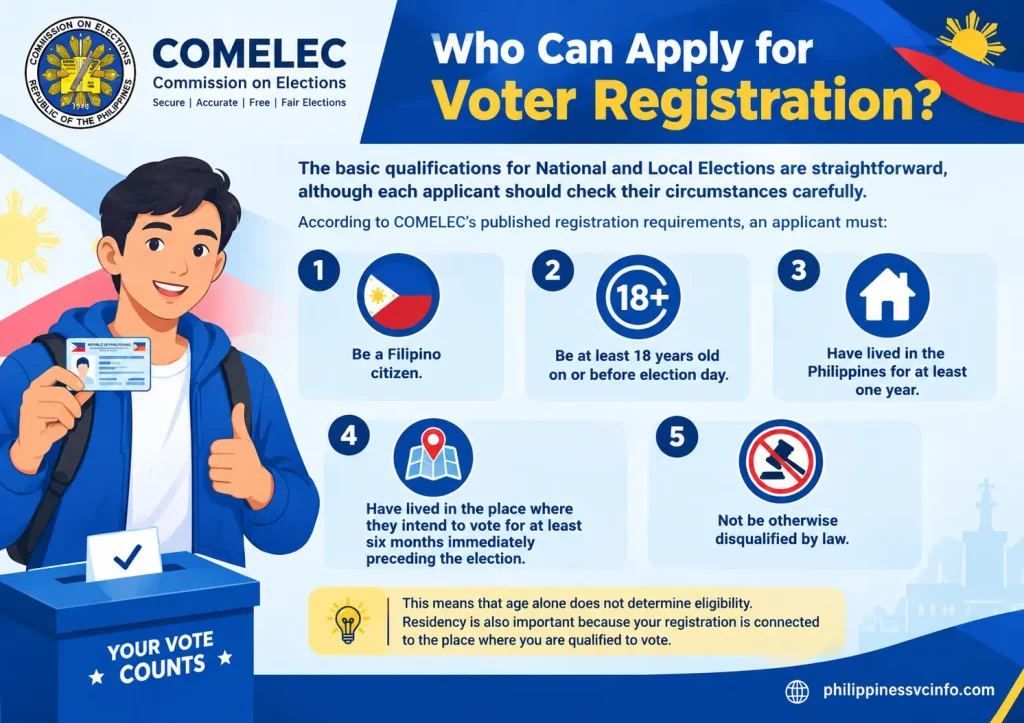
The basic qualifications for National and Local Elections are straightforward, although each applicant should check their circumstances carefully.
According to COMELEC’s published registration requirements, an applicant must:
- Be a Filipino citizen.
- Be at least 18 years old on or before election day.
- Have lived in the Philippines for at least one year.
- Have lived in the place where they intend to vote for at least six months immediately preceding the election.
- Not be otherwise disqualified by law.
This means that age alone does not determine eligibility. Residency is also important because your registration is connected to the place where you are qualified to vote.
What About Naturalised Filipino Citizens?
Naturalised Filipino citizens can be relevant to the same registration framework because the requirement is Filipino citizenship, together with the applicable age, residency and legal qualifications.
Foreign residents who have not acquired Philippine citizenship should not assume that residence in the Philippines gives them voting eligibility. COMELEC registration for Philippine elections is intended for qualified Filipino citizens.
Documents to Prepare Before Applying
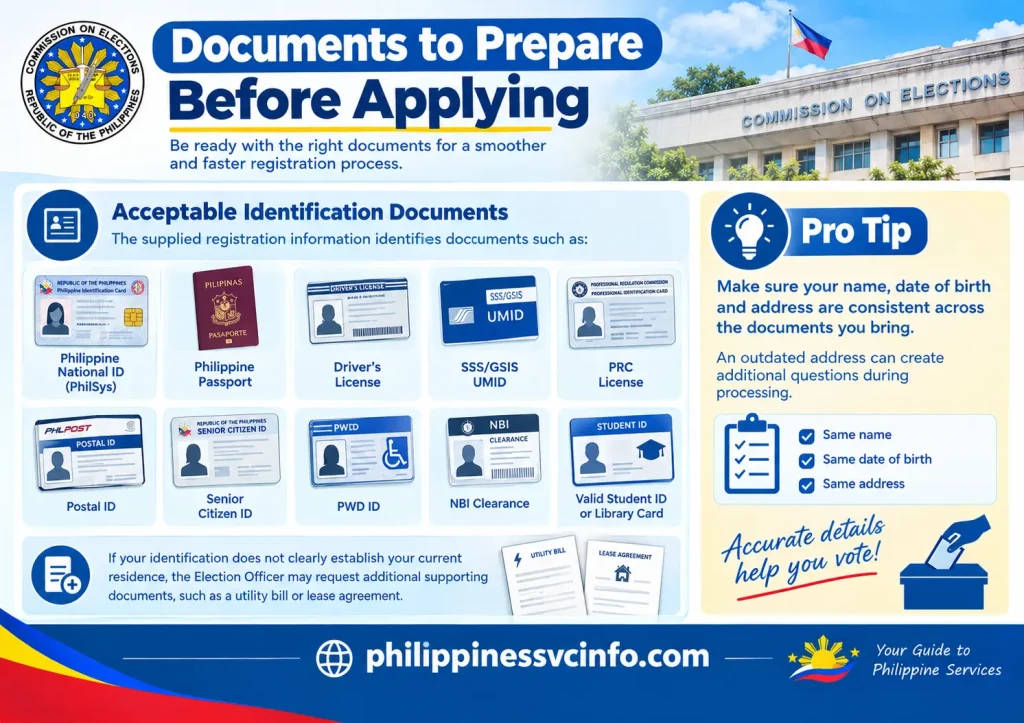
Being prepared can make your visit to the election office much easier. Your application form should contain accurate personal and residential information, and you should bring an acceptable identification document.
The supplied registration information identifies documents such as:
- Philippine National ID (PhilSys)
- Philippine Passport
- Driver’s License
- SSS/GSIS UMID
- PRC License
- Postal ID
- Senior Citizen ID
- PWD ID
- NBI Clearance
- Valid Student ID or Library Card
If your identification does not clearly establish your current residence, the Election Officer may request additional supporting documents, such as a utility bill or lease agreement.
Tip: Make sure your name, date of birth and address are consistent across the documents you bring. An outdated address can create additional questions during processing.
Which Registration Form Do You Need?
The prescribed voter application form is the Revised CEF-1. Current COMELEC materials also show that the form can cover different transactions, including a new registration, transfer of registration, reactivation and correction or change of entries.
COMELEC has also made application forms available through its website and election offices. Its published rules specify long bond paper for downloaded forms.
Before printing, always check the latest version of the form on the official COMELEC website rather than relying on an old copy saved on your computer.
How the COMELEC Registration Process Works
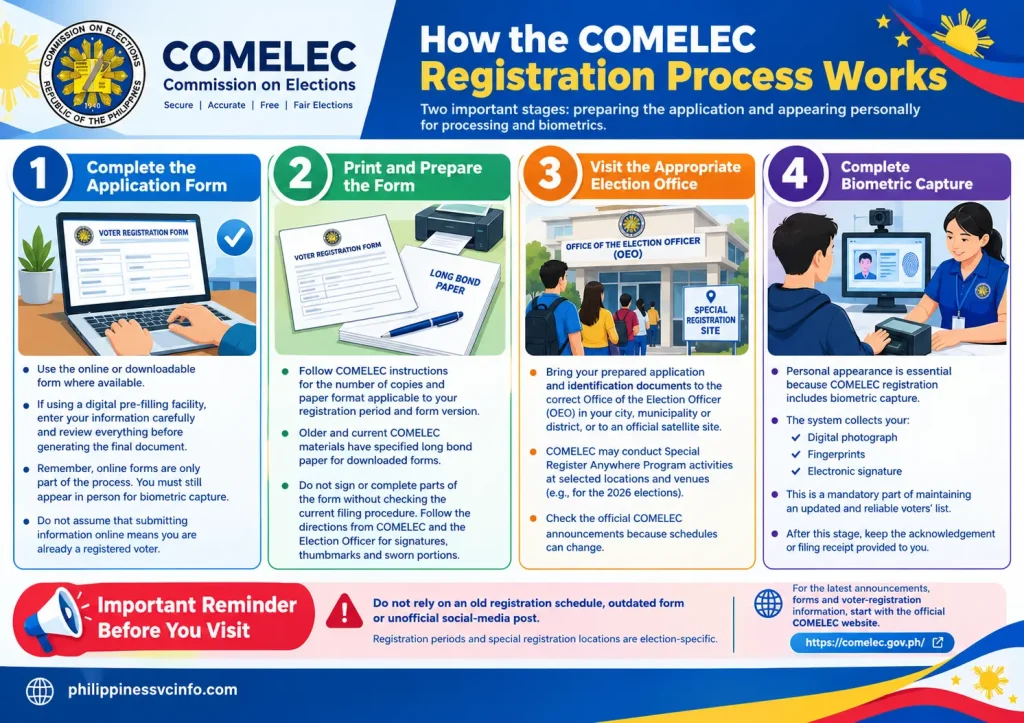
There are two important stages to understand: preparing the application and appearing personally for processing and biometrics.
Step 1: Complete the Application Form
Applicants may use the applicable online or downloadable form process where available. If using a digital pre-filling facility, enter your personal information carefully and review everything before generating the final document.
For online-generated forms, the important point is that the digital preparation is only part of the overall process. COMELEC’s current registration rules emphasise personal appearance and biometric capture as part of voter registration.
Do not assume that submitting information online means you are already an active registered voter.
Step 2: Print and Prepare the Form
Follow the current COMELEC instructions for the number of copies and paper format applicable to your registration period and form version.
Older and current COMELEC materials have specified long bond paper for downloaded application forms.
One common mistake is signing or completing parts of the form without checking the instructions for the current filing procedure. Follow the directions given by COMELEC and the Election Officer, particularly for signatures, thumbmarks and sworn portions.
Step 3: Visit the Appropriate Election Office
Take your prepared application and identification documents to the appropriate Office of the Election Officer (OEO) in your city, municipality or district, or to an officially announced satellite registration site.
COMELEC may conduct special registration activities in other venues. For example, its published 2026 schedules include Special Register Anywhere Program activities at selected locations and venues.
Because these schedules can change, check the official COMELEC announcements before making a trip.
Step 4: Complete Biometric Capture
Personal appearance is essential because COMELEC registration includes biometric capture. The registration system is designed to collect the applicant’s:
- Digital photograph
- Fingerprints
- Electronic signature
COMELEC describes biometric capture as a mandatory part of maintaining an updated and reliable voters’ list.
Once this stage is completed, keep the acknowledgement or filing receipt provided to you. It can be useful when following up on the application.
Important Reminder Before You Visit
Do not rely on an old registration schedule, outdated form or unofficial social-media post. Registration periods and special registration locations are election-specific.
For the latest announcements, forms and voter-registration information, start with the official COMELEC website.
When Can You File a COMELEC Registration Application?
COMELEC registration periods are established through official resolutions and may be adjusted for particular elections. They are not permanently open under one identical timetable every year.
For example, COMELEC Resolution No. 11177 set the registration period for the 2026 Barangay and Sangguniang Kabataan Elections at 20 October 2025 to 18 May 2026 for non-BARMM areas, while the BARMM period was 1 May to 18 May 2026. The same resolution provided specific holiday exceptions and allowed COMELEC to modify or suspend the schedule when necessary.
Therefore, anyone searching for COMELEC registration dates should check the current official schedule instead of relying on an old Facebook post, blog article or screenshot.
What Are the Usual Office Hours?
The published 2026 registration rules specified reception of applications at the Office of the Election Officer from 8:00 AM to 5:00 PM, Monday to Friday, including Saturdays and holidays, except when COMELEC declares otherwise.
Local arrangements can differ when special registration activities are conducted. Always verify the schedule of the particular OEO or satellite venue before visiting.
Where Should You Go for COMELEC Registration?
The normal registration centre is the local Office of the Election Officer (OEO). COMELEC explains that there is an OEO in every district, city or municipality, usually located at or near the city or municipal hall.
If you are unsure where to file your application, use COMELEC’s official field-office information or contact the appropriate local, provincial or regional COMELEC office.
Can You Register at a Satellite Venue?
Yes, COMELEC may conduct satellite or special registration activities to make voter registration more accessible.
COMELEC’s published schedules have included Register Anywhere Program (RAP) and Special Register Anywhere/Anytime Program (SRAP) activities at selected venues. These programmes can include locations outside the applicant’s usual local COMELEC office, depending on the official schedule and applicable rules.
The important distinction is that you should only use a venue officially announced by COMELEC or the authorised local election office.
Do You Need an Appointment?
An appointment is not automatically required for every COMELEC registration transaction nationwide. Registration arrangements can depend on the local OEO and any special programme being conducted.
Some locations may introduce appointment or queue-management systems, while other registration centres may process applicants according to their published office arrangements.
Before travelling, check:
- The current COMELEC announcement
- Your local OEO
- Any official satellite-registration notice
- The applicable registration period
- Required documents
- Whether the location accepts your particular transaction
This is especially useful for students and first-time voters who may have limited time between classes or work.
What Happens to Your Application After Filing?
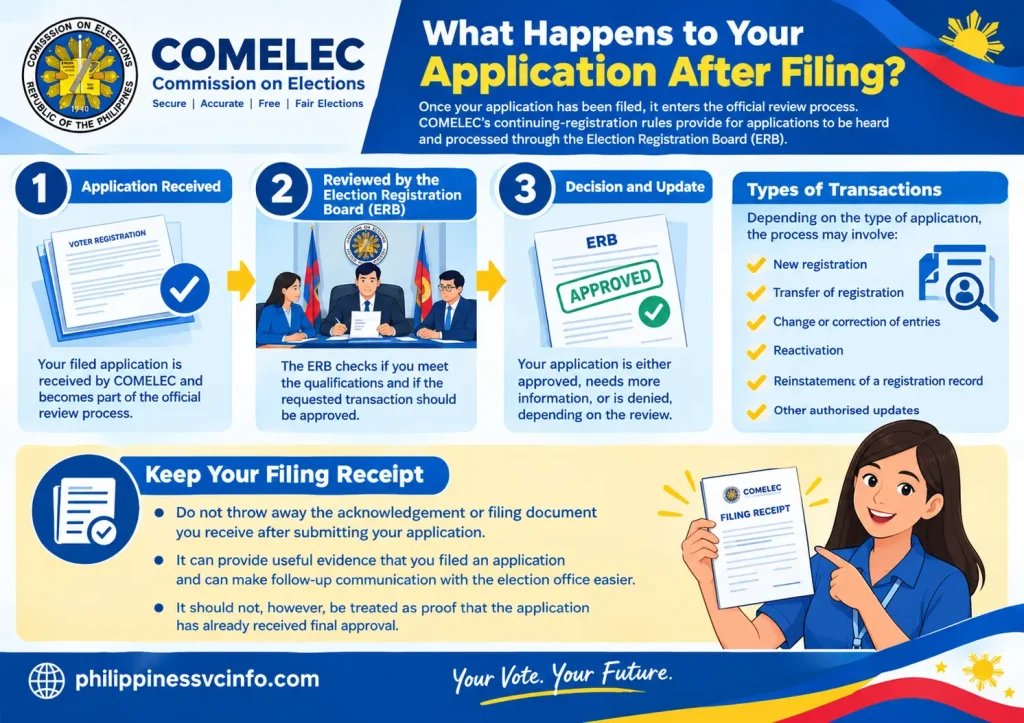
Once your application has been filed, it enters the official review process. COMELEC’s continuing-registration rules provide for applications to be heard and processed through the Election Registration Board (ERB).
The ERB determines whether an applicant meets the applicable qualifications and whether the requested transaction should be approved.
Depending on the type of application, the process may involve:
- New registration
- Transfer of registration
- Change or correction of entries
- Reactivation
- Reinstatement of a registration record
- Other authorised updates
The 2026 ERB records published by COMELEC demonstrate that applications can be classified into different transaction types, including new registration, transfer, reactivation and correction of entries.
Keep Your Filing Receipt
Do not throw away the acknowledgement or filing document you receive after submitting your application.
It can provide useful evidence that you filed an application and can make follow-up communication with the election office easier.
It should not, however, be treated as proof that the application has already received final approval.
How Can You Check Your Registration Status?
One of the most common questions after COMELEC registration is: How do I know whether my application was approved?
The answer can depend on the election period and the particular COMELEC system or verification facility available at the time.
COMELEC publishes approved and disapproved voter lists following ERB proceedings, and the official voter-verification facilities may be activated or updated in connection with elections. For this reason, applicants should use the official COMELEC channels available for the relevant election rather than relying on unofficial status-checking websites.
What If You Moved to a New Address?
Moving does not necessarily mean you need a completely new voter registration.
If you have already registered but have transferred your residence to another city, municipality or district, you generally need to apply for a transfer of registration record rather than creating a duplicate registration.
COMELEC’s registration rules specifically distinguish transfer of registration from new registration. The Election Registration Board determines whether the applicant has actually transferred residence to the place where the transfer application was filed.
Moving Within the Same City or Municipality
A change of address within the same city, municipality or district may also require an update. If the new address results in a different precinct assignment, the registration record may be transferred to the appropriate precinct.
This is why you should not simply register again after moving. Tell the Election Officer that you already have a voter record and need the appropriate change or transfer transaction.
What Is Reactivation of Voter Registration?
A registration record can become deactivated under circumstances provided by election law. A voter whose record has been deactivated may apply for reactivation.
COMELEC Resolution No. 10963 provides procedures for reactivation and also recognises combined transactions, such as:
- Reactivation with correction of entries
- Reactivation with transfer within the same city, municipality or district
- Reactivation with transfer and correction of entries
The Election Officer verifies the applicant’s record and the ERB determines whether the reason for deactivation no longer exists.
Why Is Reactivation Different From New Registration?
A person with an existing but deactivated record should not automatically submit a new-registration application.
The purpose of reactivation is to restore an existing registration record when the applicable requirements have been satisfied. COMELEC’s rules specifically provide a separate procedure for this transaction.
If you are unsure whether your record is active or deactivated, ask your local OEO before filing another application.
How Do You Correct an Error in Your Voter Record?
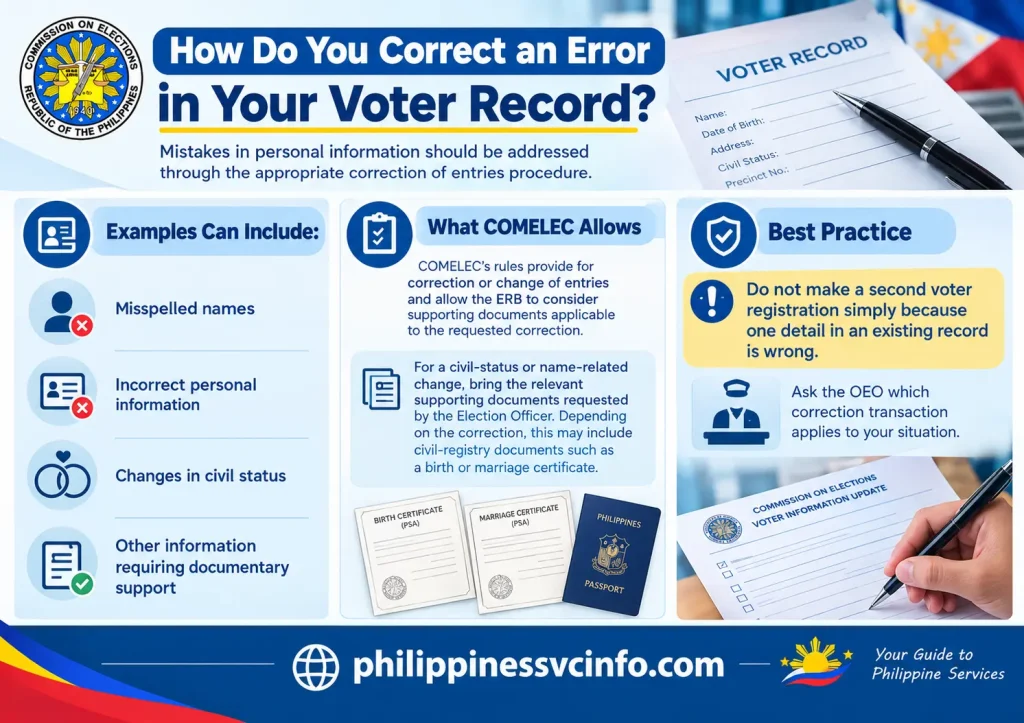
Mistakes in personal information should be addressed through the appropriate correction of entries procedure.
Examples can include:
- Misspelled names
- Incorrect personal information
- Changes in civil status
- Other information requiring documentary support
COMELEC’s rules provide for correction or change of entries and allow the ERB to consider supporting documents applicable to the requested correction.
For a civil-status or name-related change, bring the relevant supporting documents requested by the Election Officer. Depending on the correction, this may include civil-registry documents such as a birth or marriage certificate.
Best practice: Do not make a second voter registration simply because one detail in an existing record is wrong. Ask the OEO which correction transaction applies to your situation.
How Do You Find Your Precinct?
After your registration has been approved and the applicable voter-verification service is available, you can use COMELEC’s official precinct-verification facility to determine your voting information.
The precinct information can help identify the voting centre and assigned precinct relevant to your registration.
However, the availability of online precinct verification can be tied to election schedules. COMELEC has historically made precinct-finder services available around election periods, so a system that is unavailable at one point should not automatically be interpreted as proof that your registration does not exist.
If an online search does not provide a result, contact your local election office and provide your registration or filing information.
Common COMELEC Registration Problems
A few mistakes can create unnecessary delays or confusion.
1. Using an Old Registration Form
COMELEC forms and instructions can change. Download or obtain the applicable form through official COMELEC channels instead of using an old copy saved by a friend.
2. Going to the Wrong Office
Registration centres are organised according to districts, cities and municipalities. Confirm the correct OEO before travelling.
3. Assuming an Online Form Is Final Registration
Digital pre-filling can make preparation easier, but it does not replace the personal processing and biometric requirements applicable to voter registration.
4. Registering Again After Moving
If you already have a voter record and have changed residence, ask about a transfer of registration rather than immediately filing a new registration.
5. Ignoring Official Schedule Changes
COMELEC can modify, suspend or adjust registration schedules when necessary. Its official schedule page is therefore more reliable than an old article or social-media post.
COMELEC Registration: A Practical Checklist
Before leaving for the election office, run through this checklist:
- Confirm that you meet the citizenship, age and residency qualifications.
- Check the current COMELEC registration period.
- Identify your correct OEO or authorised satellite venue.
- Prepare the prescribed application form.
- Bring an acceptable identification document.
- Prepare supporting proof if your address or other information needs verification.
- Follow the Election Officer’s instructions for signatures and biometric capture.
- Keep your acknowledgement or filing receipt.
- Monitor official COMELEC announcements for ERB proceedings and voter-verification services.
A few minutes of preparation can prevent a wasted trip.
What Should First-Time Voters Remember?
For students and other first-time voters, the most important point is to start with the eligibility requirements and then follow the official process in order.
Do not pay someone to “guarantee” approval. Standard voter-registration filing is an official government process, and applicants should deal directly with COMELEC or an authorised registration venue.
Likewise, avoid submitting personal information to websites that merely copy the appearance of government pages. For COMELEC registration, use official COMELEC channels whenever you are asked to provide personal or registration information.
Is COMELEC Registration Free?
Yes. Standard voter registration filing is free. Applicants should not be charged simply for submitting a regular application for initial registration, transfer or reactivation.
Be cautious if someone asks for money in exchange for processing a normal registration application or promises guaranteed approval.
Some other voter-related documents or services may have administrative charges. For example, the supplied information identifies a Voter’s Certification as a document that may involve a minimal processing fee, typically around ₱75.
Because fees and procedures can change, confirm the current charge with the relevant COMELEC office before paying.
Quick Fee Guide
| Service | Typical treatment |
|---|---|
| Initial voter registration | Free |
| Transfer of registration | Free |
| Reactivation | Free |
| Correction/change of entries | Follow applicable COMELEC procedure |
| Voter’s Certification | May carry an administrative processing fee |
The key distinction is between voter registration itself and other documents or services requested after registration.
Common COMELEC Registration Mistakes to Avoid
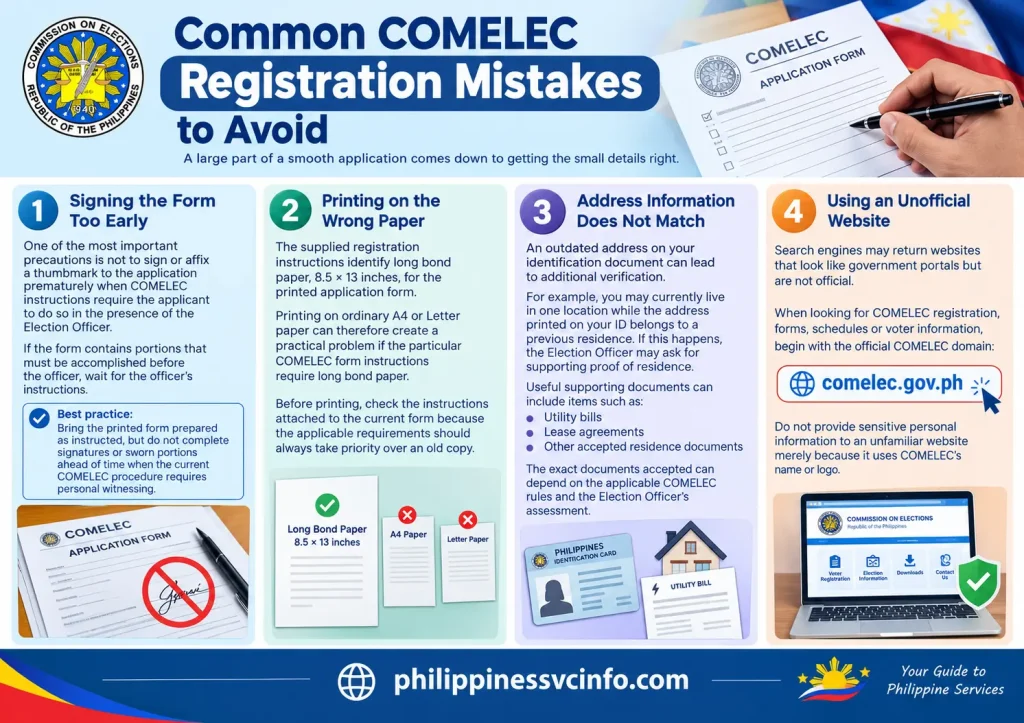
A large part of a smooth application comes down to getting the small details right.
Signing the Form Too Early
One of the most important precautions is not to sign or affix a thumbmark to the application prematurely when COMELEC instructions require the applicant to do so in the presence of the Election Officer.
If the form contains portions that must be accomplished before the officer, wait for the officer’s instructions.
Best practice: Bring the printed form prepared as instructed, but do not complete signatures or sworn portions ahead of time when the current COMELEC procedure requires personal witnessing.
Printing on the Wrong Paper
The supplied registration instructions identify long bond paper, 8.5 × 13 inches, for the printed application form.
Printing on ordinary A4 or Letter paper can therefore create a practical problem if the particular COMELEC form instructions require long bond paper.
Before printing, check the instructions attached to the current form because the applicable requirements should always take priority over an old copy.
Address Information Does Not Match
An outdated address on your identification document can lead to additional verification.
For example, you may currently live in one location while the address printed on your ID belongs to a previous residence. If this happens, the Election Officer may ask for supporting proof of residence.
Useful supporting documents can include items such as:
- Utility bills
- Lease agreements
- Other accepted residence documents
The exact documents accepted can depend on the applicable COMELEC rules and the Election Officer’s assessment.
Using an Unofficial Website
Search engines may return websites that look like government portals but are not official.
When looking for COMELEC registration, forms, schedules or voter information, begin with the official COMELEC domain:
Do not provide sensitive personal information to an unfamiliar website merely because it uses COMELEC’s name or logo.
What If You Cannot Find Your Application Online?
Don’t immediately assume that your application failed.
Online voter-verification tools can be introduced, updated or made available according to election schedules. If the online facility does not return your information, there can be several explanations.
You can:
- Recheck the information you entered.
- Make sure your name and date of birth were entered correctly.
- Check the official COMELEC website for current system announcements.
- Keep your acknowledgement or filing receipt.
- Contact your local Office of the Election Officer if you need confirmation.
The local OEO is particularly important when an application requires manual clarification or when your transaction involves transfer, reactivation or correction.
What If Your Registration Was Deactivated?
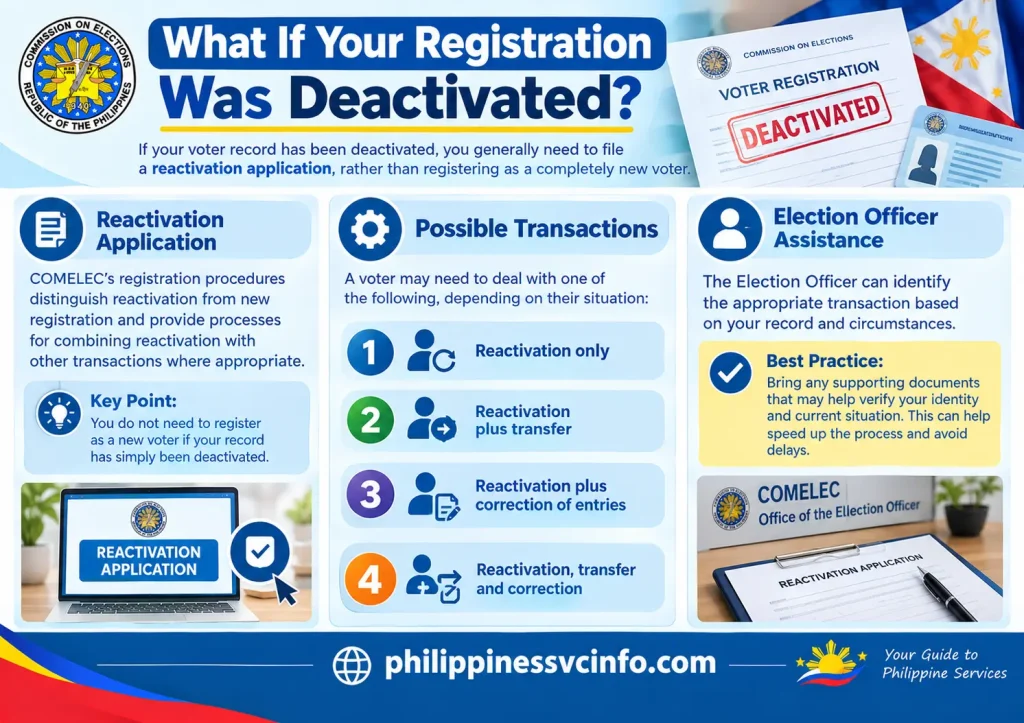
If your voter record has been deactivated, you generally need to file a reactivation application, rather than registering as a completely new voter.
COMELEC’s registration procedures distinguish reactivation from new registration and provide processes for combining reactivation with other transactions where appropriate.
For example, a voter may need to deal with:
- Reactivation only
- Reactivation plus transfer
- Reactivation plus correction of entries
- Reactivation, transfer and correction
The Election Officer can identify the appropriate transaction based on your record and circumstances.
What If You Need to Change Your Name?
A change in personal information should be handled through the appropriate correction or change of entries process.
For a name or civil-status change, you may need supporting civil-registry documentation. Depending on the particular transaction, this can include a birth certificate or marriage certificate.
Don’t create another voter record simply because your existing record contains an error. Ask the OEO how to correct the existing registration.
What If You Move to Another City?
A voter who relocates may need to transfer the registration record to the new place of residence.
This is particularly important if you have moved from one city or municipality to another and want your voting record associated with your new residence.
Prepare proof that supports your new residence and explain to the Election Officer that you already have an existing voter registration.
A duplicate application can create unnecessary complications.
Frequently Asked Questions About COMELEC Registration
Final COMELEC Registration Checklist
Before submitting your application, check the following:
Eligibility
- Filipino citizen
- At least 18 years old on or before election day
- At least one year of Philippine residence
- At least six months’ residence in the place where you intend to vote
- Not otherwise disqualified by law
Documents
- Current prescribed application form
- Acceptable government-issued or other authorised ID
- Supporting proof of residence when required
- Civil-registry documents for applicable corrections
At the Registration Centre
- Follow the current form instructions
- Do not sign restricted portions prematurely
- Submit your application to the proper OEO
- Complete biometric capture
- Check your information carefully
- Keep your acknowledgement or filing receipt
After Filing
- Watch for official COMELEC announcements
- Check the applicable voter-verification service when available
- Contact the OEO if your record requires clarification
- Do not submit a duplicate registration unnecessarily
The Bottom Line
COMELEC registration is the foundation of your voter record in the Philippines. The process is manageable when you first confirm your eligibility, prepare the correct form and identification, visit the appropriate election office, complete biometric capture and retain your filing proof.
The biggest practical mistake is treating an old schedule or unofficial website as current information. Registration periods are tied to election calendars, while local arrangements can vary. For that reason, the safest approach is to verify every time-sensitive detail directly through comelec.gov.ph or your local COMELEC office.
For first-time voters, students and qualified naturalised Filipino citizens, careful preparation can make the application considerably smoother. Check the current rules, bring the right documents and never pay an unauthorised person for a service that COMELEC provides as a standard registration procedure.
Discover What You Need to Know:
- BIR ORUS Philippines 2026: Registration, Login, TIN & Digital TIN ID Guide
- Philippine Statistics Authority (PSA) 2026: Online Services, Certificates, Fees & National ID Guide
- eGov PH and BancNet Online Philippines 2026: Registration, Login, Services & Payment Guide
- POEA e-Registration Philippines 2026: DMW Login, Registration, Requirements & OFW Guide
- PNPA Admission Philippines 2026: Requirements, Application & PNPACAT Guide