Philippine Coast Guard 2026 : Official Website, Services & Contact Guide
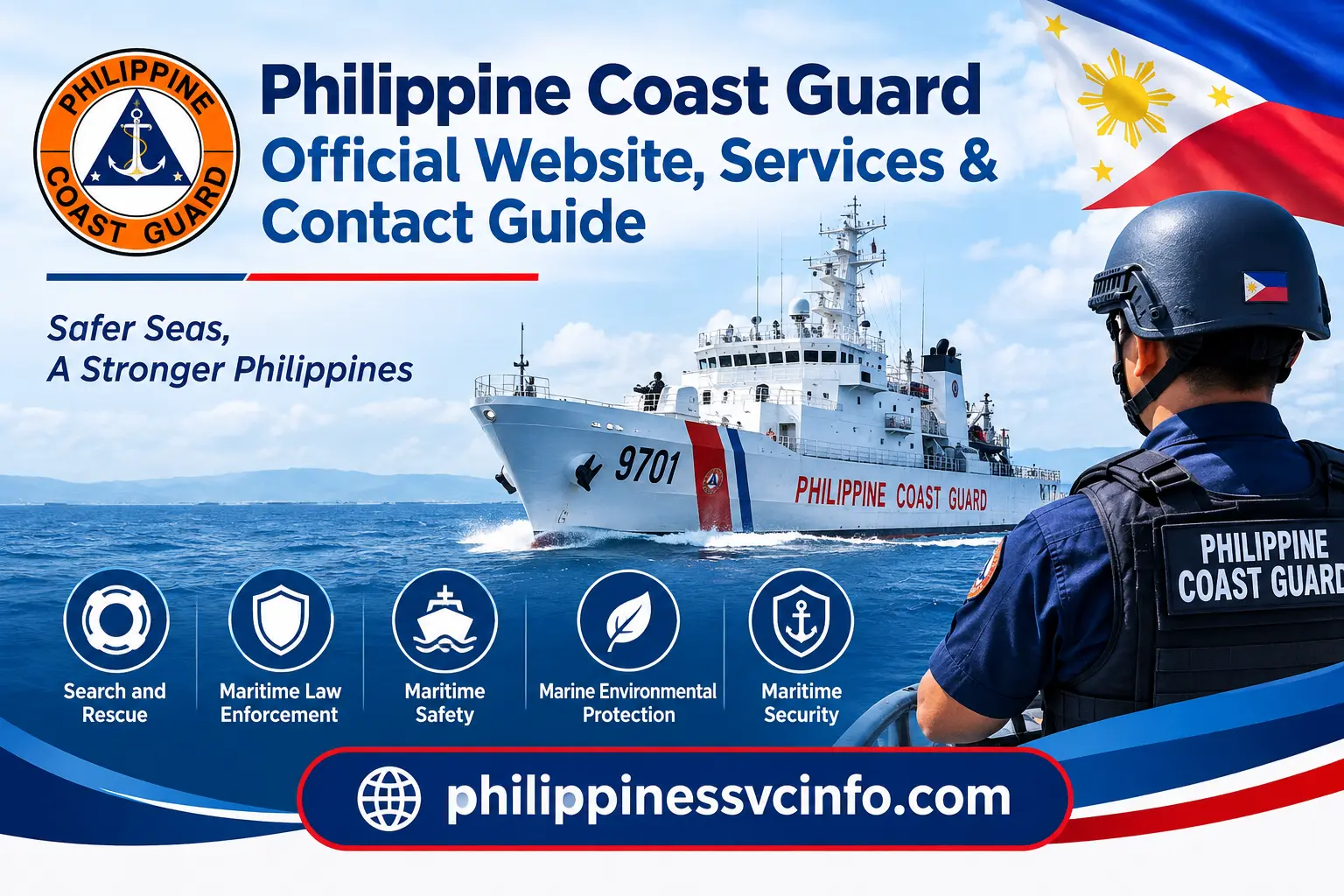
The Philippine Coast Guard (PCG) is a national government maritime service responsible for important functions including maritime search and rescue, maritime law enforcement, maritime safety, marine environmental protection and maritime security. The PCG describes these responsibilities in its official mandate documentation.
For students, foreign residents, researchers, travellers and members of the public, the Philippine Coast Guard official website is an important starting point when looking for verified information about the agency. Rather than relying on social media posts or unofficial websites, users can check the PCG’s own online resources for announcements, agency information, public documents and other official updates.
Quick answer: The Philippine Coast Guard website is the agency’s official online information platform. It can be used to learn about PCG responsibilities, announcements, organisational information, maritime activities and public information resources.
What Is the Philippine Coast Guard?
The Philippine Coast Guard is an armed and uniformed maritime service attached to the Department of Transportation. Its work covers several areas that directly affect safety and security in Philippine waters.
According to the PCG’s published mandate, its responsibilities include maritime search and rescue, maritime law enforcement, maritime safety, marine environmental protection and maritime security.
These functions make the agency relevant to a wide range of situations. A passenger travelling by sea, a researcher studying maritime incidents, a vessel operator, a coastal community and a person reporting a maritime emergency may all need information connected with the PCG.
Main Responsibilities of the PCG
The agency’s principal areas of responsibility can be understood as follows:
| Area | What it involves |
|---|---|
| Maritime Search and Rescue | Responding to maritime emergencies and assisting people in distress at sea |
| Maritime Law Enforcement | Implementing and enforcing applicable maritime laws |
| Maritime Safety | Supporting safer maritime transport and navigation |
| Marine Environmental Protection | Responding to and helping prevent marine pollution and related environmental threats |
| Maritime Security | Supporting the security of Philippine maritime jurisdictions |
The official PCG mandate is the appropriate source when you need the agency’s formal responsibilities rather than a general description from a third-party website.
Why Use the Official Philippine Coast Guard Website?
Searching for Philippine Coast Guard information online can produce news reports, social media accounts, blogs and other third-party pages. These may be useful for background information, but official PCG information should be checked against the government website whenever accuracy matters.
The official site is particularly useful for people who need agency information for study, research or practical purposes.
Information You May Find Through the PCG Website
Depending on the section and current website arrangement, users may encounter:
- PCG announcements and news
- Official statements and press information
- Agency background and organisational information
- Information about maritime activities
- Public documents
- Transparency-related information
- Information associated with PCG units and commands
- Government and public-service resources
The website should therefore be treated as an official reference point rather than simply a news portal.
A Useful Tip for First-Time Visitors
Before entering personal information or relying on a page that claims to represent the Philippine Coast Guard, check the web address.
The official PCG website supplied for this guide is:
coastguard.gov.ph
Use the official domain when looking for agency information, and be cautious with websites that use similar-looking names or unusual domains.
Understanding the Philippine Coast Guard Website
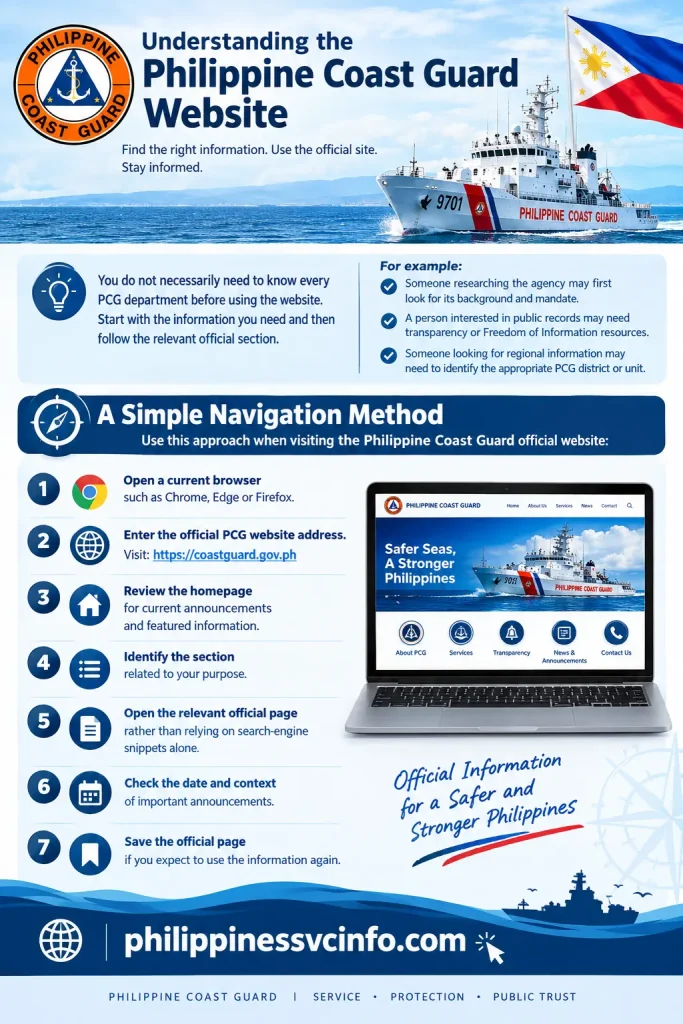
You do not necessarily need to know every PCG department before using the website. Start with the information you need and then follow the relevant official section.
For example, someone researching the agency may first look for its background and mandate. A person interested in public records may need transparency or Freedom of Information resources. Someone looking for regional information may need to identify the appropriate PCG district or unit.
A Simple Navigation Method
Use this approach when visiting the Philippine Coast Guard official website:
- Open a current browser such as Chrome, Edge or Firefox.
- Enter the official PCG website address.
- Review the homepage for current announcements and featured information.
- Identify the section related to your purpose.
- Open the relevant official page rather than relying on search-engine snippets alone.
- Check the date and context of important announcements.
- Save the official page if you expect to use the information again.
This method is especially useful for students and researchers because government websites can contain different types of information in separate sections.
PCG Information for Students and Researchers
Students often need more than a short description of the agency. They may be researching maritime safety, environmental protection, maritime law enforcement, government administration or incidents at sea.
The Philippine Coast Guard also appears as an agency on the Philippine government’s electronic Freedom of Information platform. The PCG’s FOI page contains requests concerning topics such as maritime incidents, organisational information and other government records.
For example, the official FOI platform currently lists PCG-related research requests, including requests concerning maritime incidents and oil-spill information.
How to Use FOI for Research
If information you need is not readily available on the main PCG website, you can check the government’s FOI platform.
A basic process is:
- Visit the official FOI Philippines platform.
- Search for Philippine Coast Guard or PCG.
- Review existing requests before submitting a new one.
- Check whether the information you need has already been released.
- If appropriate, submit a clearly written information request through the platform.
- Keep the request or tracking information for your records.
Not every requested record will necessarily be released. Some information may have restrictions, and actual FOI responses can depend on the nature of the requested material. PCG FOI records show examples where information was only partially released or where security-related information was not disclosed.
Philippine Coast Guard Services and Public Information
The work of the PCG extends beyond emergency response. Its official mandate covers several interconnected maritime functions.
For the general public, this means the agency can be relevant to questions involving:
- Maritime emergencies
- Search and rescue activities
- Maritime safety
- Marine pollution
- Maritime law enforcement
- Maritime security
- Government maritime information
- Public records and research
The PCG’s published mandate confirms these five major areas of responsibility, making them useful topic categories when searching the official website.
Where to Start Based on Your Need
| Your purpose | Useful starting point |
|---|---|
| Learn about the agency | PCG official website |
| Read current agency information | PCG homepage and official announcements |
| Understand PCG responsibilities | Official mandate documents |
| Research government records | PCG FOI page |
| Study maritime incidents | PCG FOI resources and official releases |
| Find public information | Official PCG website and government portals |
The key is to match the source with the question. A news announcement, mandate document and FOI response serve different purposes, so they should not be treated as interchangeable.
Important: Verify Information Before Sharing It
Maritime information can change quickly. An announcement about an operation, weather-related activity, vessel movement or public advisory may be time-sensitive.
When you find information about the Philippine Coast Guard, check:
- Whether the page is on an official government domain
- The publication or update date
- Whether the information is an announcement, report or general background
- Whether the page refers to a particular location or PCG unit
- Whether newer official information has replaced it
How to Find Philippine Coast Guard Districts and Units
The Philippines has Coast Guard commands and stations serving different parts of the country. If you need regional information, start with the official Philippine Coast Guard website rather than relying on an unofficial directory.
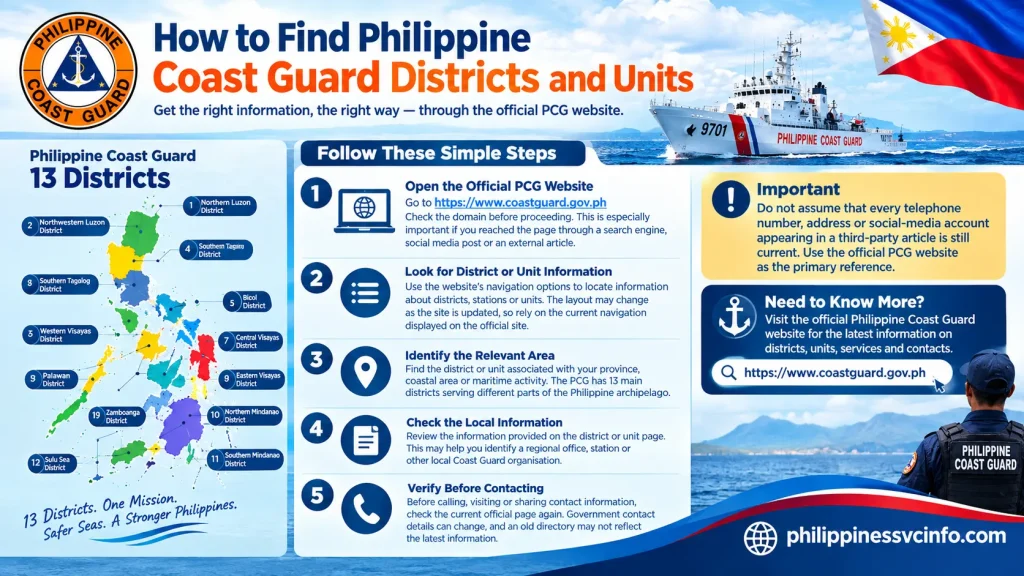
The general process is straightforward:
Step 1: Open the Official PCG Website
Go to:
Check the domain before proceeding. This is especially important if you reached the page through a search engine, social media post or an external article.
Step 2: Look for District or Unit Information
Use the website’s navigation options to locate information about districts, stations or units.
The exact appearance of a government website can change as pages are updated, so users should rely on the current navigation displayed on the official site rather than an old screenshot or third-party tutorial.
Step 3: Identify the Relevant Area
If your question concerns a particular province, coastal area or maritime activity, identify the PCG district or unit associated with that area.
The PCG structure includes regional commands serving different parts of the Philippine archipelago. Your source material identifies 13 main Coast Guard districts.
Step 4: Check the Local Information
Once you locate the relevant district or unit, review the information provided there. Depending on the page, this may help you identify a regional office, station or other local Coast Guard organisation.
Step 5: Verify Before Contacting
Before calling, visiting or sharing contact information, check the current official page again. Government contact details can change, and an old directory may not reflect the latest information.
Important: Do not assume that every telephone number, address or social-media account appearing in a third-party article is still current. Use the official PCG website as the primary reference.
Why PCG District Information Matters
A national agency can have many offices, stations and units. Someone looking for assistance in Manila may not need the same information as someone researching a maritime issue in another part of the Philippines.
Regional information is therefore useful for:
- Identifying the relevant Coast Guard area
- Understanding local PCG organisation
- Finding regional office information
- Researching maritime activities in a particular area
- Determining where a public enquiry may be directed
- Understanding how the national agency operates across the archipelago
For students, this can also provide useful context when studying the geographical reach of the Philippine Coast Guard.
Philippine Coast Guard News and Press Information
The official website can also be used to check information released by the agency.
This is particularly important when researching maritime events. A third-party report may provide a useful summary, but the official PCG source can provide the agency’s own announcement or account.
What to Look For
When reading a PCG news item or announcement, check:
- The publication date
- The title of the announcement
- The location mentioned
- The PCG district or unit involved
- The type of operation or activity
- Whether the information describes an ongoing or completed event
- Whether a newer announcement provides an update
This approach is useful when a student or researcher needs to distinguish an old incident from a current development.
Using PCG News for Research
If you are preparing an academic assignment, avoid copying a headline without reading the underlying information.
Instead:
- Open the original PCG publication.
- Record the publication date.
- Note the main facts relevant to your research.
- Identify the PCG office or unit mentioned.
- Keep the official page as your source.
- Compare information with other authoritative sources when the topic requires broader research.
This creates a clearer research trail and reduces the risk of repeating information that has been taken out of context.
What Is the Transparency Seal?
The Transparency Seal is associated with government agencies’ publication of information intended to support public accountability.
For researchers, transparency information can be useful when studying:
- Government administration
- Public expenditure
- Procurement
- Agency operations
- Institutional accountability
- Public-sector management
The specific documents available can change over time, so users should consult the current official PCG website rather than relying on a static third-party list.
How to Look for Public Documents
A practical approach is:
Official PCG website → Transparency/public information section → Select the relevant document or category → Review the published material
Before using a document in research, check its date and title. A document from an earlier reporting period should not automatically be treated as current.
Research Tip
If you are collecting several PCG documents, create a simple record containing:
| Information to record | Why it helps |
|---|---|
| Document title | Identifies the source |
| Publication date | Establishes the time period |
| PCG page URL | Makes the source easy to revisit |
| Relevant section | Helps locate your evidence |
| Date accessed | Useful for research records |
| Notes | Records the information you actually used |
This is particularly useful for longer university projects or reports.
How to Use the Philippine FOI Portal for PCG Information
Sometimes the information a researcher needs may not be readily available through the main PCG website. In that situation, the Philippine government’s Freedom of Information (FOI) platform can be another official route to investigate available public information.
The official FOI website is:
You can search the platform for Philippine Coast Guard and review information associated with the agency.
Step-by-Step: Searching for PCG Information Through FOI
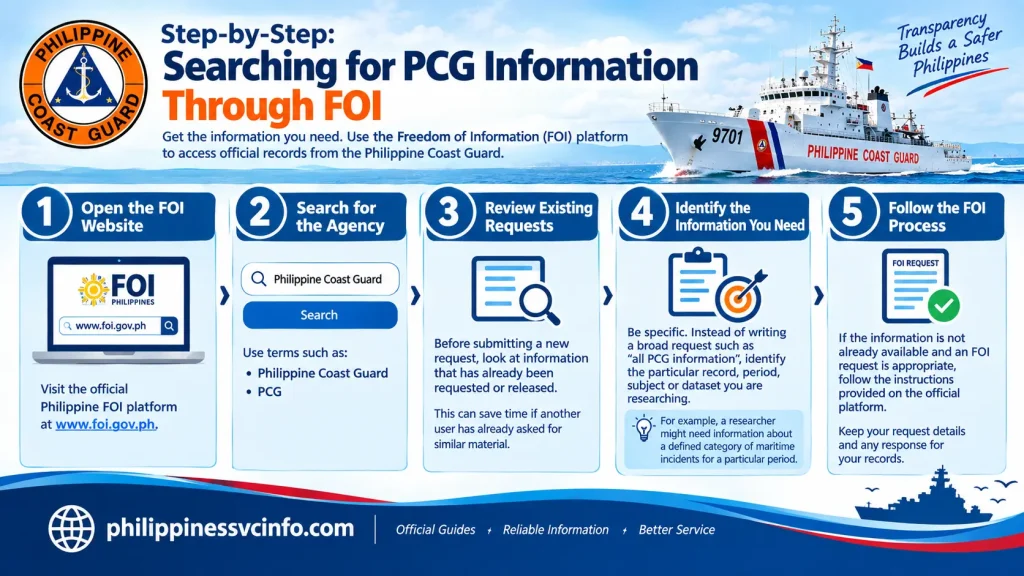
1. Open the FOI Website
Visit the official Philippine FOI platform.
2. Search for the Agency
Use terms such as:
Philippine Coast Guard
or
PCG
3. Review Existing Requests
Before submitting a new request, look at information that has already been requested or released.
This can save time if another user has already asked for similar material.
4. Identify the Information You Need
Be specific. Instead of writing a broad request such as “all PCG information”, identify the particular record, period, subject or dataset you are researching.
For example, a researcher might need information about a defined category of maritime incidents for a particular period.
5. Follow the FOI Process
If the information is not already available and an FOI request is appropriate, follow the instructions provided on the official platform.
Keep your request details and any response for your records.
FOI Does Not Mean Every Record Is Automatically Available
An FOI system provides a mechanism for requesting government information, but that does not mean every requested record must be publicly released without restrictions.
The nature of the requested information matters. Some records may contain information that cannot be disclosed or may require limitations.
For that reason, researchers should avoid promising that an FOI request will produce a particular document before the relevant government office has processed the request.
Philippine Coast Guard Information for Foreign Residents
Foreign residents in the Philippines may encounter the Philippine Coast Guard in situations involving maritime travel, coastal areas, research or other activities connected with Philippine waters.
The safest approach is to identify the purpose of the enquiry first.
For example:
| Situation | Useful approach |
|---|---|
| General agency information | Check the PCG official website |
| Research project | Check PCG publications and government information resources |
| Regional question | Identify the appropriate PCG district or unit |
| Public records research | Review transparency and FOI resources |
| Current agency announcement | Check recent official PCG publications |
| Maritime emergency | Use appropriate emergency channels rather than relying on an article |
A website guide should not be treated as a replacement for emergency communication. If a person is experiencing an immediate emergency, they should use the appropriate emergency service available to them.
How Students Can Research the Philippine Coast Guard
Students can use the PCG website as a primary source when studying government and maritime subjects.
A good research workflow is to begin with the agency’s own description of its role and then move towards specific publications or public records.
Suggested Student Research Workflow
Start with the agency → understand its mandate → identify your topic → locate official publications → record dates and sources → cross-check important claims
For example, a student studying marine environmental protection could first learn about the PCG’s environmental responsibilities, then search for relevant official information or publications.
Likewise, someone studying maritime search and rescue could use the agency’s own information to understand the role of the Coast Guard before examining individual incidents.
Avoid These Common Research Mistakes
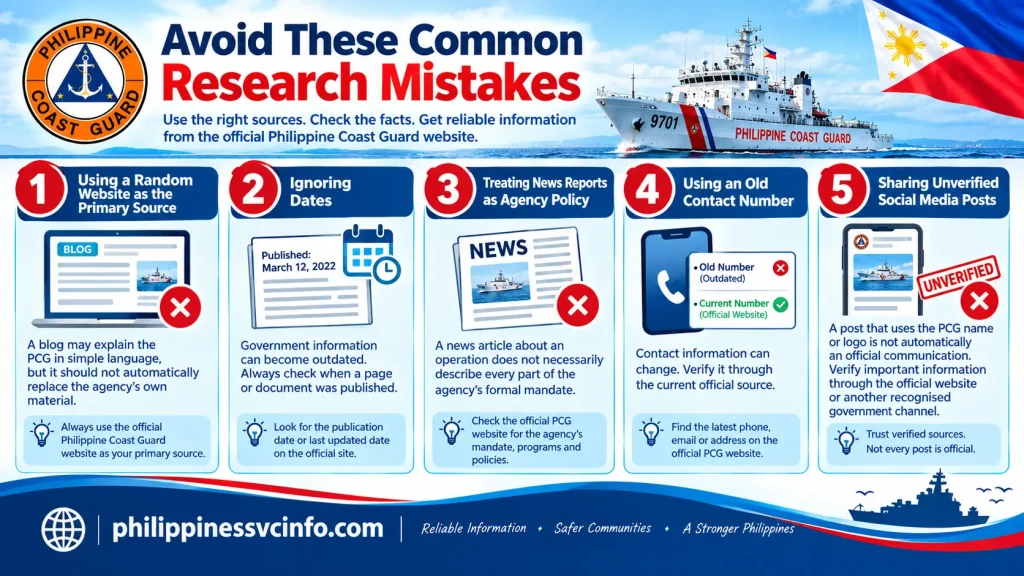
Mistake 1: Using a Random Website as the Primary Source
A blog may explain the PCG in simple language, but it should not automatically replace the agency’s own material.
Mistake 2: Ignoring Dates
Government information can become outdated. Always check when a page or document was published.
Mistake 3: Treating News Reports as Agency Policy
A news article about an operation does not necessarily describe every part of the agency’s formal mandate.
Mistake 4: Using an Old Contact Number
Contact information can change. Verify it through the current official source.
Mistake 5: Sharing Unverified Social Media Posts
A post that uses the PCG name or logo is not automatically an official communication. Verify important information through the official website or another recognised government channel.
Quick Checklist Before Using PCG Information
Before citing or sharing information about the Philippine Coast Guard, ask:
- Did I check the official PCG domain?
- Did I verify the date?
- Did I identify the relevant PCG district or unit?
- Did I read the original document rather than only a summary?
- Is the information still relevant to my question?
- If I need public records, have I checked the official FOI platform?
- Am I distinguishing official information from third-party commentary?
This checklist is particularly useful for academic research and public-information content.
Philippine Coast Guard Official Website and Contact Reference
For general information, begin with the official PCG website:
The supplied reference information identifies the PCG headquarters as:
139 25th Street, Port Area, Manila, 1018 Philippines
For current telephone numbers, office contacts or local station details, users should verify the information through the official PCG website rather than relying on an old directory.
Emergency Situations
A website article should not replace emergency communication.
If you are experiencing an immediate maritime emergency, use the appropriate emergency channels available in the Philippines. The supplied information identifies 911 as the national emergency number and advises coordination with appropriate Coast Guard stations for maritime distress.
For non-emergency questions, use the relevant official PCG information or contact channel instead of treating an emergency line as a general enquiry service.
How to Check Whether a PCG Website Is Official
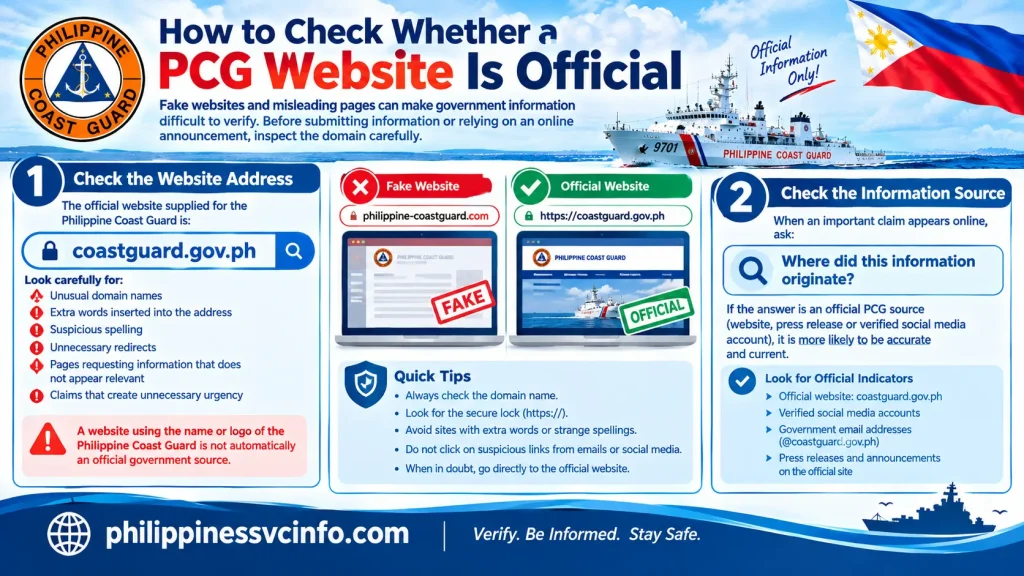
Fake websites and misleading pages can make government information difficult to verify. Before submitting information or relying on an online announcement, inspect the domain carefully.
Check the Website Address
The official website supplied for the Philippine Coast Guard is:
coastguard.gov.ph
Look carefully for:
- Unusual domain names
- Extra words inserted into the address
- Suspicious spelling
- Unnecessary redirects
- Pages requesting information that does not appear relevant
- Claims that create unnecessary urgency
A website using the name or logo of the Philippine Coast Guard is not automatically an official government source.
Check the Information Source
When an important claim appears online, ask:
Where did this information originate?
If the answer is an official PCG announcement or government document, open the original source. If the information comes only from an unidentified social media account, verify it before sharing.
Philippine Coast Guard Website: Best Practices for Users
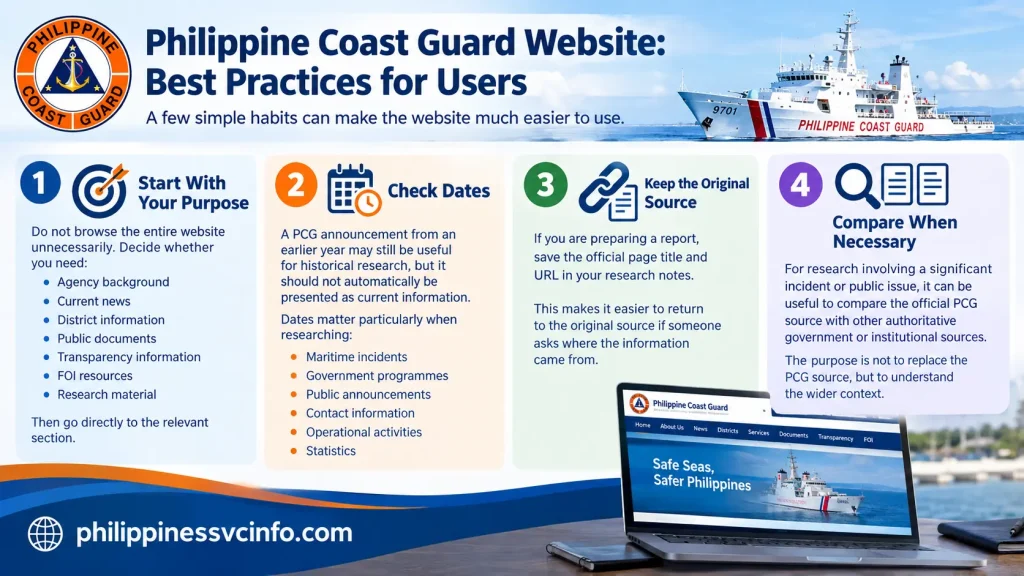
A few simple habits can make the website much easier to use.
1. Start With Your Purpose
Do not browse the entire website unnecessarily. Decide whether you need:
- Agency background
- Current news
- District information
- Public documents
- Transparency information
- FOI resources
- Research material
Then go directly to the relevant section.
2. Check Dates
A PCG announcement from an earlier year may still be useful for historical research, but it should not automatically be presented as current information.
Dates matter particularly when researching:
- Maritime incidents
- Government programmes
- Public announcements
- Contact information
- Operational activities
- Statistics
3. Keep the Original Source
If you are preparing a report, save the official page title and URL in your research notes.
This makes it easier to return to the original source if someone asks where the information came from.
4. Compare When Necessary
For research involving a significant incident or public issue, it can be useful to compare the official PCG source with other authoritative government or institutional sources.
The purpose is not to replace the PCG source, but to understand the wider context.
Philippine Coast Guard FAQs
Philippine Coast Guard Research Checklist
Before publishing information about the PCG, run through this final checklist:
Source Verification
- Official PCG domain checked
- Original source opened
- Publication date checked
- Relevant PCG district or unit identified
- Information distinguished from third-party commentary
Research
- Official documents retained
- FOI portal checked when appropriate
- Historical information labelled by date
- Current information rechecked before publication
Safety
- Emergency information is clearly distinguished from general enquiries
- Unverified social-media claims are not presented as official
- Old contact details are not assumed to be current
Official Links
| Resource | Official link |
|---|---|
| Philippine Coast Guard | https://www.coastguard.gov.ph/ |
| Philippine FOI Portal | https://www.foi.gov.ph/ |
| PCG FOI Agency Page | https://www.foi.gov.ph/en/agencies/pcg/ |
Final Reminder
When searching for Philippine Coast Guard information, start with the official government website and verify the date and source of important material. For research or public-record questions, the official FOI platform can provide another route to government information.
The most reliable workflow is simple: identify your purpose, find the relevant official PCG source, check its date, verify the information and keep the original source for reference.
Discover What You Need to Know:
- Bangko Sentral ng Pilipinas 2026 : Official Website, Services, Regulations & Consumer Guide
- LTFRB Philippines 2026 : Complete Guide Requirements, Registration, Franchise & Renewal
- PAIS Admin Philippine 2026: PNP Login, Registration, Website & Access Guide
- BFP Payslip Online 2026: Login, Download, Salary, Deductions & Payroll Guide
- DOH Philippines Guide 2026: Department of Health Services, Online Portal, Registration & Login
- PAIS 2026: Complete Guide to Tambos, PIAS, Services & Official Website