Silliman University is a private university in Dumaguete City, Philippines, offering undergraduate and graduate programmes across diverse fields. It provides admission pathways for local and international students, academic programmes, scholarships, student services, online portals, registrar assistance, and residential facilities to support students throughout their university journey.
What Is Silliman University?
Silliman University is a Philippine university offering undergraduate and graduate education across a wide selection of academic fields. Its programmes cover areas such as business, computer studies, engineering, health sciences, agriculture, environmental and marine sciences, arts and sciences, theology, public affairs and the performing and visual arts.
The exact admission requirements can depend on the applicant category and intended programme. A student applying as a first-year undergraduate may have a different set of requirements from a transferee or international applicant.
That distinction matters because some programmes also have higher academic thresholds, qualifying examinations or interviews.
Who Can Use This Guide?
The information is particularly useful for:
- Filipino students preparing for university admission
- International students considering study in the Philippines
- Parents helping applicants prepare credentials
- Transferees researching admission procedures
- Students looking for Silliman University courses
- Applicants who need information about the student portal
- Students planning for accommodation and campus life
Before Applying: Know Which Applicant Category You Belong To
The first step is to identify your admission category. Requirements can differ depending on whether you are entering university for the first time, transferring from another institution, or applying as an international student.
For a typical first-year undergraduate application, applicants should prepare their academic records and supporting documents before beginning the online process.
The supplied admission information indicates that first-year applicants should have a Grade 12 report card (Form 138/SF9) showing a general average of at least 80%, together with copies of Grade 11 grades from both semesters.
Some degree programmes have a higher academic requirement. These include fields such as:
- Accountancy
- Architecture
- Engineering
- Nursing
- Medical Technology
- Pharmacy
- Computer Studies
For these programmes, the stated general-average requirement is 85% or higher.
Documents First-Year Applicants Should Prepare
Having your documents ready before starting the application can make the process smoother.
| Requirement | What to Prepare |
|---|---|
| Academic record | Grade 12 Form 138/SF9 and Grade 11 grades |
| General average | At least 80% for the stated general requirement |
| Programme-specific average | 85% or higher for listed programmes |
| Good Moral Certificate | School and community/Barangay certificates |
| Birth record | PSA/NSO document or equivalent official record |
| Photographs | Recent passport-size photos with white background |
Foreign applicants should also prepare documents appropriate to their nationality and educational background.
Admission for International Students
International applicants need to plan for additional documentation because overseas academic records and identity documents may require authentication.
A valid passport copy is one of the stated requirements. Applicants may also need authenticated transcripts or school-leaving certificates, including Apostille or equivalent authentication where applicable.
English-language preparation can also be relevant. The supplied information lists examples such as:
- IELTS: overall score of 6.0 or above
- TOEFL iBT: 77 or above
These scores are described in the supplied material in connection with English orientation requirements, so international applicants should confirm the current requirement for their particular situation with the university.
An international admission application also includes a stated US$100 non-refundable admission fee, payable through the designated university banking arrangement.
Important: International students should verify document authentication, language requirements, payment instructions and immigration-related requirements directly with Silliman University before sending documents or making payments.
How to Apply to Silliman University Online
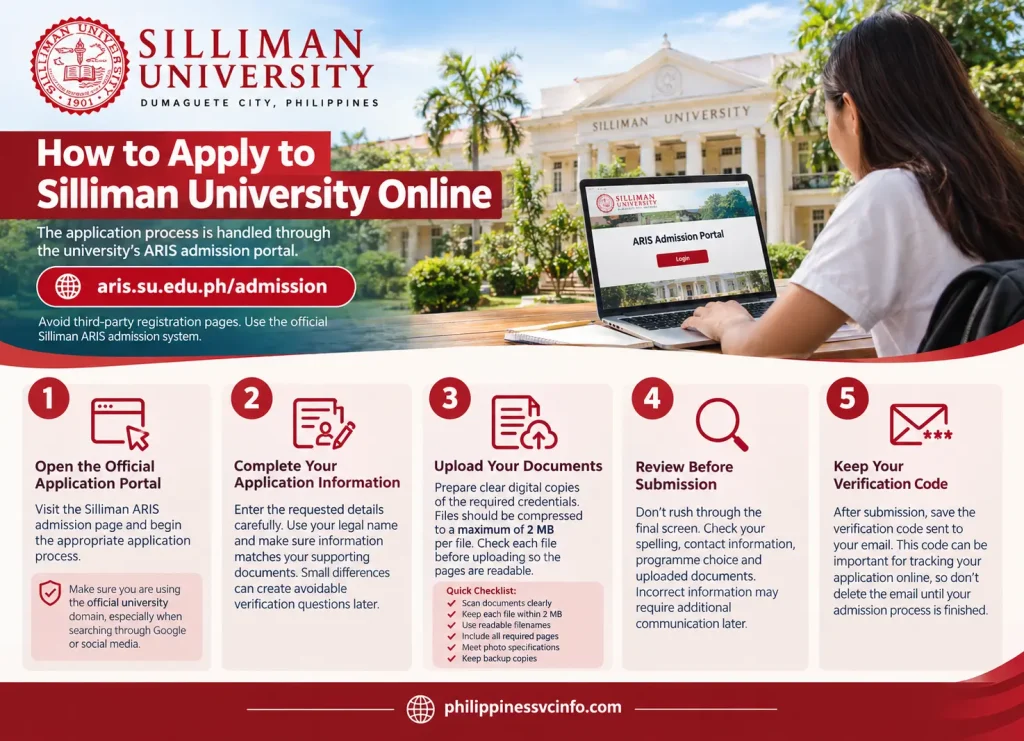
The application process is handled through the university’s ARIS admission portal.
Applicants should avoid starting from random third-party registration pages. Instead, use the university’s designated application system:
The online process generally involves entering applicant information, uploading supporting documents and submitting the application for review.
Step 1: Open the Official Application Portal
Visit the Silliman ARIS admission page and begin the appropriate application process.
Before entering information, check that you are using the official university domain. This is especially important when searching for admission forms through Google or social media.
Step 2: Complete Your Application Information
Enter the requested details carefully.
Use your legal name and make sure information matches your supporting documents. Small differences between an application and an academic record can create avoidable verification questions later.
Step 3: Upload Your Documents
Prepare clear digital copies of the required credentials.
The supplied information states that uploaded files should be compressed to a maximum of 2 MB per file. Check each file before uploading so that important pages are readable.
A practical preparation checklist is:
- Scan documents clearly.
- Keep each file within the stated size limit.
- Use readable filenames.
- Check that every required page is included.
- Make sure photographs meet the stated specifications.
- Keep backup copies of everything submitted.
Step 4: Review Before Submission
Don’t rush through the final screen.
Check your spelling, contact information, programme choice and uploaded documents. If an application contains incorrect information, correcting it later may require additional communication with the admissions office.
Step 5: Keep Your Verification Code
After submission, save the verification code sent to your email.
This code can be important for tracking your application online, so don’t delete the email until your admission process is finished.
What Happens After the Online Application?
Submitting an application does not necessarily mean that admission is final.
Depending on the chosen programme, an applicant may need to take a qualifying examination, attend an interview, or complete another screening requirement.
This is particularly relevant for programmes with additional academic or professional screening.
Silliman University Entrance Exams and Interviews
Some programmes listed in the supplied material require a programme-specific qualifying examination and/or interview.
These include areas such as:
- Accountancy
- Architecture
- Engineering
- Nursing
- Nutrition and Dietetics
- Physical Therapy
- Marine and Environmental Sciences
Other listed fields, including Medical Technology, Sociology, Anthropology, Geology and Biology, may involve structured interviews.
The exact schedule and procedure should be confirmed with the relevant department or the Admissions Office after the initial online application has been reviewed.
A Useful Preparation Tip
Don’t prepare only for the application form.
If your chosen course has a qualifying examination or interview, research the programme itself beforehand. Understand what you are applying to, what subjects it involves and why the course fits your academic goals.
That preparation can make an interview much less stressful.
Silliman University Course & Academic Program
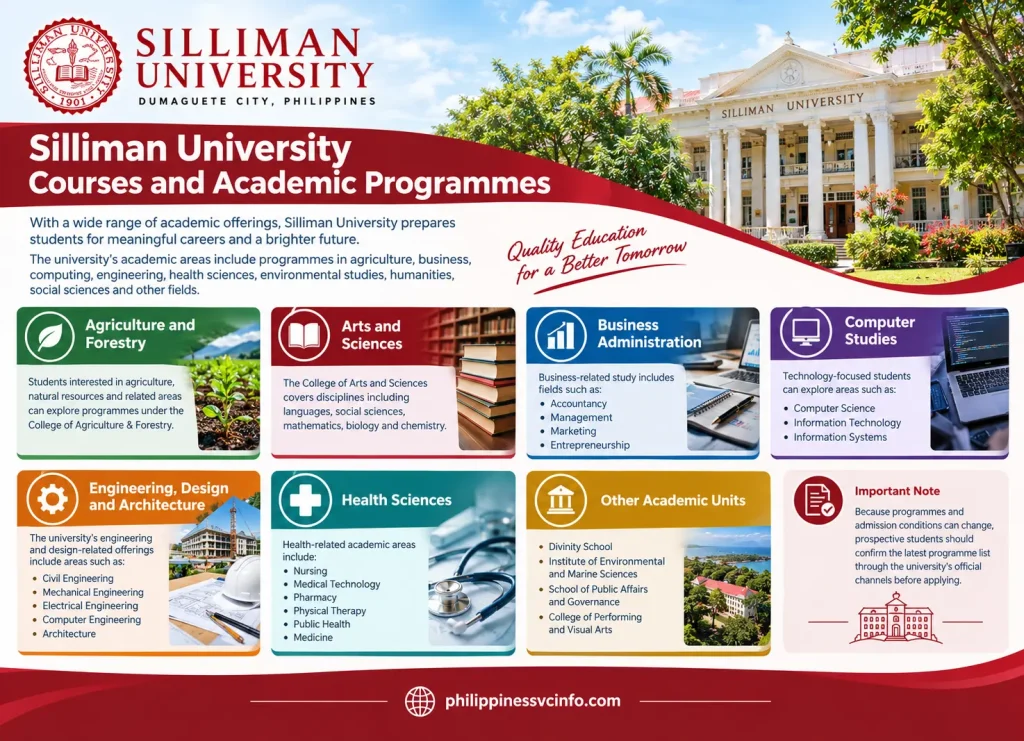
One reason applicants search for Silliman University is the breadth of its academic offerings.
The university’s academic areas include programmes connected with agriculture, business, computing, engineering, health sciences, environmental studies, humanities, social sciences and other fields.
Some of the major academic areas mentioned in the supplied information are:
Agriculture and Forestry
Students interested in agriculture, natural resources and related areas can explore programmes under the College of Agriculture & Forestry.
Arts and Sciences
The College of Arts and Sciences covers disciplines including languages, social sciences, mathematics, biology and chemistry.
Business Administration
Business-related study includes fields such as:
- Accountancy
- Management
- Marketing
- Entrepreneurship
Computer Studies
Technology-focused students can explore areas such as:
- Computer Science
- Information Technology
- Information Systems
Engineering, Design and Architecture
The university’s engineering and design-related offerings include areas such as:
- Civil Engineering
- Mechanical Engineering
- Electrical Engineering
- Computer Engineering
- Architecture
Health Sciences
Health-related academic areas include:
- Nursing
- Medical Technology
- Pharmacy
- Physical Therapy
- Public Health
- Medicine
Other academic units include the Divinity School, Institute of Environmental and Marine Sciences, School of Public Affairs and Governance, and College of Performing and Visual Arts.
Because programmes and admission conditions can change, prospective students should confirm the latest programme list through the university’s official channels before applying.
How Much Does Silliman University Cost?
There isn’t one single tuition figure for every Silliman University student.
The amount can depend on factors such as:
- Degree programme
- Number of units
- Student classification
- Laboratory requirements
- Other institutional charges
The figures supplied for this guide provide approximate annual ranges rather than a guaranteed fee schedule.
| Student category | Level | Approximate annual range |
|---|---|---|
| Filipino/local students | Undergraduate | PHP 40,000–PHP 80,000+ |
| International students | Undergraduate/Graduate | PHP 50,000–PHP 100,000+ |
| Postgraduate students | Master’s/graduate | Varies by programme and units |
Additional charges may include laboratory, developmental, library, medical or insurance-related fees.
Do not treat these figures as a final billing quotation. Students should check the current university assessment for their specific programme and enrolled units.
Silliman University Scholarships & Financial Aid
Tuition is only one part of planning for university. Students who need financial assistance can explore the scholarship and student-aid opportunities available through Silliman University.
The university offers several forms of assistance for students who meet the relevant academic or eligibility conditions. These may include academic scholarships, student assistantships and grants supported by alumni, church groups or private benefactors.
Because scholarship conditions can vary, applicants should check the latest information directly with the university rather than assuming that an award is automatic.
Academic Scholarships
Academic performance can be an important factor in scholarship consideration.
The supplied information identifies opportunities for honour students, valedictorians and salutatorians, with selection potentially taking account of entrance examination performance and high-school grades.
Students who are applying for admission and hoping to receive academic assistance should therefore keep their academic records organised and monitor official scholarship announcements.
Student Assistantships
A student assistantship can provide another route to financial support.
Under this arrangement, eligible students may have opportunities to work on campus while receiving tuition assistance. This can be particularly useful for students who want to combine academic study with practical work experience.
The availability of positions and the conditions attached to them should be confirmed with the university’s scholarships and aid office.
External and Endowed Grants
Not all financial support necessarily comes directly from the university.
The supplied information also refers to grants supported by:
- Alumni associations
- Church-affiliated organisations
- Private benefactors
- Other endowed sources
Students should ask the Office of Scholarships and Aid about current opportunities, eligibility requirements, application deadlines and supporting documents.
Tip: Don’t wait until registration week to ask about financial assistance. If you know that funding will affect your ability to enrol, investigate scholarship and aid options as early as possible.
What to Do After Silliman University Accepts Your Application
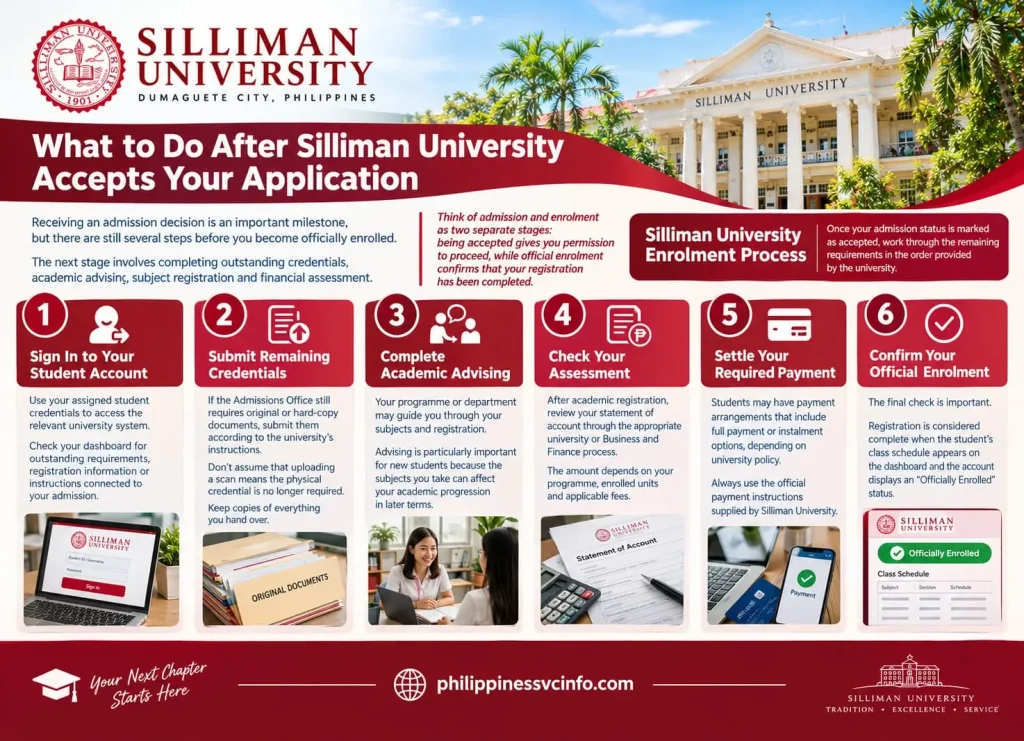
Receiving an admission decision is an important milestone, but there are still several steps before you become officially enrolled.
The next stage involves completing outstanding credentials, academic advising, subject registration and financial assessment.
Think of admission and enrolment as two separate stages: being accepted gives you permission to proceed, while official enrolment confirms that your registration has been completed.
Silliman University Enrolment Process
Once your admission status is marked as accepted, work through the remaining requirements in the order provided by the university.
1. Sign In to Your Student Account
Use your assigned student credentials to access the relevant university system.
Check your dashboard for outstanding requirements, registration information or instructions connected with your admission.
2. Submit Remaining Credentials
If the Admissions Office still requires original or hard-copy documents, submit them according to the university’s instructions.
Don’t assume that uploading a scan means the physical credential is no longer required.
Keep copies of everything you hand over.
3. Complete Academic Advising
Your programme or department may guide you through your subjects and registration.
Advising is particularly important for new students because the subjects you take can affect your academic progression in later terms.
4. Check Your Assessment
After academic registration, review your statement of account through the appropriate university or Business and Finance process.
The amount depends on your programme, enrolled units and applicable fees.
5. Settle Your Required Payment
Students may have payment arrangements that include full payment or instalment options, depending on university policy.
Always use the official payment instructions supplied by Silliman University.
6. Confirm Your Official Enrolment
The final check is important.
According to the supplied information, registration is considered complete when the student’s class schedule appears on the dashboard and the account displays an “Officially Enrolled” status.
That status is a useful confirmation that the enrolment process has been finalised.
Silliman University Student Portal: MySilliman Login
After admission and enrolment, students will regularly need access to university online systems.
The MySilliman portal is used for student-related functions such as checking grades, viewing schedules, handling registration information and receiving announcements.
Students generally sign in using their assigned Student ID and password.
What Can Students Check Through MySilliman?
Depending on the student’s account and available functions, the portal can be used to access information such as:
- Grades
- Class schedules
- Registration blocks
- Student announcements
- Dashboard information
- Other academic or enrolment-related details
The portal should become one of the main places students check after registration.
MySilliman Login Problems
If you cannot access the portal, first check the basics:
- Confirm that the Student ID has been entered correctly.
- Check the password carefully.
- Make sure Caps Lock is not causing a typing problem.
- Try accessing the official portal again.
- Check whether the issue affects the website generally or only your account.
- Contact the appropriate university office if your credentials remain unusable.
Avoid repeatedly guessing passwords if the system indicates that an account has been locked or restricted.
Registrar Services at Silliman University
The Office of the Registrar becomes especially important when students need official academic documents.
Examples include requests involving:
- Official Transcripts of Records
- Diplomas
- Certificates
- Authentication or certification of academic documents
A student may need these documents for employment, further education, professional applications, transfers or other official purposes.
How to Request Academic Documents
The exact procedure can depend on the document being requested and the current university process.
A typical request involves identifying the document required and providing information such as:
- Type of document
- Number of copies
- Purpose of the request
- Student identification details
- Other information required by the Registrar
The supplied information also notes that students may need to clear financial and property obligations before official credentials can be released.
Before Requesting a Transcript
It is worth checking your university account and previous obligations first.
If a financial, library, property or other clearance issue remains unresolved, it may delay the release of your requested document.
For current procedures, start with the official Silliman University website and the relevant university office.
Campus Life at Silliman University
Silliman University is not simply a place where students attend classes.
Its campus in Dumaguete City has a distinctive waterfront setting and is known for its mature acacia-lined surroundings. For students moving from another city or country, understanding the residential side of university life can be just as important as choosing a degree programme.
Housing is supported through the Student Housing and Residence Division (SHRD).
Students who intend to live on campus should arrange accommodation before arriving rather than assuming that a room will automatically be available.
Silliman University Dormitories and Student Housing
The supplied accommodation information describes both regular university-supervised residences and cooperative dormitories.
Regular dormitories operate under university supervision and have fixed board arrangements.
Female Residential Options
The listed female residences include:
- Edith Carson Hall
- Larena Hall
- Woodward Hall
- Davao Cottage for high-school students
Male Residential Options
The supplied information lists:
- Doltz Hall for high-school students
- Other allocated university residential spaces
Availability can depend on the student’s classification and the spaces available for a particular period.
Cooperative Dormitories
Cooperative residences operate somewhat differently.
Students take a more active role in areas such as food planning and housekeeping, with an adviser providing oversight.
The supplied list includes:
Female Cooperative Residences
- Azucena Cottage
- Sampaguita Cottage
Male Cooperative Residences
- Ipil Cottage
- Molave Cottage
- Narra Cottage
This type of accommodation may suit students who are comfortable sharing responsibility for daily residential arrangements.
How Silliman University Dormitory Applications Work
Students should not treat accommodation as a last-minute task.
The supplied information indicates that new applicants may need to pay a processing fee of approximately PHP 100–200 and a refundable damage/surety deposit of approximately PHP 500–1,000.
Board and lodging costs may generally be arranged through instalment payments, with the stated schedule including:
- Downpayment
- Preliminary term
- Midterm
- Final term
The exact amount and current payment rules should be confirmed before making a payment.
Who Gets Housing Priority?
The supplied information states that freshmen and sophomores from outside Dumaguete City receive priority for available housing slots.
That makes early application particularly important for students relocating from another Philippine city or coming from overseas.
Important Housing Rule
Advance reservations through the Student Housing and Residence Division are required before moving into university accommodation.
Do not arrive on campus expecting to secure a room without completing the required housing process.
What Students Should Prepare Before Arrival
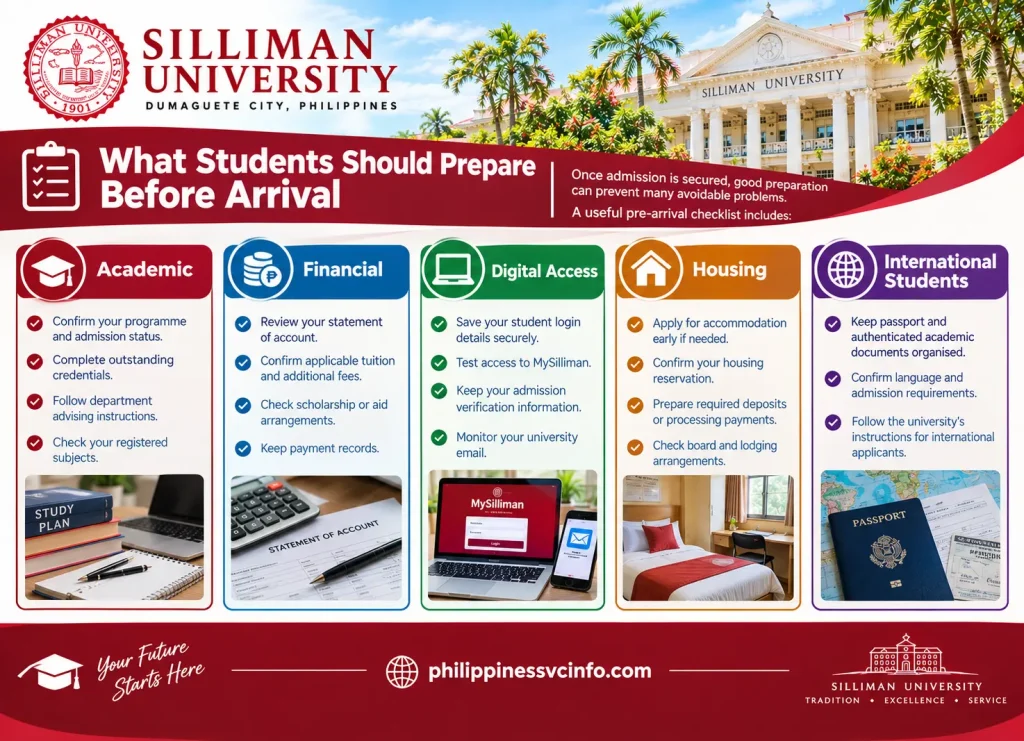
Once admission is secured, good preparation can prevent many avoidable problems.
A useful pre-arrival checklist includes:
Academic
- Confirm your programme and admission status.
- Complete outstanding credentials.
- Follow department advising instructions.
- Check your registered subjects.
Financial
- Review your statement of account.
- Confirm applicable tuition and additional fees.
- Check scholarship or aid arrangements.
- Keep payment records.
Digital access
- Save your student login details securely.
- Test access to MySilliman.
- Keep your admission verification information.
- Monitor your university email.
Housing
- Apply for accommodation early if needed.
- Confirm your housing reservation.
- Prepare required deposits or processing payments.
- Check board and lodging arrangements.
International students
- Keep passport and authenticated academic documents organised.
- Confirm language and admission requirements.
- Follow the university’s instructions for international applicants.
Common Mistakes New Applicants Should Avoid
Even a straightforward admission process can become difficult when applicants leave preparation until the last minute.
Waiting Until the Deadline to Scan Documents
Large or unclear files can cause problems during online submission. Prepare readable digital copies before opening the application.
Assuming Every Programme Has the Same Requirements
Some Silliman University programmes have higher academic requirements or additional screening. Always check the requirements for your selected course.
Losing Your Verification Code
The verification code sent to your email can be needed to monitor the application. Keep it somewhere safe.
Treating Admission as Final Enrolment
Being accepted is not necessarily the same as being officially enrolled. Complete credentials, advising, assessment, payment and registration requirements.
Leaving Housing Until Arrival
Students who need university accommodation should apply in advance because residential spaces are limited and priority rules may apply.
Quick Silliman University Student Checklist
Before you move from application to university life, make sure you can answer yes to these questions:
- Have I selected the correct programme?
- Do I meet the academic requirement?
- Have I prepared all required documents?
- Have I submitted the online application?
- Did I save my verification code?
- Does my programme require an exam or interview?
- Have I checked scholarship opportunities?
- Have I completed remaining admission requirements?
- Can I access MySilliman?
- Does my class schedule appear?
- Does my account show “Officially Enrolled”?
- If needed, have I reserved university housing?
This checklist brings the main stages together without replacing the university’s own instructions.
Official Silliman University Links
For convenience, these are the key official links discussed in this guide:
| Purpose | Official resource |
|---|---|
| Main university website | Silliman University |
| Online admission | Silliman ARIS Admission |
| Student portal | MySilliman |
When searching for other university services, start from the official su.edu.ph domain and follow links provided by Silliman University.
A Practical Way to Plan Your Silliman University Application
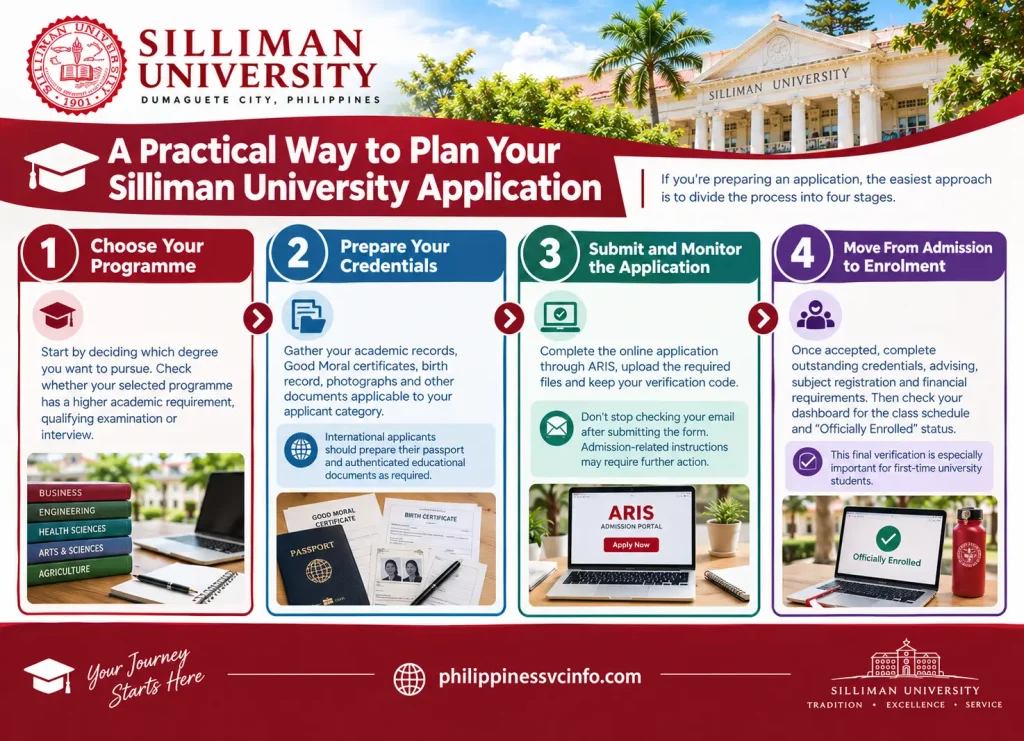
If you’re preparing an application, the easiest approach is to divide the process into four stages.
Stage 1: Choose Your Programme
Start by deciding which degree you want to pursue. Check whether your selected programme has a higher academic requirement, qualifying examination or interview.
Stage 2: Prepare Your Credentials
Gather your academic records, Good Moral certificates, birth record, photographs and other documents applicable to your applicant category.
International applicants should prepare their passport and authenticated educational documents as required.
Stage 3: Submit and Monitor the Application
Complete the online application through ARIS, upload the required files and keep your verification code.
Don’t stop checking your email after submitting the form. Admission-related instructions may require further action.
Stage 4: Move From Admission to Enrolment
Once accepted, complete outstanding credentials, advising, subject registration and financial requirements. Then check your dashboard for the class schedule and “Officially Enrolled” status.
This final verification is especially important for first-time university students.
What Makes Silliman University Information Easy to Misread?
There are several areas where applicants should avoid making assumptions.
Admission requirements are not identical across all programmes. A general university requirement may not apply to a programme with additional screening.
Estimated tuition is not the same as a final assessment. Units, course requirements and additional charges can change the amount a student actually pays.
An online application is not the same as enrolment. Applicants may still have credentials, advising, payment and registration steps to complete.
Portal access is not the same as admission. MySilliman is primarily a student-facing system, while ARIS is used for the admission application process described in this guide.
Housing should be planned early. Students who need accommodation should coordinate with SHRD rather than waiting until arrival.
Silliman University FAQs
Final Takeaway for Prospective Students
Silliman University applicants need to think beyond the initial application form. A successful transition involves choosing the right programme, preparing the correct credentials, meeting any course-specific screening requirements, monitoring the admission application and then completing the separate enrolment process.
For international students, document authentication, passport requirements and English-language requirements deserve particular attention. Local applicants should likewise check whether their intended programme has the higher academic threshold or an additional qualifying examination.
Once admitted, students can move through advising, assessment and registration before confirming their “Officially Enrolled” status. Those planning to live on campus should also contact the Student Housing and Residence Division early because accommodation requires advance arrangements.
The safest approach is simple: use official Silliman University systems, verify programme-specific requirements, keep copies of every submitted document, and check university instructions before making decisions about admission, payment or housing.
That approach gives prospective students and parents a clearer path from application → admission → enrolment → student portal → campus life without relying on outdated or unofficial information.
Discover What You Need to Know:
- Edusuite Portal Login Philippines 2026 : Stdent Enrollment, Grades, Payments & Parent Guide
- Police Open Academy Philippines 2026 : Login, Registration, Courses, TLL & Training Guide
- Form 138 Philippines 2026 : How to Request Your DepEd Report Card Online
- NU Manila Philippines 2026 : Admission Requirements, Courses, Fees, Scholarships & Login Guide
- DepEd Logo PNG: Official Download, Transparent File & Usage Guide 2026